

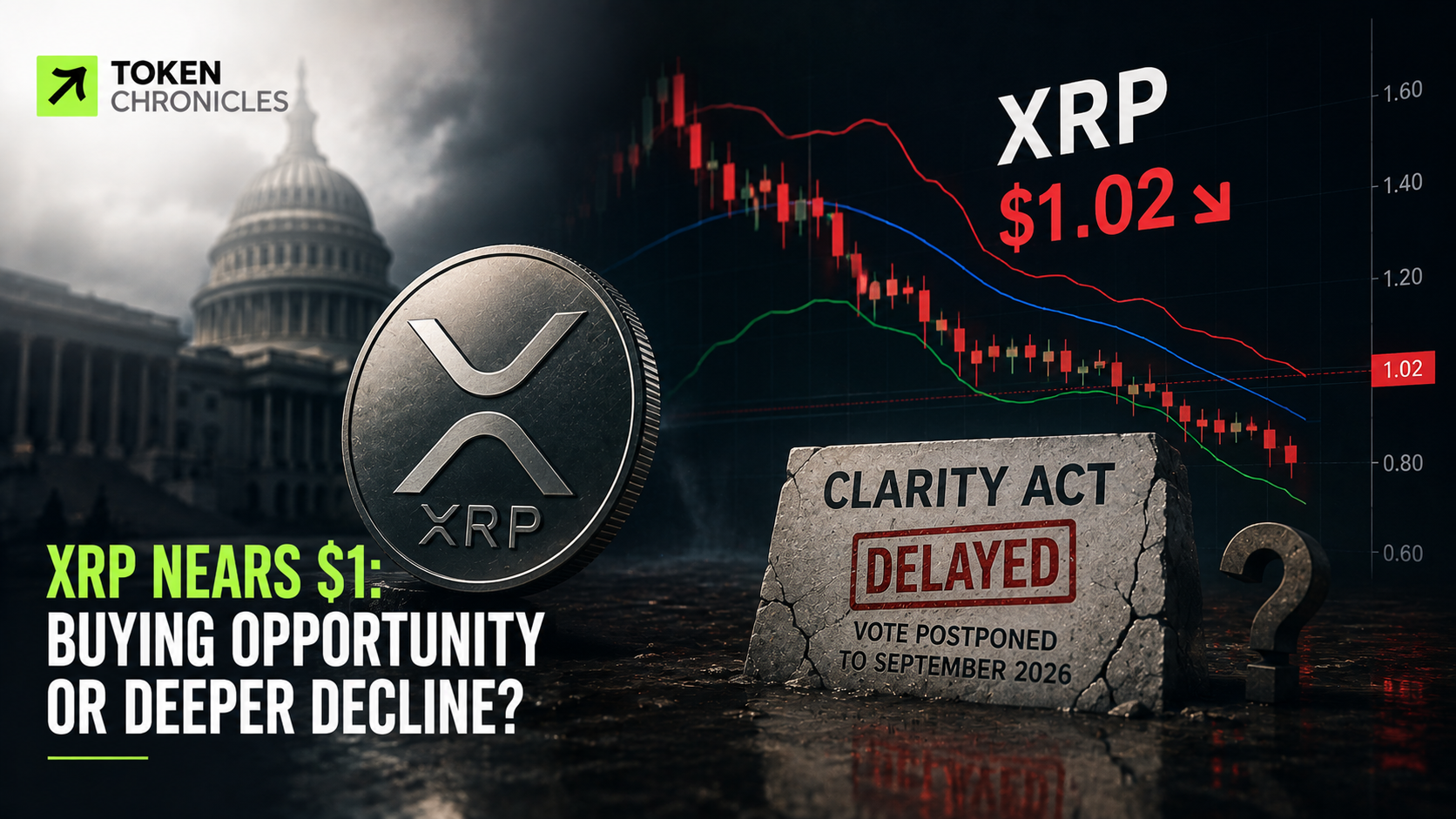
XRP has come under renewed selling pressure after the U.S. Senate delayed action on the CLARITY Act, pushing the market toward a critical technical and psychological level around $1. With XRP trading near $1.02, investors are now debating whether a break below $1 would signal deeper weakness or create an attractive entry point for longer-term buyers.
The regulatory setback has quickly become a major sentiment driver. The Senate’s August recess means the legislation’s final vote has been pushed to September 2026, removing an important near-term catalyst for the digital-asset market. XRP has been among the major cryptocurrencies hit hardest by the shift in sentiment, while traders reassess expectations for institutional participation and regulatory clarity.
XRP Tests a Critical $1 Support Level
Technical indicators suggest that XRP is approaching an important decision point.
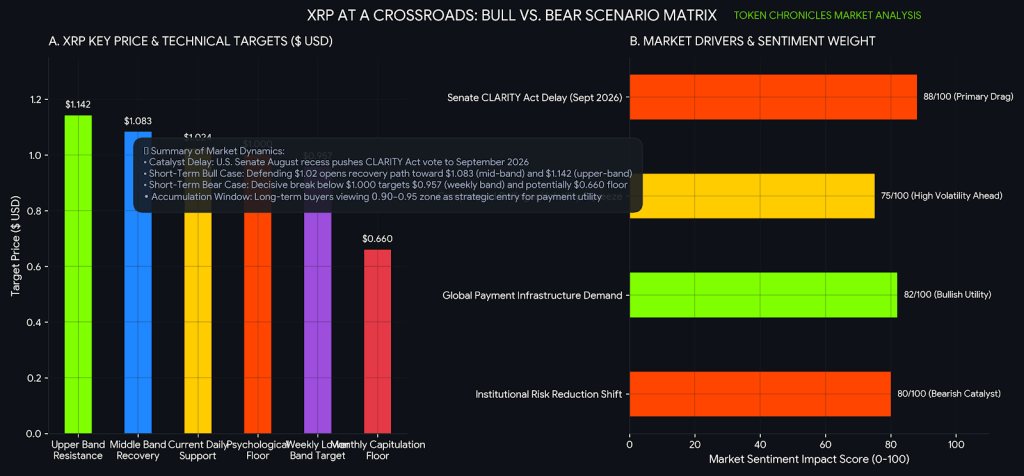
The token has fallen toward the lower daily Bollinger Band around $1.024, where the latest decline has temporarily stabilized. At the same time, the Bollinger Bands have tightened considerably, indicating a period of declining volatility that could precede a larger price move.
A short-term rebound remains possible if buyers successfully defend the current level. Such a move could initially target the middle Bollinger Band near $1.083, followed by the upper band around $1.142.
However, a technical bounce would not necessarily signal a reversal of the broader bearish trend. Traders would need to see stronger buying volume and a sustained recovery above key resistance levels before concluding that market sentiment has materially improved.
What Happens If XRP Falls Below $1?
The $1 level represents more than just technical support. It is also a major psychological threshold for traders and investors.
If sellers decisively break below it, XRP could next move toward the lower weekly Bollinger Band near $0.957. A sustained move below that region could increase the probability of a deeper correction.
In an extreme capitulation scenario, longer-term technical support could emerge around $0.66, based on the lower boundary of the monthly Bollinger Bands.
That would represent a substantially deeper decline from current prices and would likely require a combination of weak crypto-market conditions, prolonged regulatory uncertainty and aggressive risk reduction across digital assets.
The Bear Case
Several factors are currently working against XRP.
The delay surrounding the CLARITY Act removes an important regulatory catalyst and could encourage institutional investors to remain cautious until there is greater clarity around the U.S. digital-asset framework.
XRP has also lost an important longer-term technical level, increasing the risk that sellers could attempt to push the asset below the $1 psychological threshold.
If broader crypto markets remain under pressure, XRP could face additional selling as traders reduce exposure to assets perceived as more sensitive to regulatory developments.
The Bull Case
Despite the bearish pressure, XRP has not yet confirmed a full breakdown.
The ability of buyers to defend the $1.02–$1.03 area could provide the foundation for a short-term recovery. The compressed Bollinger Bands also suggest that volatility may be approaching a breakout phase, meaning a sharp move in either direction could follow.
Continued interest in XRP’s role within global payment infrastructure could provide another long-term source of demand if regulatory uncertainty eventually eases.
A recovery above the $1.08–$1.14 region would strengthen the short-term bullish case, while a sustained move back above higher resistance levels would be needed to establish a more convincing trend reversal.
Could a Sub-$1 XRP Become a Buying Opportunity?

The answer depends heavily on an investor’s time horizon.
For short-term traders, the current environment remains challenging. Regulatory uncertainty, weakening momentum and the possibility of a break below $1 could encourage speculative capital to stay on the sidelines until a clearer technical setup emerges.
For long-term investors, however, a deeper correction could present a different proposition.
A decline toward $0.90–$0.95 could attract strategic buyers looking for discounted exposure, while an extreme market-wide sell-off toward the $0.66 area could potentially create an even more significant accumulation opportunity.
But lower prices alone do not guarantee value. Investors would still need to assess XRP’s adoption, regulatory outlook, broader market liquidity and the underlying fundamentals supporting its long-term role in digital payments.
The Bottom Line
XRP is approaching a critical crossroads. Holding the $1 level could give buyers an opportunity to regain momentum, while a decisive break below it could open the door to significantly lower technical targets.
The CLARITY Act delay has removed a major near-term catalyst, but it has not fundamentally determined XRP’s long-term trajectory. Whether the current weakness becomes the beginning of a deeper bear phase or an accumulation opportunity will depend on how the market responds to the $1 threshold and whether regulatory clarity improves when the Senate returns.