
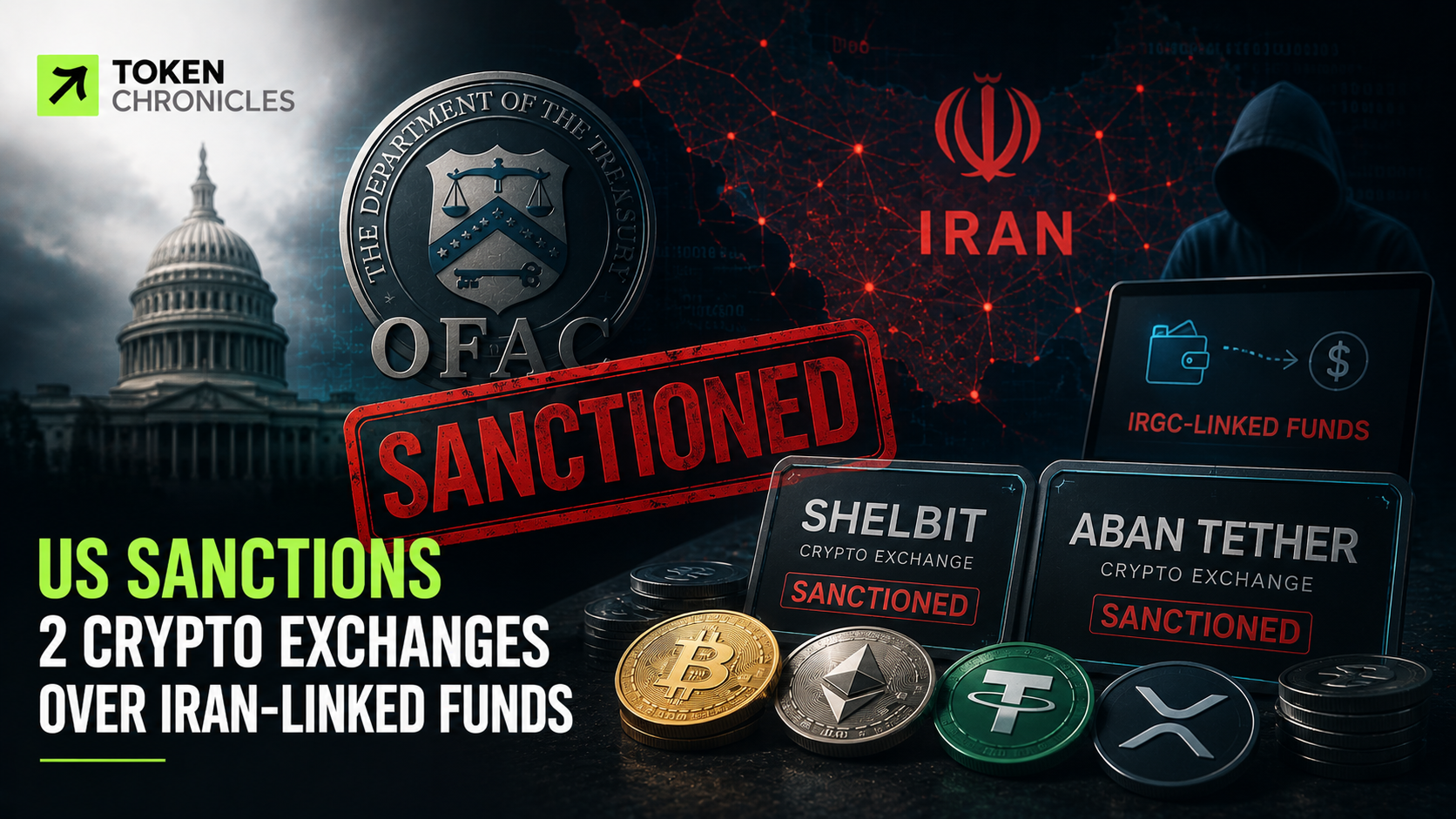
The U.S. Treasury Department has sanctioned crypto exchanges Shelbit and Aban Tether, along with Iranian national Siavash Kayvanpour, accusing them of helping Iran circumvent U.S. sanctions and move cryptocurrency linked to the Islamic Revolutionary Guard Corps (IRGC).
The action, announced by the Treasury Department’s Office of Foreign Assets Control (OFAC) on Aug. 7, is part of a broader U.S. effort to disrupt Iran’s access to international financial networks and prevent digital assets from being used to move restricted funds.
According to Treasury allegations:
- IRGC-linked wallets sent more than $1 million in cryptocurrency to addresses associated with Shelbit.
- Shelbit-linked wallets allegedly transferred more than $2 million to wallets controlled by the IRGC.
- Wallets connected to Kayvanpour allegedly sent more than $2 million to Nobitex, a previously sanctioned Iranian crypto exchange.
OFAC Targets Shelbit and Aban Tether
OFAC accused Shelbit and Aban Tether of facilitating cryptocurrency transactions that helped Iranian entities evade U.S. sanctions.
According to Treasury, Iranian networks have used lightly regulated or unregulated crypto platforms, corporate structures and other businesses to move digital assets through international financial channels.
The sanctions also target Kayvanpour and companies linked to him across Georgia, Poland and the United Arab Emirates. Treasury described him as operating a network of front companies allegedly connected to Shelbit.
The agency said transactions involving Shelbit included more than $1 million in crypto received from IRGC-linked addresses, while wallets associated with Shelbit allegedly transferred more than $2 million onward to IRGC-controlled addresses.
Treasury also identified more than $2 million in transfers from Kayvanpour-linked wallets to Nobitex, one of Iran’s largest cryptocurrency exchanges.
Aban Tether Accused of Processing Funds for Sanctioned Exchanges
OFAC separately alleged that Iran-based Aban Tether processed millions of dollars in transactions involving cryptocurrency exchanges already subject to U.S. sanctions.
Those exchanges include Nobitex, Wallex, Bitpin and Ramzinex, which were previously targeted by the U.S. government over alleged connections to restricted Iranian financial networks.
Nobitex has disputed allegations of direct relationships or contractual arrangements with the IRGC, Iran’s central bank and other government institutions.
Shelbit has likewise rejected accusations that it knowingly participated in money laundering, terrorism financing or sanctions evasion. The company’s former management has said it stopped accepting new customers in December 2025 and completed its customer wind-down in January.
The latest OFAC designations are administrative sanctions, not criminal convictions. They nevertheless block the designated parties’ property and financial interests that come within U.S. jurisdiction.
Washington Expands Its Crypto Crackdown on Iran
The latest sanctions form part of a broader U.S. campaign targeting cryptocurrency exchanges, wallets and companies allegedly involved in helping Iran bypass financial restrictions.
U.S. authorities have increasingly focused on blockchain transactions as they trace crypto flows connected to Iranian financial networks. Previous enforcement actions have included freezing cryptocurrency held in wallets allegedly linked to Iran’s central bank and blocking USDT associated with Iranian networks.
The growing use of centralized stablecoins has also created an additional enforcement mechanism for authorities. Stablecoin issuers can potentially freeze assets held at addresses identified by sanctions authorities, whereas decentralized assets such as Bitcoin generally cannot be frozen by an issuer because there is no central entity controlling the network.
What the Sanctions Mean for Crypto Companies
The designations create significant compliance obligations for cryptocurrency companies operating internationally.
U.S. individuals and businesses are generally prohibited from providing funds, services or other economic benefits to sanctioned entities. Companies that are at least 50% owned by blocked parties can also fall under the sanctions framework even if they are not individually named.
Foreign exchanges, stablecoin issuers and payment companies could also face additional sanctions risks if they knowingly facilitate prohibited transactions involving designated parties.
OFAC has published blockchain addresses associated with the latest designations across networks including Bitcoin, Ethereum, Tron and Solana. Crypto businesses will need to incorporate those addresses and sanctioned entities into their transaction-monitoring and screening systems.
The Bigger Picture
The latest action demonstrates how cryptocurrency is becoming an increasingly important part of U.S. sanctions enforcement.
As Iranian entities and other restricted networks turn to digital assets to access international liquidity, U.S. authorities are responding by targeting the exchanges, wallets, intermediaries and stablecoin infrastructure involved in those flows.
For the broader crypto industry, the episode highlights the growing importance of transaction screening, wallet intelligence and sanctions compliance, particularly for exchanges and stablecoin businesses operating across multiple jurisdictions.