

The dominant narrative around the AI boom is increasingly familiar: enormous capital expenditure, rapidly expanding data-center capacity, aggressive expectations and soaring valuations could eventually produce a classic technology glut.
History provides plenty of reasons to take that argument seriously.
Telecommunications infrastructure experienced a brutal supply-demand imbalance around the turn of the century. Fiber-optic capacity was built far faster than customers could use it, destroying enormous amounts of shareholder value. The American railroad industry experienced a similar phenomenon in the late 19th century, when excessive construction eventually pushed many operators into financial distress.
The pattern is straightforward:
A technology creates enormous excitement → capital floods into infrastructure → capacity grows faster than demand → prices collapse → weaker businesses fail.
But there is another historical example that offers a very different possibility: aluminium.
Aluminium eventually experienced enormous increases in production and a dramatic collapse in price. Yet instead of producing a short-lived glut, falling costs repeatedly created entirely new markets.
That distinction may offer an important framework for thinking about AI tokens, compute and the economics of artificial intelligence.
Aluminium Was Once More Valuable Than Gold

Today, aluminium is one of the world’s most common industrial materials.
In the 19th century, it was effectively a luxury material.
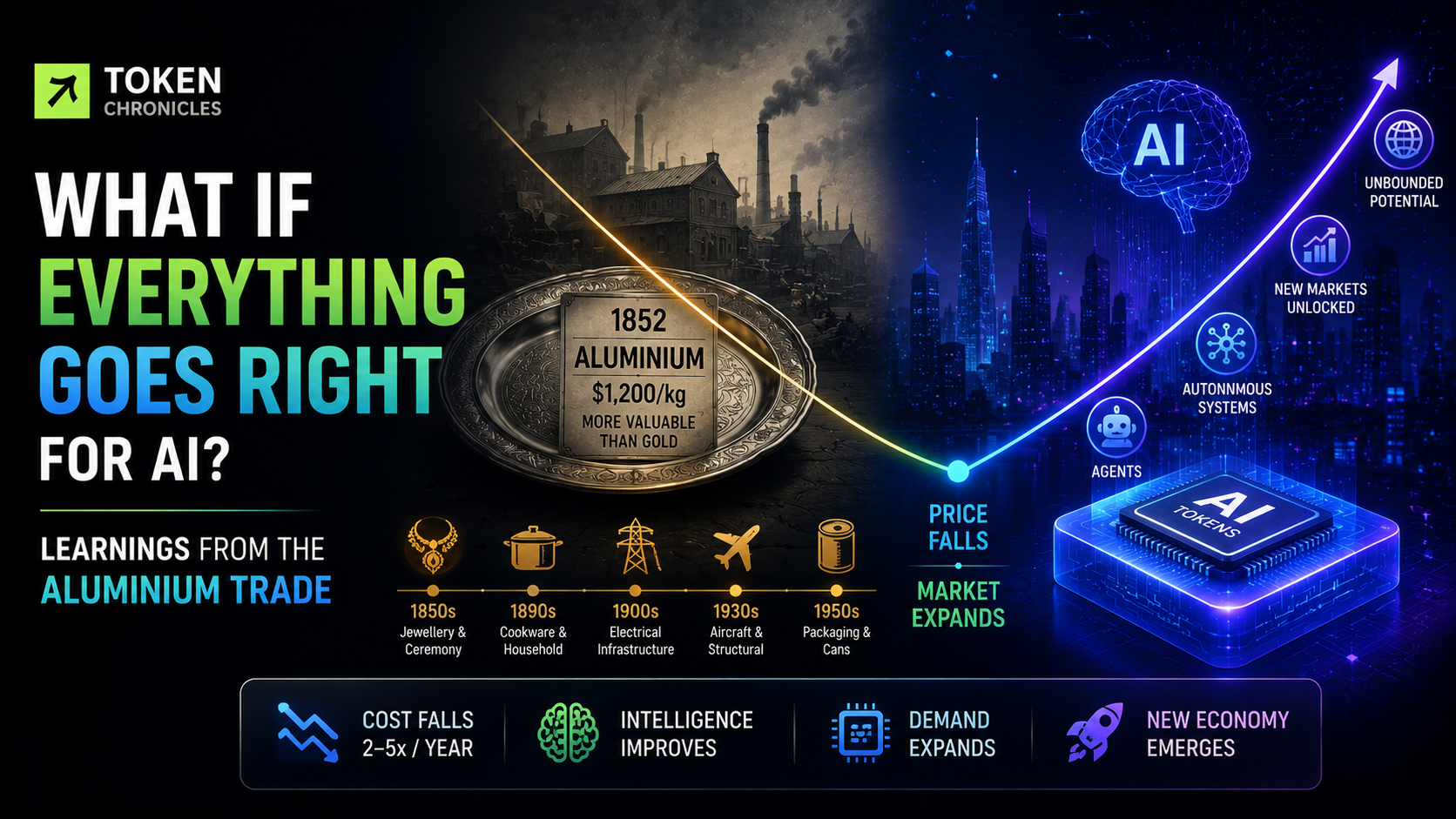
Around 1852, aluminium reportedly cost approximately $1,200 per kilogram, compared with about $600 for gold at the time. The metal was sufficiently valuable that it was associated with prestige and ceremonial use.
The irony was that aluminium itself wasn’t particularly scarce.
It is one of the most abundant metals in Earth’s crust. The problem was extracting usable aluminium from its ores.
The technology required to economically separate the metal simply didn’t exist.
That created an important economic constraint:
The number of applications for aluminium was determined by its price.
At $1,200 per kilogram, nobody was going to build aircraft, beverage cans or electrical infrastructure from aluminium.
The material had plenty of theoretical potential, but its economics prevented widespread adoption.
Technology Changed the Economics
That changed dramatically in the late 19th century.
The Hall-Héroult electrolytic process, developed independently by Charles Martin Hall and Paul Héroult in 1886, dramatically reduced the cost of aluminium production. The Bayer process subsequently improved the economics of extracting aluminium from ore.
Over the following decades, production scaled and prices collapsed.
By the middle of the 20th century, aluminium could be produced for well below $1 per kilogram.
At first glance, this looked like the ultimate commodity glut.
The cost had fallen by more than 99.9%.
But something much more interesting happened.
Every major reduction in cost made a previously uneconomic application possible.
The market didn’t simply become saturated with cheap aluminium.
The definition of what aluminium was useful for kept changing.
Falling Prices Created Entirely New Markets

The progression is particularly revealing.
At extremely high prices, aluminium was primarily associated with luxury and ceremonial applications.
As production costs declined, entirely different industries became economically viable:
- High prices: jewellery, prestige objects and scientific applications
- Lower prices: cookware and household products
- Further declines: electrical transmission and infrastructure
- Structural innovations: aircraft and industrial components
- Mass manufacturing: foil, packaging and beverage cans
The crucial point is that consumers didn’t simply buy more of the original product.
They bought completely different products.
Nobody needed thousands of times more aluminium jewellery.
Instead, aluminium became an input into products that previously could not have been economically manufactured using the material.
This distinction is central to the AI debate.
The Real Question Isn’t Whether AI Compute Gets Cheaper
Suppose the cost of AI inference continues falling rapidly.
The obvious conclusion is:
AI companies will have to sell intelligence more cheaply.
That is probably true.
But it isn’t necessarily bearish for the underlying technology.
The more important question is:
What becomes economically possible when intelligence becomes extremely cheap?
This is where aluminium provides a useful analogy.
Cheap aluminium didn’t simply make aluminium products cheaper.
It changed what engineers could build.
Likewise, inexpensive AI inference may not simply make today’s chatbots cheaper.
It could change what software itself looks like.
Applications that currently require humans to make decisions could increasingly become automated. Software could continuously reason about problems, coordinate tools, monitor systems and initiate actions without waiting for a human to provide every instruction.
In other words:
The biggest AI opportunity may emerge after intelligence becomes too cheap to meter.
Chatbots May Be Only the First Market
Today’s consumer AI market is still constrained by humans.
A person asks a question.
A model generates an answer.
The person reads it.
The person decides what to do next.
That creates an obvious ceiling.
There are only so many questions a person can ask and only so much information a person can consume.
Agentic AI changes the equation.
An AI system doesn’t necessarily need a human to read every intermediate step.
An agent could:
- identify a problem,
- formulate a plan,
- execute multiple actions,
- evaluate the results,
- revise the strategy,
- call additional agents or tools,
- and continue until the objective is completed.
That means the consumer of computation doesn’t necessarily have to be a person.
It could be another machine.
And that potentially removes one of the most important limitations on AI demand.
The Ultimate AI Market Could Be Machine-to-Machine
Imagine millions of software agents operating continuously.
They negotiate with other agents.
They purchase data.
They optimize supply chains.
They monitor financial markets.
They write and test software.
They manage infrastructure.
They discover scientific hypotheses.
They negotiate contracts.
They coordinate logistics.
They supervise other AI systems.
In such an environment, demand for intelligence is no longer limited by human attention.
The relevant constraints become different:
Cost × Capability × Utility
If inference becomes dramatically cheaper while model capability continues improving, the number of economically attractive machine-driven tasks could expand enormously.
This is where the aluminium analogy becomes particularly powerful.
Cheap aluminium created applications that consumed vastly more aluminium than the original luxury market ever could.
Cheap intelligence could create applications that consume vastly more computation than today’s chatbot market.
But Cheap Compute Alone Isn’t Enough
There is an important qualification.
Aluminium became useful not merely because it became cheap.
The material also became better suited to important applications.
The development of aluminium alloys was crucial. Once aluminium could provide the necessary strength-to-weight characteristics, entirely new industries became possible.
Aircraft are an obvious example.
The lesson for AI is similar:
Lower inference costs matter, but capability improvements matter just as much.
A model that costs one-tenth as much but cannot reliably perform a task has limited economic value.
Conversely, a highly capable model that costs too much may also be commercially impractical.
The real breakthrough occurs when:
Capability crosses the threshold required for a task while cost falls below the value created by completing it.
Every time that happens, another category of work can potentially become automated.
The AI Cost Curve Could Create New Demand

This produces an interesting feedback loop.
Stage 1 — Intelligence is expensive
Only high-value tasks justify advanced AI.
Stage 2 — Models become cheaper
Businesses begin deploying AI across more routine workflows.
Stage 3 — Reliability improves
AI moves from assisting humans toward completing tasks independently.
Stage 4 — Agents emerge
Machines begin consuming intelligence on behalf of other machines.
Stage 5 — New applications appear
Entire categories of software become economically viable because reasoning is inexpensive.
At each stage, the market expands rather than simply consuming more of the original product.
This is precisely what happened with aluminium.
The Infrastructure Layer Could Still Capture Enormous Value
The aluminium story also contains another lesson: the producer of the underlying commodity can become extraordinarily powerful during the expansion phase.
Alcoa built an enormous competitive advantage through a combination of manufacturing expertise, access to raw materials and control over energy resources.
The company didn’t merely possess a patent.
It developed an integrated industrial system that competitors struggled to replicate.
That comparison is relevant when examining today’s AI infrastructure leaders.
Nvidia Has Some Alcoa-Like Characteristics
Nvidia occupies a uniquely powerful position in AI computing.
Its competitive advantage isn’t simply the physical design of GPUs.
A major part of the moat comes from the surrounding software ecosystem.
CUDA, libraries, developer tools and frameworks have created a substantial switching cost for organizations building AI infrastructure.
In that sense, Nvidia’s advantage resembles an industrial process moat.
But the analogy isn’t perfect.
Software moat: strong
Nvidia controls an enormous software ecosystem surrounding its accelerators.
Manufacturing access: strategic but outsourced
Unlike an industrial company that owns its raw-material supply, Nvidia depends heavily on external manufacturing and packaging partners.
Its supply-chain relationships are exceptionally important, but they are not the same as owning the underlying resources.
Energy: increasingly controlled by customers
AI infrastructure requires enormous quantities of electricity.
Large technology companies are increasingly securing their own power arrangements, including long-term renewable and nuclear contracts.
Some are also designing their own custom silicon.
That creates a fascinating shift:
AI infrastructure customers are beginning to build pieces of their own supply chain.
Nvidia May Not Capture the Entire AI Value Chain
This distinction matters.
During an infrastructure boom, investors naturally focus on the companies selling the picks and shovels.
That can be enormously profitable.
But the biggest long-term economic value may ultimately emerge from the applications enabled by the infrastructure.
The aluminium industry demonstrates why.
The material producer was important.
But the economic value unlocked by aluminium extended far beyond aluminium itself.
Aircraft manufacturers created aviation markets.
Packaging companies created new consumer-product economics.
Electrical infrastructure created new networks.
Automakers incorporated aluminium into increasingly sophisticated products.
The material became an invisible component of much larger industries.
AI could follow a similar trajectory.
The Biggest AI Companies of the Future May Not Look Like AI Companies
Consider what happens when intelligence becomes embedded into ordinary software.
A logistics company might deploy autonomous planning systems.
A bank might operate AI-driven financial infrastructure.
A pharmaceutical company could run thousands of research agents continuously.
A manufacturer might use agents to manage procurement, maintenance and production.
A cybersecurity company could deploy autonomous defensive systems.
A software company might employ AI agents to build, test and maintain its entire codebase.
In each case, AI becomes an input, not necessarily the product.
That’s an important distinction.
The company selling intelligence may capture some of the value.
But the company that uses inexpensive intelligence to create an entirely new product category could capture substantially more.
This Is Where AI Tokens Enter the Story
For token-based AI infrastructure, the same principle can apply.
If AI inference becomes dramatically cheaper, the value of a token isn’t necessarily determined by today’s demand for model calls.
The bigger question is whether cheaper intelligence enables new economic activity that didn’t previously exist.
A token tied to a network providing computation, coordination, data, inference or autonomous services could potentially benefit from increasing machine-to-machine activity.
But there is a major caveat:
Not every token benefits simply because AI grows.
The network must capture some portion of the economic activity it enables.
That requires sustainable demand, useful infrastructure, defensible network effects and a mechanism that actually connects usage with token economics.
Cheap intelligence alone doesn’t guarantee token value.
The Most Important Ceiling Is the Human Bottleneck
Traditional industries eventually encounter physical or human limitations.
There are only so many houses.
Only so many cars.
Only so many passengers.
Only so many cans of soda.
Those limits can eventually turn excess production capacity into a glut.
AI has the potential to be different because its consumers can themselves be computational systems.
An AI agent doesn’t need sleep.
A software agent doesn’t have a commute.
A machine can run thousands of processes simultaneously.
If one autonomous system creates economic value by employing another autonomous system, demand can potentially scale far beyond human labor capacity.
That doesn’t mean infinite demand is guaranteed.
It means the historical ceiling may be dramatically higher.
What If the AI Boom Actually Goes Right?
This leads to a counterintuitive conclusion.
The successful outcome for AI infrastructure may not be permanently high prices.
It could be the opposite.
Imagine inference costs falling by 10x, 100x or even more.
That sounds terrible for an inference provider if the market remains unchanged.
But if each 10x reduction makes another million tasks economically viable, total demand can expand faster than prices decline.
That is the aluminium scenario.
Prices fall.
Usage explodes.
New applications emerge.
The market becomes dramatically larger.
The technology succeeds precisely because the original product becomes cheaper.
The Value Moves Up the Stack

The ultimate lesson from aluminium isn’t that commodity producers lose.
It is that value migrates as technology becomes cheaper.
Early aluminium value was concentrated in the material itself.
Later, enormous value appeared in the products enabled by the material.
AI could experience the same progression:
Compute → Models → Agents → Applications → Autonomous businesses
At every step, the economic center of gravity can move.
Today’s scarce resource may be GPU capacity.
Tomorrow’s scarce resource could be model capability.
After that, it might be proprietary data, distribution, workflow integration, customer relationships or autonomous execution.
Eventually, intelligence itself could become a commodity.
And when intelligence becomes a commodity, the scarce resources may be context, trust, energy, distribution and the ability to turn intelligence into useful outcomes.
The Bull Case Is Not “AI Prices Stay High”
This may be the most important distinction.
The optimistic AI scenario isn’t:
AI demand grows while inference remains expensive.
The much larger possibility is:
AI becomes dramatically cheaper, dramatically more capable and gets embedded into vastly more economic activity.
That’s a much more ambitious thesis.
It also explains why a future AI glut wouldn’t necessarily mean the technology failed.
A glut in compute could simply mean that compute has become abundant enough to unlock applications that were previously impossible.
Just as cheap aluminium didn’t destroy the aluminium economy, abundant intelligence doesn’t necessarily destroy the AI economy.
It could redefine it.
The Real Investment Question
For investors, therefore, the key question may not be:
“Will AI infrastructure become oversupplied?”
It probably will at various points.
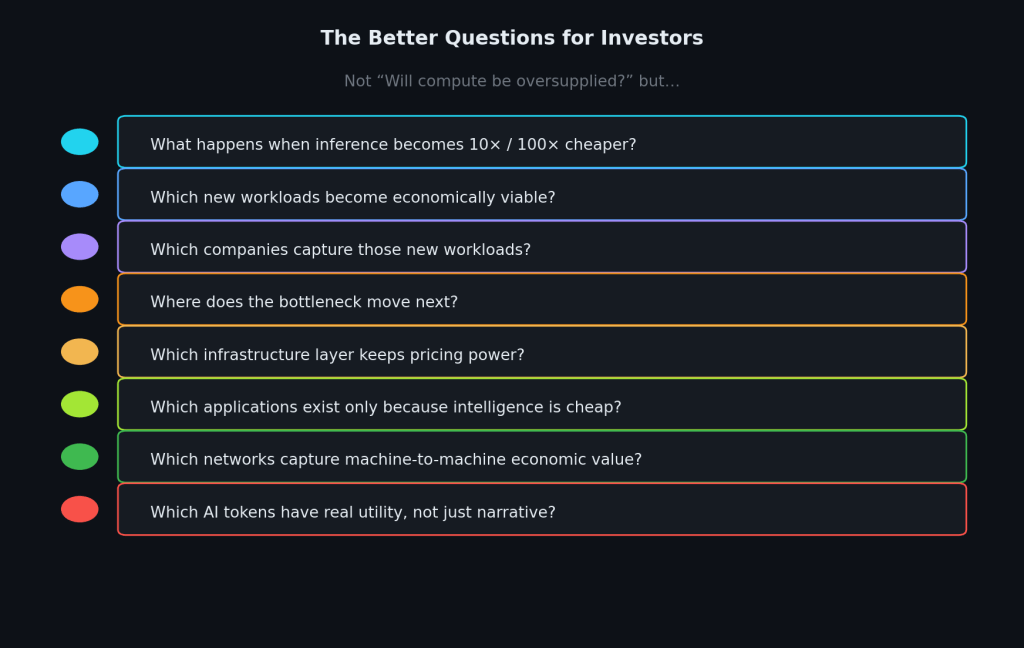
The better questions are:
- What happens when inference becomes 10x cheaper?
- Which workloads become economically viable?
- Which companies benefit from those new workloads?
- Where does the bottleneck move next?
- Which infrastructure layer retains pricing power?
- Which applications become possible only because intelligence is cheap?
- Which networks actually capture economic value from machine-to-machine activity?
- And which AI tokens have genuine utility rather than simply narrative exposure?
The aluminium story suggests that falling prices and expanding markets are not contradictory outcomes.
They can be two sides of the same technological revolution.
The greatest beneficiaries may ultimately be neither the companies selling today’s scarce compute nor the businesses built around today’s expensive AI workflows.
They may be the companies and networks that discover what becomes possible after intelligence stops being scarce.
If everything goes right for AI, the biggest story may not be that we build more intelligent machines. It may be that intelligence becomes so inexpensive that we start building an entirely new economy around it.