


BitMEX co-founder Arthur Hayes believes the U.S. Treasury’s larger bond-buyback program could mark the beginning of another Bitcoin bull cycle, with BTC trading above $80,000 and liquidity expectations becoming an increasingly important part of the market narrative.
Treasury Buybacks Become a Bitcoin Catalyst

Arthur Hayes, co-founder of BitMEX and chief investment officer at Maelstrom, has argued that the U.S. Treasury’s decision to expand purchases of longer-dated government bonds could provide the backdrop for a renewed Bitcoin rally.
In a recent research essay, Hayes connected the Treasury’s changing debt-management strategy with Bitcoin’s latest advance. BTC recently climbed to an intraday high near $81,000, reinforcing his view that shifting liquidity conditions could become a major driver for risk assets.
The Treasury plans to increase the maximum size of certain purchases of longer-maturity Treasury securities from $2 billion to at least $4 billion per operation. The expanded limit is scheduled to take effect Sept. 9 and remain in place through Nov. 4.
The broader quarterly program authorizes as much as $38 billion in liquidity-support buybacks, alongside up to $25 billion in shorter-term cash-management purchases.
Hayes believes these operations could influence markets by supporting prices for older Treasury securities and putting downward pressure on their yields.
If yields decline, investors may become more willing to allocate capital toward assets with greater potential returns, including Bitcoin and other risk assets.
However, the relationship is not guaranteed. Treasury buybacks are officially designed as debt-management and market-liquidity operations, rather than monetary stimulus.
Falling Yields and Strong Bitcoin ETF Demand
The market reaction around the Treasury announcement provided additional support for Hayes’ thesis.
The 10-year Treasury yield moved toward approximately 4.65%, while the 30-year yield approached 5.20% around the announcement period.
At the same time, Bitcoin benefited from renewed institutional demand.
U.S. spot Bitcoin ETFs recorded roughly $517 million in net inflows, providing another source of buying pressure alongside the broader macroeconomic narrative.
This combination has become increasingly important for Bitcoin investors.
A decline in long-term yields can make non-yielding assets relatively more attractive, while ETF inflows provide a direct channel through which traditional investors can gain Bitcoin exposure.
Still, correlation should not automatically be interpreted as causation. Bitcoin’s rally can also be influenced by positioning, derivatives activity, dollar movements, expectations for monetary policy and other factors.
Hayes Says Maelstrom Is Taking “Maximum Risk”
Hayes has become increasingly bullish about risk assets.
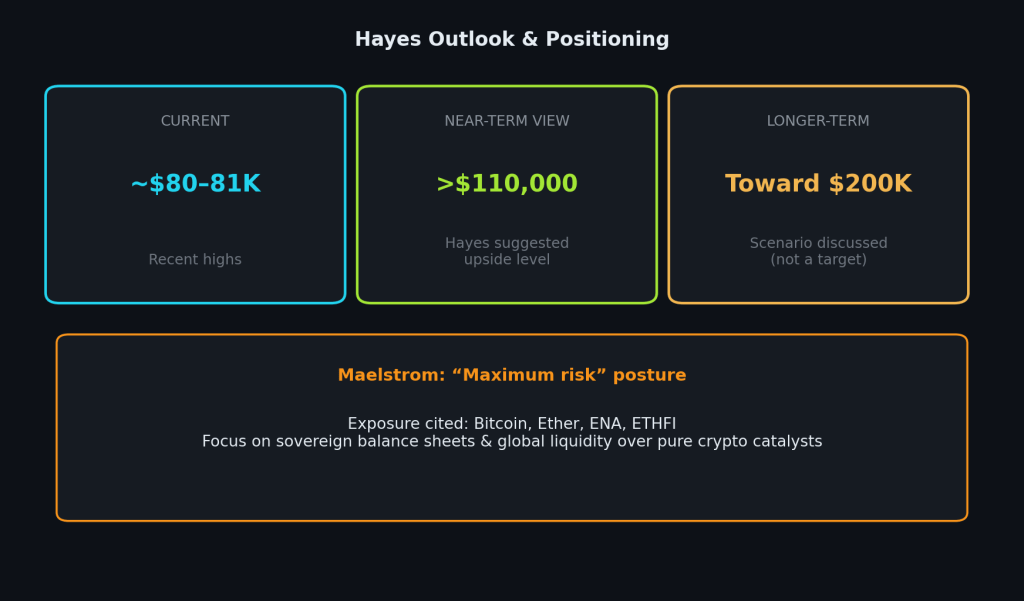
In a recent discussion with Crypto Banter host Ran Neuner, he indicated that Maelstrom was operating with a high-risk posture and had exposure to assets including Bitcoin, Ether, ENA and ETHFI.
His broader argument is that investors should pay close attention to government balance sheets rather than focusing exclusively on developments inside the cryptocurrency industry.
According to Hayes, sovereign debt management and liquidity conditions could ultimately have a greater impact on Bitcoin’s next major move than crypto-specific catalysts.
He has made a similar argument in previous research, including his discussion of potential stress in the yen-dollar market and how coordinated policy responses by Japan and the United States could influence global liquidity.
The common theme across his analysis is clear:
Bitcoin’s next major cycle could be driven as much by macroeconomic liquidity as by crypto-native developments.
Treasury Buybacks Are Not the Same as QE
There is an important distinction between Hayes’ interpretation and the official description of the Treasury program.
The Treasury’s purchases are not equivalent to Federal Reserve quantitative easing.
Under quantitative easing, the central bank creates reserves and purchases securities as part of monetary policy.
Treasury buybacks operate differently.
The Treasury is primarily seeking to improve liquidity in older securities, manage its outstanding debt and potentially reduce market friction around its financing operations.
That distinction matters because labeling the program as direct monetary stimulus could exaggerate its immediate effect on financial conditions.
Nevertheless, Hayes argues that the economic consequences can still influence asset prices.
If Treasury operations help reduce stress in the long-term bond market and lower yields, capital could gradually migrate toward assets perceived to offer greater upside.
The Treasury General Account Is Another Variable
Hayes has also highlighted the Treasury General Account, or TGA, as another potential source of liquidity.
The account has held hundreds of billions of dollars, and reports have placed its balance around $940 billion, with projections calling for a lower year-end balance.
A reduction in the TGA can place more money into the broader financial system as government spending exceeds incoming receipts. But the effect depends on how the Treasury manages its cash balance and subsequently finances government operations.
Hayes sees this mechanism as another potential component of a broader liquidity cycle.
That does not mean the government is preparing to inject hundreds of billions of dollars directly into Bitcoin.
Rather, his argument is that changes in sovereign cash management can indirectly alter the liquidity environment in which Bitcoin and other risk assets trade.
Could Bitcoin Reach $110,000?
Hayes remains highly optimistic about Bitcoin’s upside.
He has suggested that the current rally could eventually push BTC above $110,000, while longer-term scenarios discussed by Hayes have extended toward the $200,000 level.
Those figures should be viewed as market forecasts rather than established targets or guarantees.
Bitcoin remains highly volatile, and higher liquidity expectations can quickly reverse if inflation, Treasury yields, economic growth or monetary-policy expectations move in the opposite direction.
The enlarged Treasury buybacks themselves also remain relatively small compared with the enormous size of the U.S. government bond market.
Liquidity Is Becoming the Central Bitcoin Narrative
The significance of Hayes’ argument extends beyond his specific price targets.
Bitcoin is increasingly being treated as a macro asset whose performance can be influenced by:
- Treasury issuance and debt management
- Federal Reserve policy
- Global dollar liquidity
- Bond yields
- ETF flows
- Institutional positioning
- Currency movements
Under this framework, Bitcoin does not need the Treasury to directly purchase BTC to benefit from easier financial conditions.
Instead, the transmission mechanism could look like:
Treasury operations → bond-market liquidity → yields and financial conditions → investor risk appetite → capital flows into Bitcoin
Whether that chain develops as Hayes expects remains uncertain.
But with Bitcoin trading above $80,000 and institutional ETF demand returning, macro liquidity has once again become one of the market’s most closely watched variables.
For Hayes, the next Bitcoin bull market is already underway. For the broader market, the coming months will determine whether Treasury operations translate into sustained liquidity or whether the rally ultimately faces the same macroeconomic constraints that have shaped Bitcoin throughout previous cycles.