

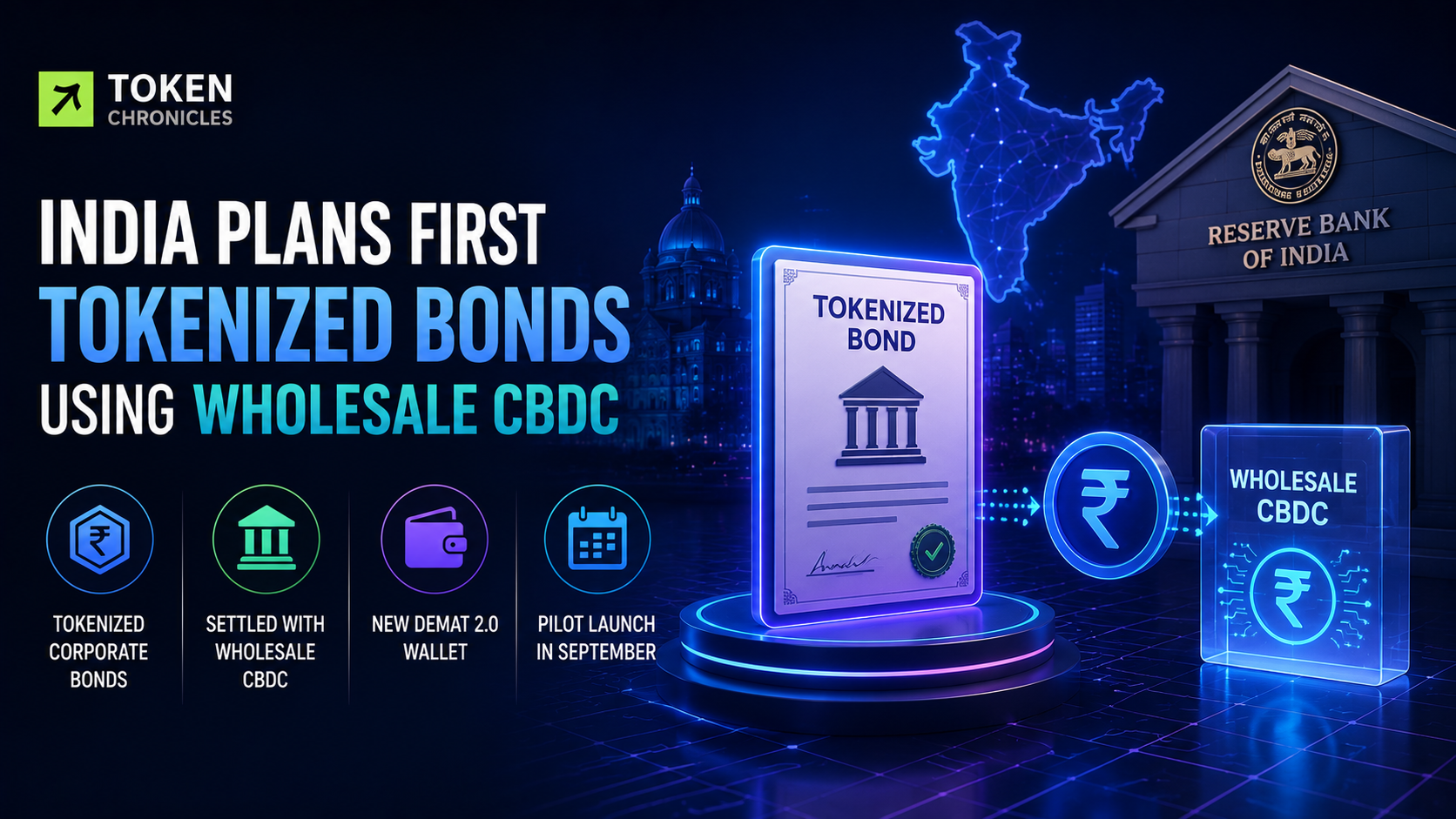
India is reportedly preparing to take another significant step toward integrating blockchain technology with its traditional financial system, with plans for a pilot issuance of tokenized corporate bonds settled through the country’s wholesale central bank digital currency (CBDC).
The initiative could become one of India’s clearest experiments with combining tokenized securities, distributed-ledger technology and digital rupee infrastructure within the regulated financial system.
According to a Reuters report published Aug. 24, state-controlled power-sector financier REC Limited is expected to issue less than 5 billion Indian rupees, or roughly $57 million, worth of tokenized bonds as part of a pilot scheduled for September. The program is expected to initially involve a limited group of institutional investors.
The pilot could be announced during an annual financial technology event in Mumbai, although the precise timing and structure have not yet been formally confirmed by the participating institutions.
Wholesale digital rupee to settle tokenized bonds
One of the most important elements of the proposed experiment is the use of India’s wholesale CBDC to settle purchases of the tokenized securities.
Rather than relying exclusively on conventional payment and settlement infrastructure, participating investors would reportedly use a wholesale digital-rupee wallet supplied by a bank to purchase the bonds.
This creates a model in which the asset and the payment mechanism can both operate in digital form:
- The bond is represented through a blockchain-based token.
- Ownership is recorded through distributed-ledger infrastructure.
- Payment is made using India’s wholesale CBDC.
- Investors access the securities through a dedicated digital securities account.
Such an arrangement could allow regulators and financial institutions to examine whether tokenized securities can reduce friction between trading, payment and settlement.
DEMAT 2.0 could provide the securities infrastructure
The proposed pilot is also expected to introduce a new electronic securities wallet reportedly referred to as DEMAT 2.0.
India’s existing dematerialized securities system already allows investors to hold stocks and bonds electronically rather than through physical certificates. The proposed system would extend that concept by incorporating distributed-ledger technology into the recordkeeping process for tokenized securities.
Indian securities depositories are reportedly working on the infrastructure, with the Reserve Bank of India (RBI) and Securities and Exchange Board of India (SEBI) involved in the broader initiative.
If implemented, the architecture could establish a bridge between India’s established securities market and blockchain-based ownership records without requiring the country to abandon its existing regulatory framework.
Why tokenized bonds matter
Tokenization essentially converts ownership or economic rights associated with an asset into digital tokens that can be recorded and transferred using blockchain infrastructure.
For financial markets, the potential benefits extend beyond simply putting a bond “onchain.”
A tokenized bond could potentially support:
Faster settlement: Transactions could move toward near-real-time settlement rather than relying on multiple intermediaries and batch-processing systems.
Greater transparency: Distributed ledgers can provide a shared record of transactions and ownership, potentially reducing reconciliation requirements.
Programmability: Digital securities can potentially incorporate automated rules governing transfers, payments, compliance and other functions.
Fractional ownership: Depending on the regulatory structure, tokenization can make it easier to divide financial instruments into smaller units.
Lower operational friction: Bringing issuance, settlement and ownership records into interconnected digital infrastructure could reduce some of the administrative processes involved in traditional securities markets.
However, these benefits depend heavily on the design of the underlying infrastructure, regulatory requirements and participation by banks, exchanges, custodians and investors.
A limited pilot rather than a nationwide rollout
The reported REC issuance should not be interpreted as the immediate launch of a broad tokenized-bond market in India.
The initial offering is expected to be relatively small and restricted to selected investors. The reported size of less than ₹5 billion also suggests that the primary objective is testing the infrastructure rather than raising substantial capital.
The reported structure includes an initial three-month holding period, limiting immediate trading after issuance.
That restriction could give regulators and market participants time to evaluate how tokenized securities behave within the existing financial ecosystem before opening the system to a broader investor base.
Secondary market could arrive later
Another potentially important development is the expected creation of a secondary trading market.
According to the report, Indian exchanges could develop infrastructure allowing investors to trade the tokenized bonds after the initial phase, with a potential target of December.
A functioning secondary market would be crucial because tokenization becomes considerably more useful when investors can transfer and trade digital securities efficiently after issuance.
The evolution could therefore take place in stages:
Issuance → digital settlement → custody → secondary trading → broader adoption
Each stage would give Indian regulators and financial institutions additional information about the costs, risks and practical advantages of tokenized securities.
India is building around CBDC infrastructure
The proposed bond pilot also demonstrates how India’s CBDC strategy could extend beyond digital payments.
The RBI has been developing separate retail and wholesale CBDC applications, with the wholesale version particularly relevant to financial institutions and capital-market transactions.
Using a wholesale CBDC alongside tokenized bonds could allow India to test a more comprehensive digital-market architecture in which money and securities exist in compatible digital environments.
That is potentially more significant than simply issuing a blockchain-based bond. The longer-term objective could be to connect digital money, securities, settlement infrastructure and financial institutions through a common technological framework.
REC provides a natural test case
REC is a particularly relevant institution for such an experiment because it is a major state-controlled financier focused on India’s power and infrastructure sectors.
The company regularly accesses India’s debt markets, making a bond issuance a familiar financial instrument while allowing the underlying settlement technology to be tested in a controlled environment.
This approach could also help regulators compare a tokenized issuance against conventional bond-market processes without introducing an entirely new asset class.
What happens next?
The September pilot will provide an early test of whether India’s blockchain-based securities infrastructure can function alongside regulated CBDC payments.
Several questions will remain important:
- How efficiently can tokenized bonds be issued and settled?
- How will investors manage the additional digital accounts?
- Can tokenized securities integrate with existing custody and compliance systems?
- How will secondary-market trading operate?
- Can tokenization reduce issuance and settlement costs?
- What regulatory safeguards will be required as participation expands?
The answers could influence whether tokenized bonds remain limited experiments or become part of India’s broader capital-market infrastructure.
For now, the reported REC transaction represents a small but potentially significant experiment. If the system works as intended, India could move closer to a financial market where digital currency settles a digitally represented security on blockchain infrastructure, bringing payments, ownership and settlement closer together than in the conventional financial system.
The reported pilot has not been formally confirmed by all participating institutions. Its structure, timing and final implementation may therefore change as regulators and financial institutions complete their preparations.