
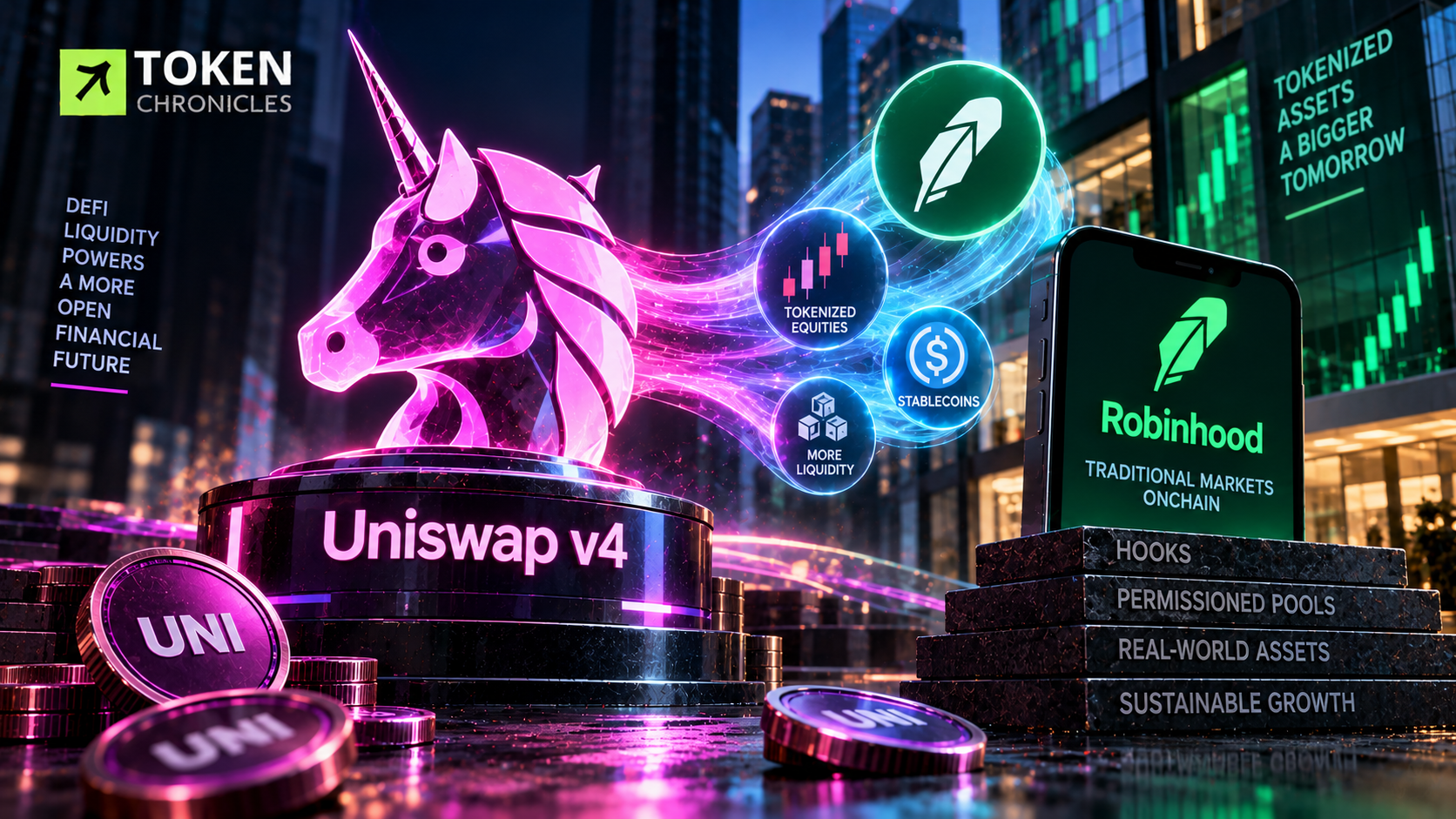
Uniswap is entering a new phase as activity on Robinhood Chain pushes the decentralized exchange back into the spotlight. The DEX has benefited from a sharp increase in speculative trading, while its v4 architecture gives developers new tools to build specialized markets around tokenized equities, stablecoins and other onchain assets.
The bigger question is whether the current surge can evolve into sustainable growth or whether Uniswap remains dependent on short-lived speculative cycles.
Key Takeaways
- UNI has gained 44% over the past month, with Robinhood Chain emerging as an important source of activity.
- Robinhood represented 22% of Uniswap’s August volume just two months after launching.
- Uniswap v4 accounted for 54% of Ethereum volume, while hook-based activity rose significantly in August.
- Tokenized assets represented 8% of spot DEX volume in August, creating a potential long-term market for Uniswap.
- The protocol generated approximately $9.3 million in UNI burns during August, with Robinhood responsible for 45% of that amount.
- Competition from platforms such as Hyperliquid, Aerodrome and Pump.fun could challenge Uniswap’s position.
Robinhood Becomes Uniswap’s Latest Growth Catalyst
Uniswap has demonstrated an unusual ability to maintain relevance through several changes in the decentralized exchange landscape.
Over the past two years, monthly trading volume has generally remained between $40 billion and $60 billion, with periods of substantially higher activity. Volume approached $100 billion following the 2024 U.S. election and again during the digital-asset treasury boom of 2025.
That resilience is particularly notable because competition among DEXs has intensified.
Uniswap’s share of overall DEX volume declined from approximately 45% in January 2024 to 29% in August 2026. However, the exchange has recently begun regaining momentum.
Rather than depending on one blockchain, Uniswap has followed users as trading activity migrated across different networks.
Robinhood Chain Delivers a Major Volume Boost
The latest example is Robinhood Chain.
Only two months after its launch, Robinhood accounted for approximately 22% of Uniswap’s August trading volume. Average daily activity exceeded $1 billion during the final week of August as speculative tokens and tokenized equities attracted traders and capital.
Tokenized equities became particularly important.
On the final day of August, tokenized equities generated approximately $220 million in Uniswap volume, with Robinhood responsible for about 87% of that activity.
Because Uniswap captured almost all of the DEX volume occurring on Robinhood Chain, the network has quickly become one of the most important short-term contributors to Uniswap’s growth.
The dynamic resembles a broader pattern seen across crypto markets. Traders often follow whichever chain has the newest assets and strongest speculative momentum. If Robinhood maintains that position, Uniswap could continue benefiting without needing every individual token on the chain to succeed.
The challenge will be maintaining that activity once speculative enthusiasm eventually cools.
V4 Gives Developers a More Flexible Trading Platform
Uniswap v4 could provide the protocol with a way to move beyond conventional token swapping.
Earlier versions primarily focused on improving swaps and capital efficiency. V4 introduced hooks, allowing developers to attach customized rules and functionality directly to liquidity pools.
The adoption of v4 has been accelerating.
The version now represents approximately 54% of Uniswap volume on Ethereum, although adoption is lower on Base and Robinhood, where it accounts for roughly 12% and 27% of volume respectively.
The composition of that activity is also changing.
Stablecoins and memecoins represented much of v4 trading during July. However, memecoin activity dropped sharply in August, while hook-based volume increased to approximately 14% of v4 volume.
That increase requires some caution because portions of the activity showed characteristics associated with wash trading.
For now, stablecoins provide a clearer demonstration that v4 can support a major trading category at scale.
Why Stablecoins Are Moving Toward V4
Stablecoin markets are particularly well suited to Uniswap v4 because transaction costs are critical for high-volume, low-margin trading.
Eight of the ten largest v4 trading pairs over the previous 30 days were stablecoin pairs. The pools can also operate with extremely low fees, with major stablecoin pairs charging roughly 0.0005% to 0.0008%, compared with a 0.01% minimum fee tier on v3.
V4’s singleton architecture and flash accounting can further reduce the cost of routing trades through multiple pools.
Aggregators and Uniswap’s own routing infrastructure have become significant sources of volume, accounting for roughly 40% of trading activity in July and 20% in August, with a substantial portion flowing through v4.
Lower fees and more efficient routing therefore give stablecoins a natural path into the newer architecture.
Hooks could take that concept considerably further.
Hooks Turn Liquidity Pools Into Programmable Markets
The most important feature of v4 may be the ability to customize what happens inside a liquidity pool.
Developers can use hooks to modify fee structures, manage liquidity, introduce trading protections or create application-specific functionality.
Several early examples illustrate the possibilities.
MEV management: Projects such as Angstrom and Kyber use hooks to capture some value that would traditionally go to arbitrageurs and redirect it toward liquidity providers.
Dynamic fees: AEGIS adjusts fees according to market conditions, potentially charging more when volatility increases and liquidity providers face greater risk.
Token launches: Clanker uses hooks to manage launches, fee distribution and MEV protection.
Application-specific markets: Unipeg incorporates generative onchain art into the trading experience, demonstrating that a liquidity pool can become part of a broader application.
Other experimental projects, including Fake World Assets, Stonkbrokers and NetNet Capital, are also exploring customized v4 markets.
These applications remain relatively small, but their importance could grow if developers discover products that attract sustained trading activity.
Instead of Uniswap having to build every new application itself, developers can construct products on top of its liquidity infrastructure.
Tokenized Assets Could Be the Bigger Opportunity
Speculative trading has provided the initial momentum, but tokenized assets may represent a more durable opportunity.
Tokenized assets accounted for approximately 8% of spot DEX volume in August, although much of the recent growth on Robinhood remains closely connected to speculative trading.
For tokenized equities and other regulated assets to grow meaningfully, however, exchanges need mechanisms that accommodate compliance requirements.
Uniswap’s new Permissioned Pools could play that role.
Using v4 hooks, these pools can enforce rules determining which wallets are permitted to trade or provide liquidity. Such functionality could be useful for tokenized securities and funds where KYC, investor eligibility and transfer restrictions are necessary.
The involvement of companies such as Superstate and Securitize also gives the approach an important connection to the regulated tokenization industry.
If more traditional assets move onchain, permissioned liquidity could become an increasingly important source of trading volume.
Correlated Asset Pairs Could Change How Tokenized Stocks Trade
Another potential innovation involves pairing tokenized assets with other assets that tend to move in the same direction.
Instead of forcing every tokenized stock to trade directly against a dollar stablecoin, stocks could potentially trade against broad indexes or other correlated assets.
For example, a tokenized Nvidia market could use a tokenized S&P 500 ETF as a liquidity pair.
The theory is that correlated assets generally experience smaller relative price movements than unrelated assets. That could reduce impermanent-loss exposure for passive liquidity providers and potentially reduce hedging requirements for professional market makers.
USDC could remain the entry and exit currency because automated routing could connect different pools.
Early experiments are already appearing on Robinhood. Tokenized stocks paired against SPY generated nearly $20 million in volume on Sept. 1, with significant activity occurring directly between tokenized equities rather than through dollar markets.
If these structures develop deeper liquidity, Uniswap could have an opportunity to become a major infrastructure layer for tokenized securities.
Hyperliquid and Other Competitors Are Closing In
Uniswap’s lead is significant, but the tokenized-asset market is still young enough for the competitive landscape to change rapidly.
Trading leadership has already moved between chains. Solana dominated earlier activity before BNB Chain took the lead in July and August, followed by Robinhood’s recent surge.
Hyperliquid represents another potential challenger.
XStocks has introduced tokenized equities and ETFs as native spot markets on Hyperliquid’s infrastructure. Unlike an AMM, these markets operate through an onchain order book featuring visible depth, limit orders and price-time priority.
Early volumes remain modest. XStocks generated approximately $7 million in spot volume during its first 21 days, compared with approximately $1.6 billion in equity volume on Uniswap during the same period.
Still, Hyperliquid’s advantage could come from integrating spot assets with derivatives and other financial products.
That could eventually give traders a single platform where they can buy tokenized assets, hedge their positions and construct more sophisticated strategies.
UNI Now Has a Direct Link to Protocol Activity
The growth story has become more significant for UNI since Uniswap activated its protocol fee mechanism.
For years, Uniswap generated enormous trading volumes without directing a portion of those fees toward the protocol itself. That began changing with the fee switch.
Protocol fees were initially activated across selected v2 and v3 pools and later expanded to additional networks and pools. Governance also moved to capture activity on Robinhood and introduced more selective fee mechanisms for v4 pools.
The financial impact has already become visible.
UNI burns approached approximately $600,000 per day, while around $9.3 million worth of UNI was burned during August. Robinhood contributed approximately 45% of those burns.
At August’s burn rate, annualized UNI purchases would reach approximately $111.6 million, equivalent to around 18.6 million UNI at prevailing prices.
That would offset a substantial portion of the protocol’s annual growth allocation of 20 million UNI.
Has Monetization Hurt Liquidity Providers?
The introduction of protocol fees naturally raised concerns among liquidity providers.
Under v2 and v3, protocol fees reduce the portion of trading fees available to LPs. V4 takes a different approach.
The fee structure allows the protocol to collect its share while leaving LPs with almost all of the pool fees, meaning traders bear much of the additional protocol charge.
This could give Uniswap a way to generate protocol revenue without substantially reducing LP economics.
However, higher trading costs can still create a problem if traders migrate to cheaper competitors.
The early evidence has been relatively encouraging.
Base Volume Collapse Does Not Tell the Whole Story
Uniswap’s Base volume fell from approximately $370 million to $26 million following the fee switch.
At first glance, the decline could suggest that higher fees drove traders away.
A closer examination tells a different story.
Before the fee change, six traders generated around 90% of Uniswap’s Base volume, with approximately 53% coming from a fake OpenAI/USDC trading pair. The rapid frequency of transactions was consistent with automated wash trading.
Once the fee switch made those transactions more expensive, the artificial activity became less profitable.
As a result, much of the apparent volume loss may have represented the elimination of low-value trading rather than a mass departure of genuine users.
That distinction is important when assessing Uniswap’s monetization strategy.
Liquidity and Execution Remain Relatively Strong
Despite the introduction of protocol fees, liquidity has remained resilient across Uniswap’s largest networks.
Total value locked has continued to move alongside broader market conditions rather than showing a dramatic migration toward competing DEXs.
Execution quality has also improved, with price impact declining across several major trading categories.
So far, the available evidence does not show that the fee switch has caused liquidity providers to abandon the platform or significantly worsened execution for traders.
That gives Uniswap an unusual combination of outcomes: the protocol is generating revenue, liquidity remains comparatively stable and execution has not visibly deteriorated.
The longer-term question is whether those conditions survive as competitors adjust their own fee structures and incentives.
UNI’s Premium Reflects Its Market Position
UNI currently trades at a premium to the average and median revenue multiples of several competing DEXs and other revenue-generating crypto protocols.
That premium partly reflects Uniswap’s position as a long-standing market leader.
The protocol has survived multiple market cycles, maintains substantial liquidity and has captured most of the DEX activity currently occurring on Robinhood Chain.
Other leading protocols, including HYPE, MORPHO and PUMP, also command higher valuations relative to their peers because investors often assign premiums to businesses with strong competitive positions.
But a premium valuation also increases the consequences of disappointing growth.
If Robinhood’s speculative activity fades, Uniswap could see both lower trading volume and reduced UNI burns.
The Real Test Is Converting Speculation Into Durable Demand
The immediate growth story is clearly connected to Robinhood and speculative trading.
The longer-term opportunity is different.
Uniswap needs to convert the users and liquidity attracted by memecoins into markets with more sustainable demand. Tokenized equities could provide one of the clearest opportunities.
The rapid emergence of tokenized stocks shows that users are willing to trade traditional assets on blockchain infrastructure. The next challenge is building deep liquidity around those assets.
V4 hooks could also allow developers to connect tokenized equities with lending, derivatives and other financial applications, creating a more complete onchain financial ecosystem.
Competition Remains the Biggest Risk
Uniswap’s position on Robinhood could attract competitors seeking a share of the same activity.
Pump.fun could potentially expand its launchpad and DEX presence if speculative trading remains strong. Recent revenue figures already show that competition for users and transaction activity is significant.
Aerodrome represents another threat within the broader EVM ecosystem. Its planned MetaDEX expansion and incentive programs could give liquidity providers alternative destinations for their capital.
The evidence from Base provides some reassurance, but the data covers only a relatively short period. New competitors and changing incentive structures could alter the balance quickly.
Uniswap’s Next Chapter
Robinhood has brought Uniswap back into the center of onchain speculation, generating significant trading volume and contributing heavily to UNI burns.
But the more important development may be taking place underneath the headline numbers.
V4 gives developers the ability to build customized financial markets directly into Uniswap’s liquidity infrastructure. Stablecoins have already demonstrated that the architecture can support substantial activity, while tokenized equities offer a potentially much larger long-term opportunity.
The key challenge is transforming today’s speculative volume into lasting financial activity.
If Uniswap can use hooks, permissioned pools and innovative asset pairings to develop deeper tokenized markets, the protocol could evolve from a leading decentralized exchange into a broader piece of onchain financial infrastructure.
For UNI, that distinction matters. Robinhood may be the catalyst behind the current resurgence, but tokenized assets and programmable liquidity could determine whether the growth lasts.