

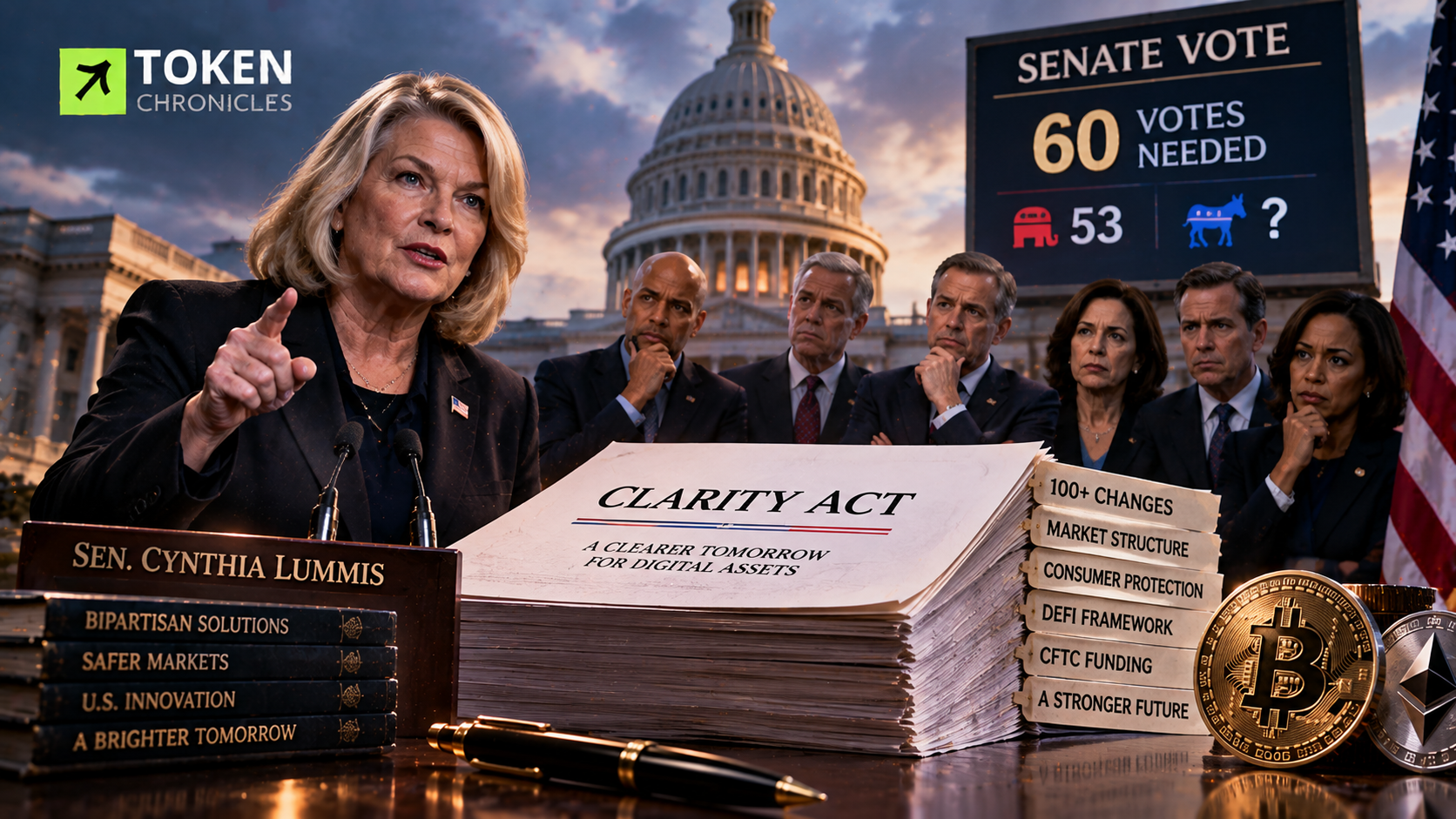
Sen. Cynthia Lummis is urging Democratic lawmakers to support the revised CLARITY Act, arguing that Republicans incorporated more than 100 changes sought by Democrats during negotiations. The appeal comes just days before a critical Senate procedural vote that requires 60 votes to move the sweeping crypto market structure bill toward debate.
Key Takeaways
- Sen. Cynthia Lummis says Democrats secured more than 100 changes in the revised CLARITY Act.
- The Senate needs 60 votes to advance the legislation to the next stage.
- Republicans hold 53 seats, meaning at least seven Democratic votes may be required if all Republicans support the measure.
- Major disagreements remain over ethics restrictions, conflicts of interest and enforcement provisions.
- Prediction markets continue to assign relatively low odds to the bill becoming law in 2026.
Lummis Turns Democratic Demands Into a Political Argument
The latest version of the Digital Asset Market Clarity Act is facing a crucial test in the Senate after months of negotiations between lawmakers from both parties.
Sen. Cynthia Lummis, a Republican from Wyoming and one of the legislation’s most prominent supporters, is now making a direct appeal to Democrats. Her argument is that lawmakers on the other side of the aisle requested substantial changes to the bill, many of which were incorporated into the latest draft.
In a Sept. 12 statement, Lummis argued that Democrats should support the legislation because they helped shape its revised provisions.
Her position comes as the Senate prepares for a procedural vote on Sept. 15. The vote is not a final decision on whether the CLARITY Act becomes law. Instead, it determines whether the Senate can move forward with debate and consideration of amendments.
The procedural hurdle is significant because the legislation needs 60 votes to advance.
More Than 100 Democratic Requests Were Added
The latest draft, which runs approximately 630 pages, incorporates more than 100 provisions requested by Democratic senators during negotiations, according to Lummis.
Some of the changes affect enforcement and market oversight rather than simply adjusting technical language.
The legislation includes restrictions designed to prevent individuals convicted of certain financial crimes from participating in regulated digital asset markets. It also proposes $150 million in additional funding for the Commodity Futures Trading Commission, giving the agency greater resources for supervision and enforcement.
Another major change concerns decentralized finance.
The revised bill seeks to distinguish genuinely decentralized protocols from platforms where an identifiable individual or coordinated group retains significant control over how the system operates.
Protocols meeting the bill’s definition of a non-decentralized trading platform could face registration requirements and additional obligations under federal financial regulations.
The DeFi provisions have also been narrowed toward spot and cash transactions involving digital commodities, while the revised language provides additional clarity for credit unions regarding certain digital asset and distributed ledger activities.
For Lummis, those changes demonstrate that Democratic concerns were taken seriously during negotiations.
The Remaining Dispute Centers on Ethics
Despite the extensive revisions, the most difficult disagreements have not disappeared.
Democratic lawmakers continue to raise concerns about ethics rules covering federal officials and their spouses who issue, promote or sponsor digital assets.
The debate has particular political significance because President Donald Trump and members of his family have financial connections to crypto-related ventures, including World Liberty Financial and the TRUMP memecoin.
Democrats have argued that the legislation needs stronger safeguards against potential conflicts of interest. They have also questioned the enforcement mechanism and the planned expiration of certain restrictions in 2029.
Republicans, meanwhile, have resisted some of the broader proposals, creating a difficult negotiating balance.
This means the remaining disagreement is not necessarily about whether Democrats received concessions. Instead, the dispute increasingly centers on whether the concessions went far enough.
Senate Math Leaves Little Room for Error
The Senate is scheduled to hold its procedural vote on Sept. 15 at 2:15 p.m. ET.
A minimum of 60 senators must support the motion for the bill to advance.
Republicans currently control 53 Senate seats. Assuming the Republican caucus remains united, at least seven Democratic senators would therefore need to support the procedural motion.
That makes bipartisan cooperation essential.
The CLARITY Act has already cleared significant legislative hurdles. The House approved its version of the legislation in July 2025 by a 294-134 vote, including support from 78 Democrats. The Senate Banking Committee later advanced its version by a 15-9 vote.
However, previous bipartisan support does not guarantee enough votes for the next stage.
The Senate could also amend the bill after debate begins, meaning Tuesday’s vote would not settle the remaining policy disputes.
What Happens If the Vote Succeeds?
A successful procedural vote would allow the Senate to begin debating the CLARITY Act and considering amendments.
Lawmakers could seek additional changes involving:
- Ethics and conflicts of interest
- Stablecoin rewards
- Anti-money laundering requirements
- DeFi registration
- Consumer protections
- SEC and CFTC jurisdiction
- Digital commodity classifications
The broader legislation seeks to establish clearer federal boundaries between securities and digital commodities while determining which regulator would oversee different parts of the crypto market.
The Commodity Futures Trading Commission would receive greater authority over spot markets involving qualifying digital commodities, while the Securities and Exchange Commission would retain jurisdiction over assets classified as securities.
If the Senate ultimately passes a different version from the House, both chambers would need to agree on identical legislation before it could reach the president.
Prediction Markets Remain Skeptical
Despite Lummis’ confidence, prediction markets have been considerably more cautious about the bill’s chances.
Polymarket currently places the probability of the CLARITY Act becoming law before the end of 2026 at roughly 23%, with more than $15 million reportedly traded on the relevant contract.
That represents a dramatic decline from earlier expectations. The market had previously assigned the legislation substantially higher odds before sentiment deteriorated during the summer.
The probability has recovered somewhat following the release of the revised bill, but traders still appear to view failure or delay as more likely than enactment this year.
Kalshi markets also reflect uncertainty. Its contracts place the probability of comprehensive crypto market structure legislation becoming law before July 2027 at around 34%, rising to approximately 46% for enactment before January 2028.
These prediction-market figures are not forecasts guaranteed to be accurate. They reflect the prices traders are willing to pay based on their expectations and can change rapidly as negotiations develop.
Midterm Elections Add Another Deadline
The political calendar could make the situation even more complicated.
The November 2026 midterm elections are approaching, leaving lawmakers with a limited window to complete major legislation before election-related priorities dominate Congress.
For the crypto industry, the timing is particularly important because comprehensive federal market structure legislation has been under discussion for years.
A failed procedural vote could force lawmakers back into negotiations and potentially push the legislation into 2027.
Lummis has continued to argue that the United States needs a durable statutory framework for digital assets rather than relying primarily on rules that can change when administrations change.
She has also warned that other financial centers, including Singapore and the United Arab Emirates, could gain an advantage if the United States fails to establish its own comprehensive crypto framework.
The Real Test Is Still Seven Votes Away
The revised CLARITY Act represents a substantial attempt to bridge disagreements between Republicans and Democrats. More than 100 requested changes have reportedly been incorporated, new funding has been proposed for the CFTC, and the legislation contains additional provisions addressing fraud, DeFi and market oversight.
Yet those concessions have not eliminated the political obstacles.
Lummis is now arguing that Democrats should support a bill they helped reshape. Democrats, meanwhile, continue to point to unresolved concerns surrounding ethics, enforcement and other protections.
The immediate question is therefore not whether the CLARITY Act is finished. It is whether it can secure the 60 votes needed to begin the next phase of the Senate process.
With Republicans holding 53 seats, the legislation may ultimately depend on a small group of Democratic senators deciding that the latest compromises are sufficient.
After months of negotiations and hundreds of pages of legislative language, the next decisive number may be much smaller: 60 votes, including potentially seven from across the aisle.