
A new decentralized finance experiment is bringing FWA liquidity, automated token burns and staking incentives together through the first external POOL4 liquidity pool for the asset.
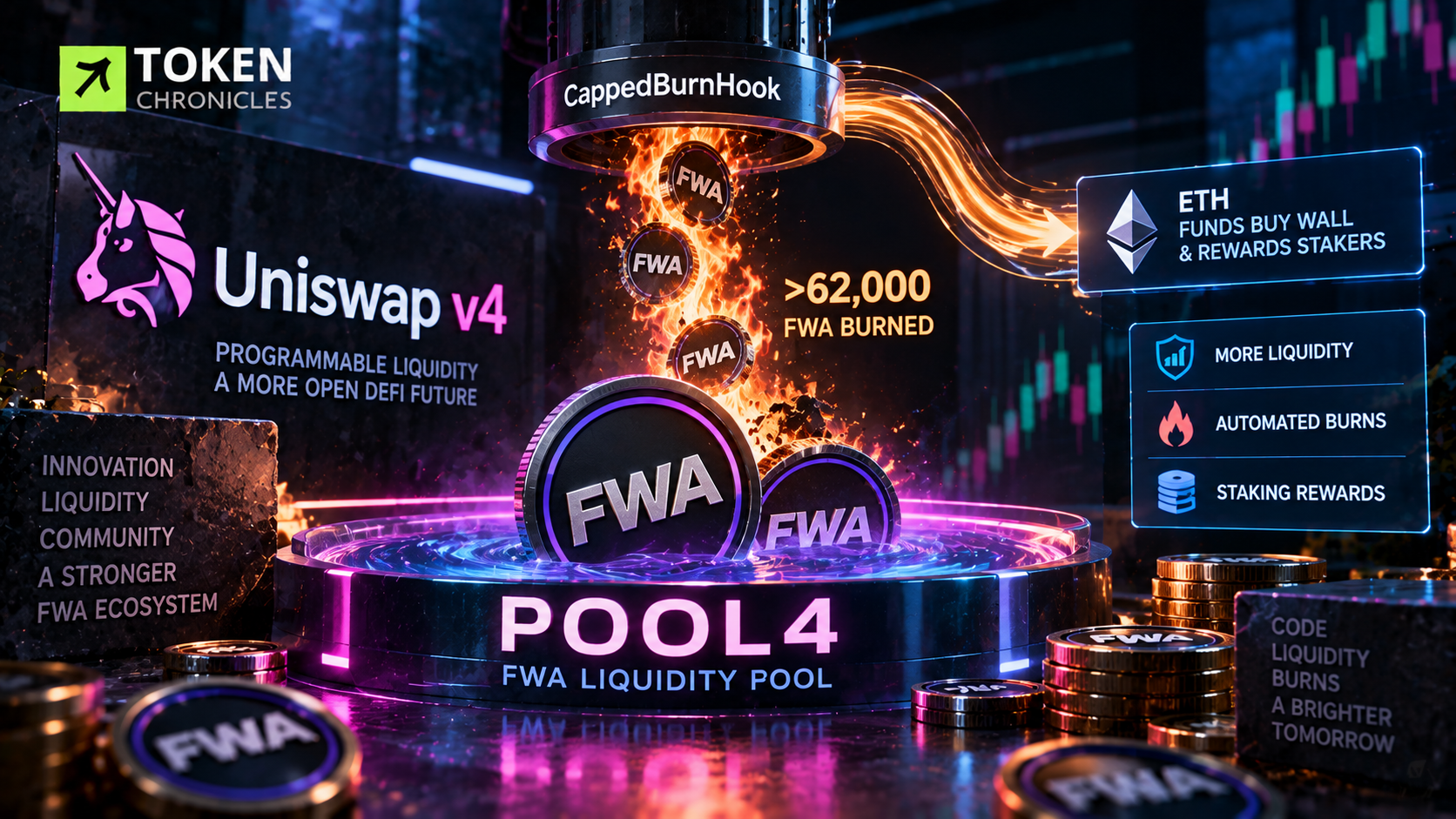
Developers Adam Rhynotic and Adam surfcoderepeat launched the pool on Uniswap v4, using a custom CappedBurnHook designed to manage large sell transactions while redirecting part of the resulting liquidity toward market support and stakers.
Key Takeaways
- The first external POOL4 liquidity pool for FWA has launched on Uniswap v4.
- A custom CappedBurnHook automatically burns excess FWA during large sell transactions.
- More than 62,000 FWA tokens have reportedly been burned since deployment.
- ETH retained through the mechanism is intended to support a buy wall and staking rewards.
- The project represents an early experiment with programmable liquidity management on Uniswap v4.
FWA Gets a New Liquidity Layer
Developers Adam Rhynotic and Adam surfcoderepeat have introduced what they describe as the first external POOL4 liquidity pool for FWA.
The pool is built using Uniswap v4, whose hook architecture allows developers to introduce custom logic around liquidity pools and trading activity.
Rather than operating as a conventional liquidity pool alone, the FWA deployment incorporates additional mechanisms intended to influence how large transactions affect the token’s supply and liquidity.
The central component is a custom CappedBurnHook, which is designed to respond when substantial sell orders enter the pool.
Custom Hook Combines Selling, Burns and Liquidity Support
The CappedBurnHook is designed to burn excess FWA tokens when large sell transactions occur.
Under the mechanism, part of the transaction’s structure is used to remove FWA from circulation, while the retained ETH is directed toward two stated objectives: strengthening a buy wall and providing funding for FWA stakers.
This creates a feedback mechanism in which trading activity can simultaneously affect token supply and liquidity.
The approach is different from a conventional token-burning system, where tokens are simply removed according to a fixed schedule or predetermined percentage.
Instead, the FWA implementation ties the burn mechanism directly to activity occurring inside the liquidity pool.
More Than 62,000 FWA Already Burned
Since the pool went live, more than 62,000 FWA tokens have reportedly been burned through the mechanism.
The figure provides an early indication of how the custom hook is functioning under actual trading conditions, although longer-term activity will be needed to determine how significant the mechanism becomes relative to FWA’s overall supply and trading volume.
The concentrated-liquidity pool has also recorded active swaps since launch, giving the deployment an operational component beyond simply announcing a new DeFi product.
As trading continues, the balance between liquidity, burns and staking incentives could become an important factor in how the pool performs.
Why Uniswap v4 Matters
The deployment also highlights one of the key differences between Uniswap v4 and earlier versions of the decentralized exchange.
Uniswap v4 allows developers to build custom hooks that can modify or extend pool behavior. This makes it possible to design specialized mechanisms around swaps, fees, liquidity management and other aspects of decentralized trading.
For FWA, that functionality is being used to create a pool where trading activity can interact with a token-burn and incentive system.
The model demonstrates how programmable liquidity infrastructure can be tailored to the economics of an individual token rather than relying solely on standardized pool behavior.
A New Approach to Token Incentives
The combination of automated burns and staking incentives is intended to create multiple benefits for participants.
Large selling activity can trigger additional FWA burns, potentially reducing the number of tokens in circulation. At the same time, ETH retained through the mechanism can be used to strengthen buy-side liquidity and support rewards for stakers.
The objective is to connect three components of the ecosystem:
Trading activity → token burns → liquidity and staking incentives
Whether that structure produces a sustainable economic benefit will depend on actual trading volume, liquidity depth, staking participation and the behavior of market participants.
A burn mechanism alone does not guarantee price appreciation, and buy-wall liquidity can change as market conditions and trading activity evolve.
Early Experiment in Programmable DeFi
The POOL4 launch represents an early experiment in using Uniswap v4’s programmable architecture to combine liquidity management with token economics.
Rather than treating liquidity provision, token supply and staking as separate systems, the FWA pool attempts to connect them through a single automated mechanism.
The deployment could provide a useful case study for how projects use customizable decentralized exchange infrastructure to develop their own market structures.
For FWA, the next stage will be determining whether the pool can maintain meaningful liquidity and trading activity while continuing to generate burns and incentives.
For the broader DeFi ecosystem, the experiment illustrates how programmable liquidity pools could enable increasingly specialized financial mechanisms without requiring a completely separate decentralized exchange.