

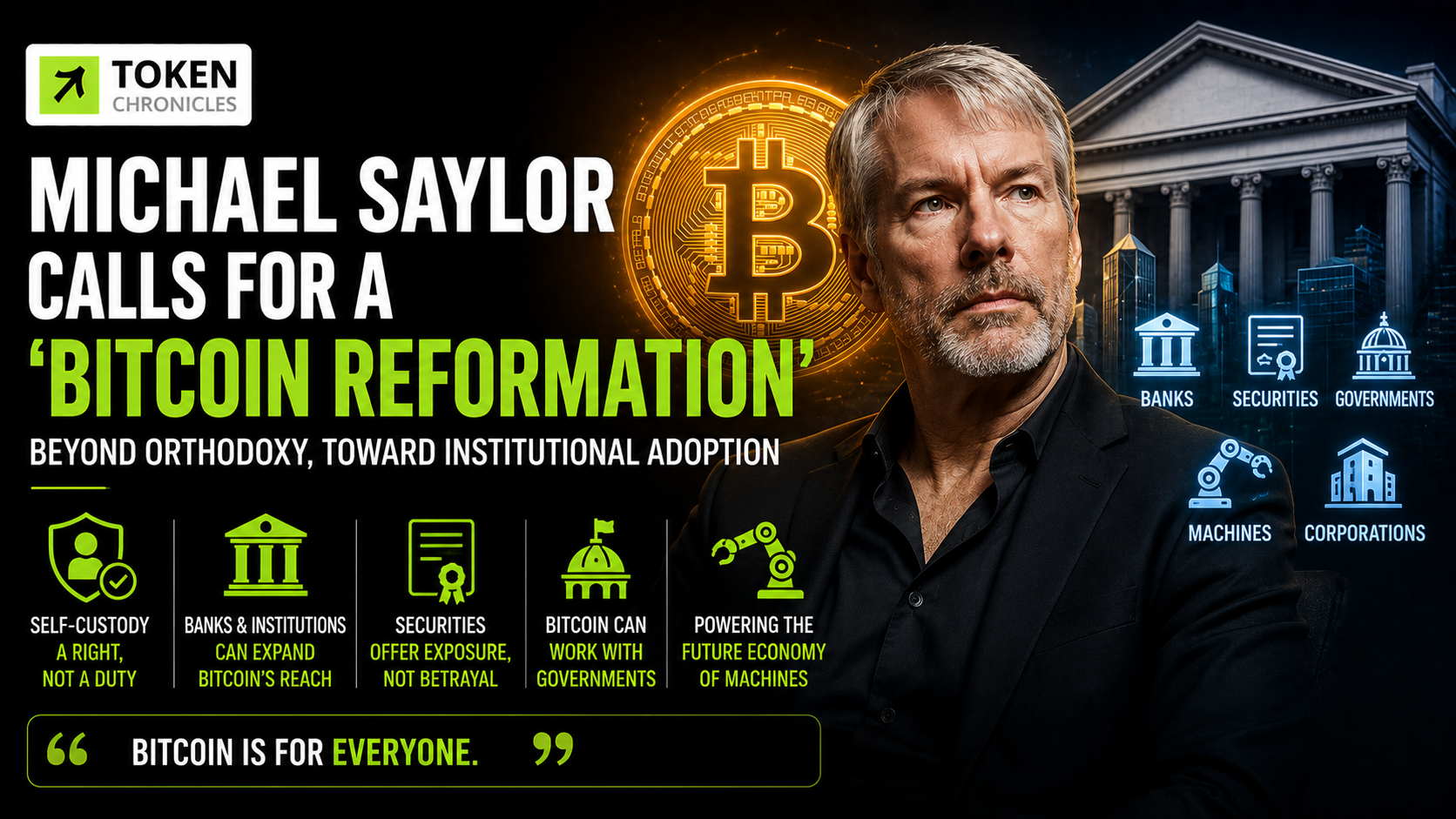
Michael Saylor is urging the Bitcoin community to rethink some of its long-standing assumptions about how the asset should be owned, governed and integrated into the global economy. In a new essay, the Strategy executive chairman argues that Bitcoin can preserve its core properties while becoming increasingly embedded in banks, corporations, capital markets, governments and machine-driven economies.
Saylor Argues Bitcoin Has Entered a New Phase
Bitcoin’s evolution should not remain constrained by the ideological framework that helped guide the network during its early years, according to Michael Saylor.
In an essay published Aug. 24, Saylor described what he calls a “Bitcoin Reformation” — a broader vision in which Bitcoin develops from a peer-to-peer payment network into a form of digital capital capable of interacting with virtually every layer of the financial system.
His argument does not call for abandoning Bitcoin’s fundamental characteristics.
Instead, Saylor believes the network can maintain its fixed supply, permissionless access and ability to support direct ownership while simultaneously becoming part of traditional financial infrastructure.
Under this model, Bitcoin would coexist with banks, exchanges, insurers, corporations, securities markets and governments rather than attempting to replace all of them.
Saylor’s broader thesis is that Bitcoin has moved through several stages of development. It began primarily as an experiment in peer-to-peer digital money, evolved into an asset increasingly viewed as digital gold and is now potentially becoming a form of digital capital that can underpin new financial products and economic structures.
That distinction is important because Bitcoin does not necessarily need to replace national currencies to become economically significant.
Governments can continue issuing currencies and collecting taxes while Bitcoin functions as a scarce, non-sovereign asset that individuals and institutions can use as a store of value, collateral or capital base.
Self-Custody Should Be an Option
One of Saylor’s more controversial arguments concerns self-custody.
Bitcoin’s ability to let individuals control their own private keys remains one of its defining characteristics. But Saylor argues that direct custody should be viewed as a choice rather than a requirement for everyone who owns Bitcoin.
Self-custody provides independence from financial intermediaries, but it also transfers substantial responsibility to the individual.
Users must protect private keys, maintain backups, plan for inheritance and ensure that their assets cannot be lost through mistakes, theft or inadequate security practices.
Institutional custody introduces a different set of risks, including counterparty exposure and concentration. However, professional custodians can also provide security infrastructure, compliance systems, recovery procedures and operational controls that many individual holders may struggle to maintain themselves.
Saylor therefore favors evaluating custodians based on their actual risk profile rather than rejecting institutional custody on ideological grounds.
Important considerations include:
- Asset segregation
- Transparency and audits
- Insurance arrangements
- Collateral requirements
- Withdrawal rights
- Leverage
- Fees
- Legal ownership
- Counterparty exposure
- Failure and recovery procedures
This approach also changes how Bitcoin-linked investment products should be evaluated.
Rather than automatically dismissing securities that provide Bitcoin exposure as “paper Bitcoin,” Saylor argues that investors should examine exactly what legal and economic rights those securities provide.
The distinction becomes particularly important as corporations create different classes of securities linked to Bitcoin holdings, each carrying its own combination of dividends, claims on assets, capital priority and corporate risk.
Institutional Products Could Broaden Bitcoin Access
Saylor believes institutional financial products can introduce Bitcoin to people who may never want to manage private keys themselves.
The approval of US spot Bitcoin exchange-traded products demonstrated how traditional investment infrastructure can provide exposure to Bitcoin without requiring investors to operate a wallet or directly manage cryptographic keys.
For Saylor, this does not necessarily undermine Bitcoin’s original principles.
Instead, he sees financial intermediaries as another access point.
An individual could hold Bitcoin directly, use a regulated investment product, rely on a qualified custodian or gain indirect exposure through corporate securities. The important principle, in his view, is maintaining the ability to choose between those models.
This represents a broader shift from viewing Bitcoin ownership as a single ideological practice toward viewing it as a spectrum of financial arrangements.
Hardware-Wallet Failures Highlight the Trade-Off
Recent security incidents also demonstrate why Saylor believes technological purity should not automatically be confused with security.
The Coldcard incident cited in his argument involved vulnerabilities associated with certain firmware and key-generation processes. The problem highlighted a fundamental reality of self-custody: even a highly respected hardware wallet can be compromised by implementation errors.
A user can follow every recommended self-custody principle and still face risks arising from software, hardware, supply chains or operational mistakes.
Other major cryptocurrency failures have demonstrated the risks of centralized intermediaries as well.
The history of exchanges and lenders includes high-profile collapses and hacks that resulted in significant losses for customers.
Saylor’s conclusion is not that one model is universally safe.
Instead, he argues that Bitcoin users should differentiate between counterparties, assess the protections available and understand precisely what risks they are accepting.
In this framework, self-custody remains an important escape route, but institutional custody can also have a legitimate role.
Bitcoin Could Become Infrastructure for Multiple Forms of Capital
Saylor’s vision extends well beyond Bitcoin as an investment asset.
His proposed economic framework includes several layers in which Bitcoin could play a role, ranging from digital capital and equity to credit, debt, currency, money and derivatives.
He also points toward an emerging category that could become increasingly important: machine capital.
As software agents and autonomous machines become economically productive, they may eventually need ways to hold, transfer and manage digital value without relying on a human intermediary for every transaction.
Bitcoin’s programmable ownership and global accessibility could potentially make it useful within that emerging machine economy.
The concept expands the potential Bitcoin user base from individuals and institutions to software systems, autonomous businesses and eventually machines.
Bitcoin Governance Is Driven by Adoption
Saylor also uses recent disagreements over Bitcoin improvement proposals to reinforce another point: no individual, developer group or ideological movement possesses absolute authority over Bitcoin.
Proposals can be written and promoted by developers, but their success ultimately depends on adoption throughout the broader ecosystem.
Miners, node operators, exchanges, custodians, businesses and individual users all influence whether a proposed change becomes part of the network’s effective rules.
This creates a decentralized form of governance in which economic participation matters as much as technical consensus.
For Saylor, that means Bitcoin should not be treated as a finished ideological document.
Its original design provides the foundation, but future development depends on how users and markets choose to interact with it.
The Opportunity Extends Beyond Bitcoin’s Current Market
Saylor’s argument also rests on the enormous size of global financial markets.
Global equities, bonds, gold and other stores of value collectively represent hundreds of trillions of dollars.
Bitcoin does not necessarily need to replace these markets to become a major financial asset.
Even capturing a relatively small percentage of global capital could dramatically expand Bitcoin’s economic significance.
That possibility is one reason Saylor favors greater integration with existing financial infrastructure.
Banks can provide custody. Exchanges can provide liquidity. Corporations can hold Bitcoin on their balance sheets. Financial institutions can create securities and derivatives. Governments can potentially incorporate Bitcoin into broader financial systems.
The result would be an ecosystem in which Bitcoin operates alongside existing financial institutions rather than outside them.
From Digital Gold to Digital Capital
The central theme of Saylor’s “Bitcoin Reformation” is therefore less about changing Bitcoin’s underlying protocol and more about changing the way the world interacts with it.
The early Bitcoin movement emphasized independence from banks, governments and centralized financial institutions.
Saylor’s newer vision is more expansive: Bitcoin can preserve its ability to operate independently while also becoming deeply integrated into the institutions that dominate the global economy.
That means accepting multiple forms of ownership, custody and financial exposure.
It also means recognizing that institutional adoption does not necessarily eliminate Bitcoin’s underlying principles.
Instead, Saylor sees the coexistence of self-custody and institutional custody, direct ownership and securities, individuals and corporations, humans and machines as part of Bitcoin’s next stage.
A Broader Definition of Bitcoin Sovereignty
The philosophy ultimately comes down to choice.
Users should be able to hold Bitcoin themselves, delegate custody to a trusted institution, obtain exposure through regulated securities or use other financial structures as the ecosystem develops.
For Saylor, sovereignty is not necessarily defined by refusing intermediaries. It is defined by having the ability to choose, verify and exit.
That philosophy could mark a significant change in Bitcoin culture if it gains wider acceptance.
Rather than measuring Bitcoin adoption by how closely users follow a particular ideological model, the next phase could be measured by how many different economic systems Bitcoin can serve.
The proposed “Bitcoin Reformation” is ultimately a call to make the network larger, more inclusive and more deeply connected to the global economy while preserving the fundamental option that made Bitcoin distinctive in the first place: the ability to own and control scarce digital value independently.