

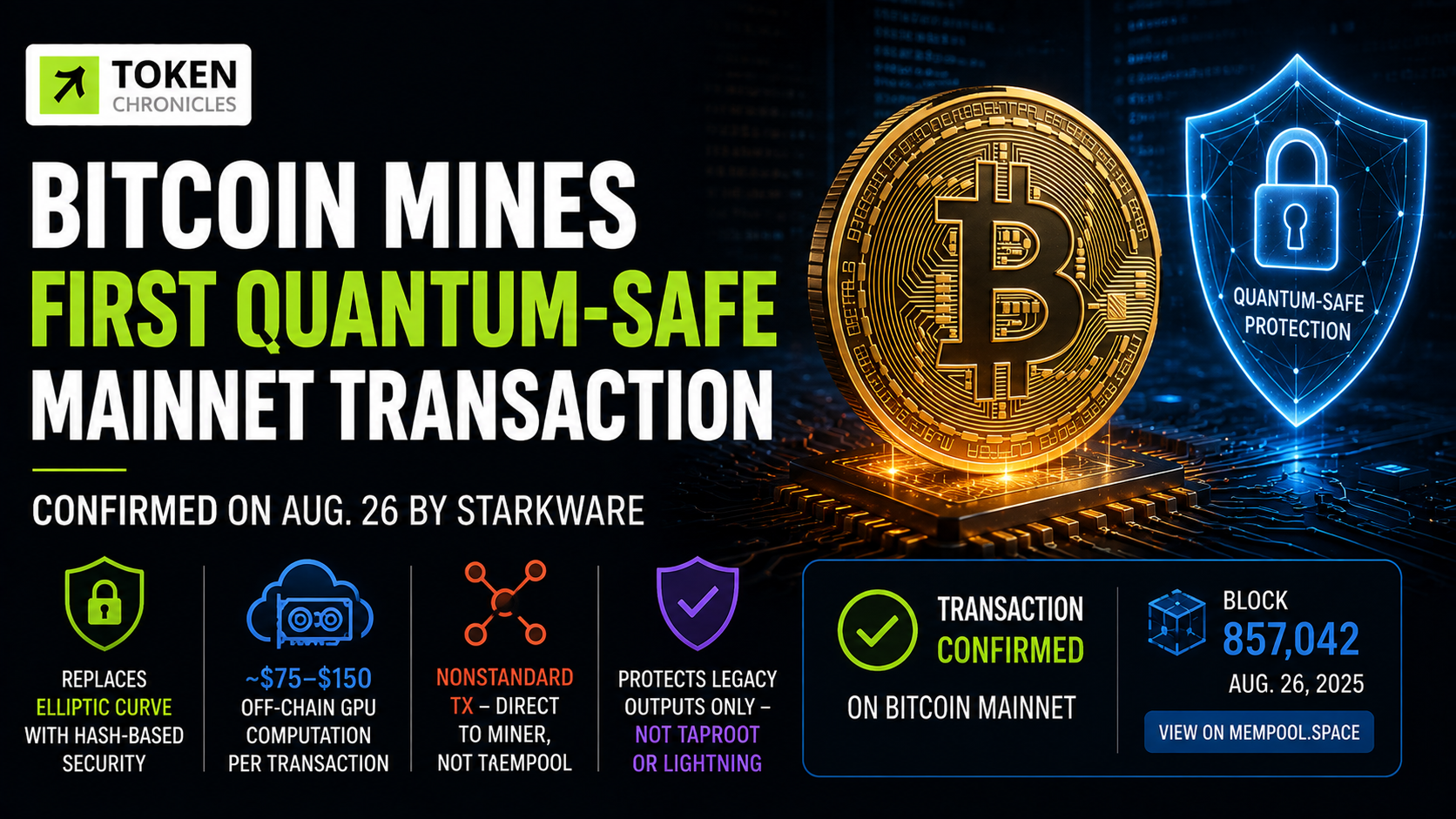
Bitcoin has reportedly processed its first mainnet transaction using a research technique designed to provide protection against future quantum attacks. Developed by researcher Avihu Levy and highlighted by StarkWare, the experiment demonstrates that a quantum-resistant transaction can be constructed using Bitcoin’s existing consensus rules, without requiring a soft fork or changes to the network’s protocol.
The transaction was confirmed on Bitcoin mainnet on Aug. 26, marking a significant proof of concept in the long-running effort to prepare the network for the possibility of cryptographically capable quantum computers.
However, the experiment should not be interpreted as meaning that Bitcoin has suddenly become quantum-resistant. The technique protects only specific outputs and comes with substantial computational and operational limitations.
Quantum-Safe Bitcoin Transaction Uses Existing Rules
The transaction relies on a technique known as Quantum-Safe Bitcoin (QSB), developed by Avihu Levy.
Rather than changing Bitcoin’s consensus mechanism, QSB attempts to use existing transaction and signature infrastructure in an unconventional way.
Conventional Bitcoin signatures rely heavily on elliptic-curve cryptography. A sufficiently powerful, fault-tolerant quantum computer could theoretically use Shor’s algorithm to attack the mathematical assumptions behind those signatures.
QSB takes a different approach.
Its security is intended to come primarily from the difficulty of finding cryptographic hash preimages rather than from the hardness of the elliptic-curve discrete logarithm problem. The construction uses Bitcoin’s existing ECDSA verification mechanism while creating data that effectively functions as a hash-based cryptographic puzzle.
According to the project’s published estimates, the construction provides roughly 118-bit second-preimage resistance under its modeled quantum threat assumptions.
The important achievement is therefore not that Bitcoin’s cryptography has been replaced, but that researchers demonstrated a way to create a specialized transaction whose security properties are different from ordinary Bitcoin signatures without modifying the consensus rules.
No Soft Fork Was Required
The first mainnet transaction was accepted under Bitcoin’s existing rules.
That means the experiment did not require:
- A new Bitcoin opcode
- A consensus-rule change
- A soft fork
- A network-wide client upgrade
- Changes to Bitcoin’s block-validation rules
This makes the experiment particularly interesting from a research perspective.
A conventional protocol-level quantum-resistance upgrade would require agreement among Bitcoin developers, miners, node operators and users before new transaction formats could become part of the network.
QSB instead demonstrates a way to construct a specialized quantum-resistant output using functionality that Bitcoin already supports.
That does not make it a practical replacement for ordinary transactions, but it provides researchers with a potential emergency or transitional mechanism.
Creating a QSB Transaction Is Expensive
The biggest limitation is computational cost.
Generating a QSB spend requires searching for transaction parameters that produce a particular RIPEMD-160 hash satisfying the conditions needed for the construction.
That process involves an enormous number of hashing attempts.
The project’s implementation estimates that producing an individual QSB spend could require approximately 2⁴⁶ search attempts.
Because of that computational requirement, the transaction cannot be generated in the same way as an ordinary Bitcoin transaction.
The published estimates place the cloud-GPU computation cost at approximately $75 to $150 per transaction, although the underlying research gives a somewhat wider range depending on implementation assumptions.
Importantly, this is not the Bitcoin transaction fee.
The computation represents an additional off-chain expense required before the transaction can be broadcast. The search can also be distributed across multiple GPUs, but each new QSB transaction requires its own computational work.
That makes the technique considerably less practical for routine payments.
QSB Transactions Face Bitcoin Relay Restrictions
Another obstacle is Bitcoin’s standard transaction-relay policy.
QSB transactions are sufficiently unusual and large that ordinary Bitcoin nodes will generally not propagate them through the public mempool.
As a result, simply creating the transaction and broadcasting it normally may not be enough to get it included in a block.
For the first mainnet demonstration, MARA’s Slipstream service provided a direct route to a participating miner.
This distinction is important.
The Bitcoin consensus rules accepted the transaction, but the network’s normal transaction-relay infrastructure was not designed to distribute this type of transaction.
In practice, QSB therefore currently depends on specialized access to miners or block-building infrastructure.
The Experiment Does Not Make All Bitcoin Quantum-Safe
The mainnet confirmation is an important proof of concept, but it has a much narrower meaning than the phrase “quantum-safe Bitcoin” might suggest.
QSB does not automatically protect every Bitcoin coin or address.
The construction currently focuses on specific legacy-style outputs and does not directly provide protection for every modern Bitcoin transaction type.
In particular, it does not automatically secure:
- Taproot outputs
- Lightning Network channels
- Previously exposed public keys
- Coins that have never been moved into a compatible QSB output
That limitation is critical because Bitcoin’s quantum risk is not simply a question of whether a new quantum-resistant transaction can be created.
The broader challenge is migrating existing Bitcoin holdings into cryptographic structures that would remain secure if sufficiently powerful quantum computers became available.
Previously Exposed Keys Remain a Concern
Quantum attacks would be particularly relevant when a Bitcoin public key is exposed.
Under Bitcoin’s conventional cryptographic model, an attacker with a sufficiently powerful quantum computer could theoretically derive a corresponding private key from an exposed public key.
This creates a timing problem.
If a user moves coins from a conventional output into a quantum-resistant output only after a capable quantum computer becomes operational, the attacker could potentially attempt to interfere with that transaction during the migration process.
Coins associated with public keys that have already been exposed through previous spending can also face different levels of risk.
QSB therefore works best as a preemptive migration mechanism, rather than a technology that can magically recover coins after a quantum attack has already begun.
Dormant Bitcoin Could Be a Bigger Problem
The existence of a quantum-safe transaction does not resolve the question of what happens to Bitcoin that owners never move.
Bitcoin’s supply includes coins that have remained untouched for extremely long periods. Some may belong to lost wallets, while others may simply be held by owners who have no intention of moving them.
If quantum computing eventually becomes powerful enough to threaten Bitcoin’s existing cryptography, these dormant outputs could become one of the most difficult issues for the network to address.
A migration strategy would need to consider whether and how holders could move vulnerable coins before an attacker gains the ability to exploit exposed keys.
That is one reason researchers and Bitcoin developers continue to investigate protocol-level solutions rather than relying exclusively on specialized transaction constructions such as QSB.
QSB Is Better Viewed as a Fallback Than a Replacement
The researchers themselves characterize QSB as a potential last-resort mechanism, rather than a system designed to replace ordinary Bitcoin transactions.
Its advantages are clear:
No consensus change.
No soft fork.
Existing Bitcoin rules.
Hash-based security assumptions.
But those advantages come with substantial trade-offs:
High computational cost.
Large transaction structures.
Limited relay compatibility.
Dependence on direct miner access.
Incomplete coverage of Bitcoin’s existing output types.
For everyday Bitcoin users, ordinary transactions remain vastly more practical.
QSB’s value is therefore primarily as evidence that a specialized quantum-resistant escape route can function on the existing network.
Bitcoin Developers Are Also Exploring Protocol-Level Protection
A more comprehensive solution would likely require changes to Bitcoin itself.
One proposal under discussion is BIP-360, which explores Pay-to-Merkle-Root outputs as part of a broader strategy for reducing Bitcoin’s exposure to quantum attacks.
Unlike QSB, a proposal such as BIP-360 would require changes at the Bitcoin protocol level and therefore would involve significantly more technical, governance and coordination challenges.
A full post-quantum transition could eventually require changes covering several components of the ecosystem, including wallet software, transaction formats, signature schemes, custody systems and potentially second-layer networks.
The challenge is not merely inventing a quantum-resistant signature. Developers must also determine how millions of existing users could migrate their holdings safely and efficiently.
Why the Mainnet Transaction Matters
The first successful QSB transaction provides an important piece of experimental evidence.
It shows that researchers can construct a transaction with alternative cryptographic security assumptions while remaining compatible with Bitcoin’s current consensus rules.
But it also highlights how much work remains.
A practical quantum-resistance solution would need to be inexpensive, scalable, widely relayable, compatible with modern Bitcoin outputs and easy enough for ordinary users and institutions to adopt.
Most importantly, it would need to provide a migration path before quantum computing becomes a credible threat to Bitcoin’s existing cryptography.
No publicly demonstrated quantum computer currently possesses the capabilities required to break Bitcoin’s cryptographic protections at scale.
That gives the ecosystem time to research and test potential solutions.
The Bottom Line
Bitcoin’s first reported quantum-safe mainnet transaction is an important proof of concept, not a declaration that Bitcoin is now quantum-proof.
QSB demonstrates that a specialized hash-based protection mechanism can operate under Bitcoin’s existing consensus rules, but its computational expense, relay limitations and restricted coverage prevent it from serving as a practical replacement for conventional transactions today.
The bigger significance lies in what the experiment demonstrates: Bitcoin may have emergency paths toward quantum resistance without immediately requiring a network-wide overhaul.
The long-term challenge, however, remains much larger — developing a scalable protocol-level migration strategy that can protect the entire Bitcoin ecosystem before quantum computing becomes powerful enough to threaten today’s cryptographic foundations.