
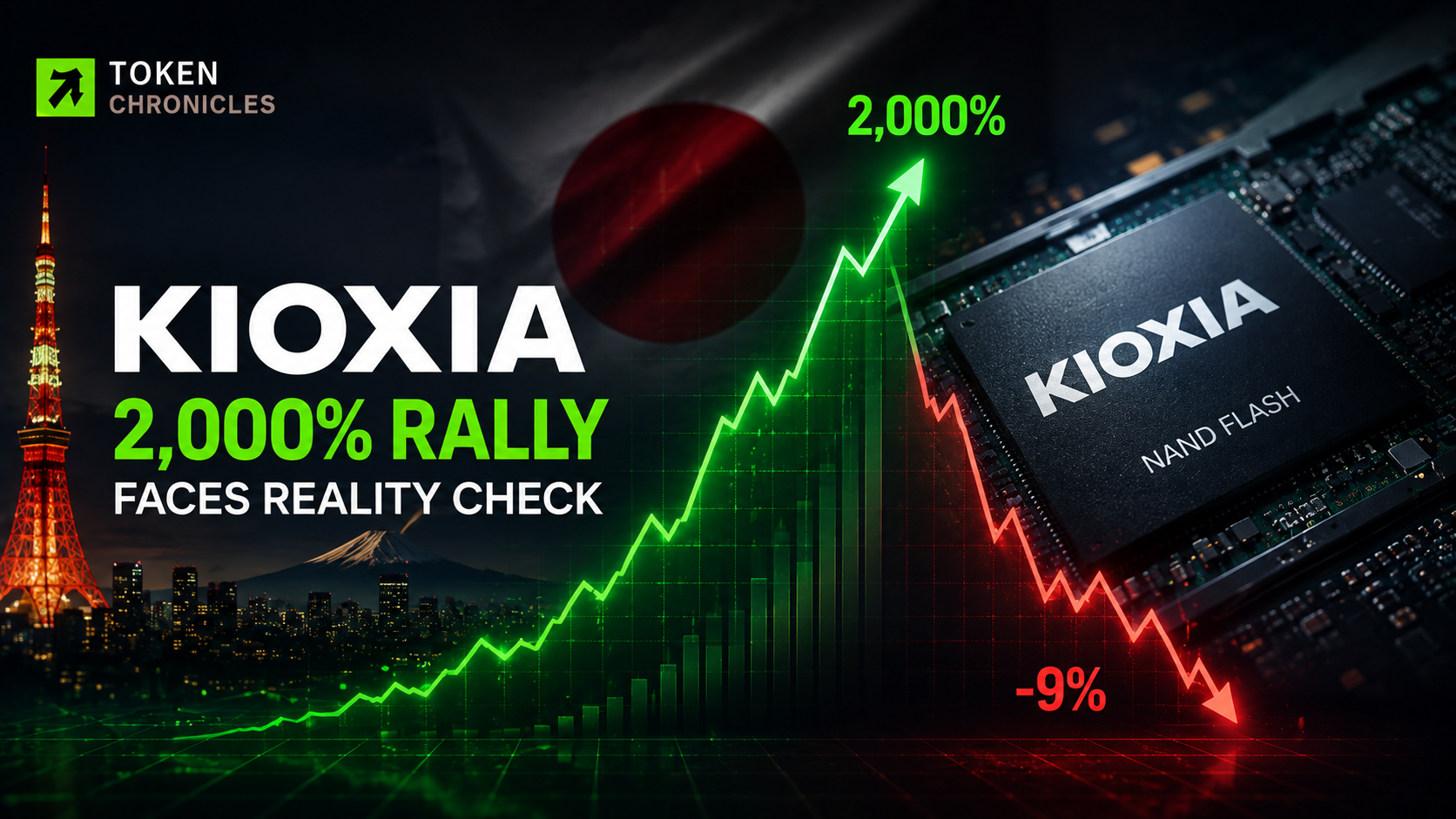
Kioxia Holdings, one of the world’s leading NAND flash memory manufacturers, remains Japan’s best-performing stock over the past year despite heightened volatility that has shaken investor confidence. After soaring approximately 2,000% in twelve months—nearly four times the gain of the country’s next-best-performing stock—the semiconductor company has recently experienced sharp price swings as investors reassess the sustainability of the AI-driven memory boom.
While the stock continues to rank among the strongest performers on the Tokyo Stock Exchange, its latest decline underscores growing uncertainty about the next phase of the AI semiconductor cycle.
AI Demand Fueled Historic Stock Rally
Kioxia’s remarkable rise has been driven largely by the global surge in artificial intelligence infrastructure spending.
As technology companies expanded AI data centers at an unprecedented pace, demand for NAND flash memory—used in servers, smartphones, enterprise storage systems, and AI hardware—accelerated significantly.
The tightening supply-demand balance boosted memory prices, improving Kioxia’s profitability and propelling its share price to record levels throughout 2025 and into 2026.
At one point, the rally briefly elevated Kioxia to become Japan’s most valuable publicly listed company by market capitalization.
Its performance also far outpaced the broader Japanese equity market, with second-ranked AIMECHATEC gaining approximately 540% over the same period.
Outlook Triggers Investor Caution
Investor sentiment shifted after Kioxia released financial guidance that fell short of market expectations.
The company projected operating income that implied slower earnings growth for the current quarter than many analysts had anticipated.
Although management announced shareholder-friendly initiatives—including a three-for-one stock split and an ¥800 billion share repurchase program—the earnings outlook raised concerns that profit growth may be moderating after an exceptionally strong AI-driven expansion.
The guidance prompted renewed selling pressure as investors questioned whether memory pricing had reached its peak.
AI Memory Market Faces New Challenges
Beyond company-specific forecasts, the broader semiconductor sector has entered a more volatile phase.
Several factors are contributing to investor caution, including:
- Cooling momentum across certain AI-related technology stocks.
- Expanding NAND production capacity from Chinese manufacturers.
- Concerns that increased supply could weaken pricing power.
- Questions about how long current AI infrastructure spending can remain at elevated levels.
While demand for AI hardware remains strong, investors are increasingly focused on whether memory producers can maintain the extraordinary profit margins achieved during the recent supply shortage.
Extreme Volatility Replaces One-Way Rally
Despite its long-term gains, Kioxia’s share price has become considerably more volatile.
The stock recently recorded a double-digit percentage gain over several trading sessions before quickly reversing and posting another sharp decline.
These rapid price movements reflect a market struggling to determine whether Kioxia remains an attractive long-term AI investment or whether expectations have moved ahead of fundamentals.
Analysts Remain Divided
Wall Street and Japanese equity analysts continue to hold differing views on the company’s outlook.
The majority of research firms maintain Buy ratings, with several believing Kioxia still offers substantial upside as AI infrastructure investment continues expanding.
Major financial institutions including Daiwa, UBS, and Goldman Sachs have recently reaffirmed positive recommendations.
However, not all analysts share that optimism.
Some remain cautious, arguing that increasing industry competition and potential pricing pressure could reduce future earnings growth if memory supply begins to outpace demand.
AI Growth Story Still Intact
Despite recent volatility, Kioxia continues to report strong year-over-year improvements in both revenue and profitability.
The company’s long-term investment thesis remains closely tied to continued growth in:
- Artificial intelligence infrastructure
- Cloud computing
- Enterprise storage
- High-performance data centers
- Advanced semiconductor demand
Whether the recent pullback represents a temporary correction or the beginning of a broader slowdown will likely depend on future earnings results and broader trends within the global memory chip market.
Investors Await the Next Signal
Kioxia now finds itself at an important crossroads.
Supporters argue the company remains one of the biggest beneficiaries of the long-term AI infrastructure boom and believe current weakness represents a healthy consolidation after an extraordinary rally.
More cautious investors, however, are watching closely for signs that expanding global NAND production and moderating pricing could mark the beginning of a more challenging environment for memory manufacturers.
The company’s upcoming earnings reports and market outlook will be closely scrutinized, as they may determine whether Kioxia’s remarkable rally resumes or enters a more prolonged period of consolidation amid an evolving AI semiconductor landscape.