

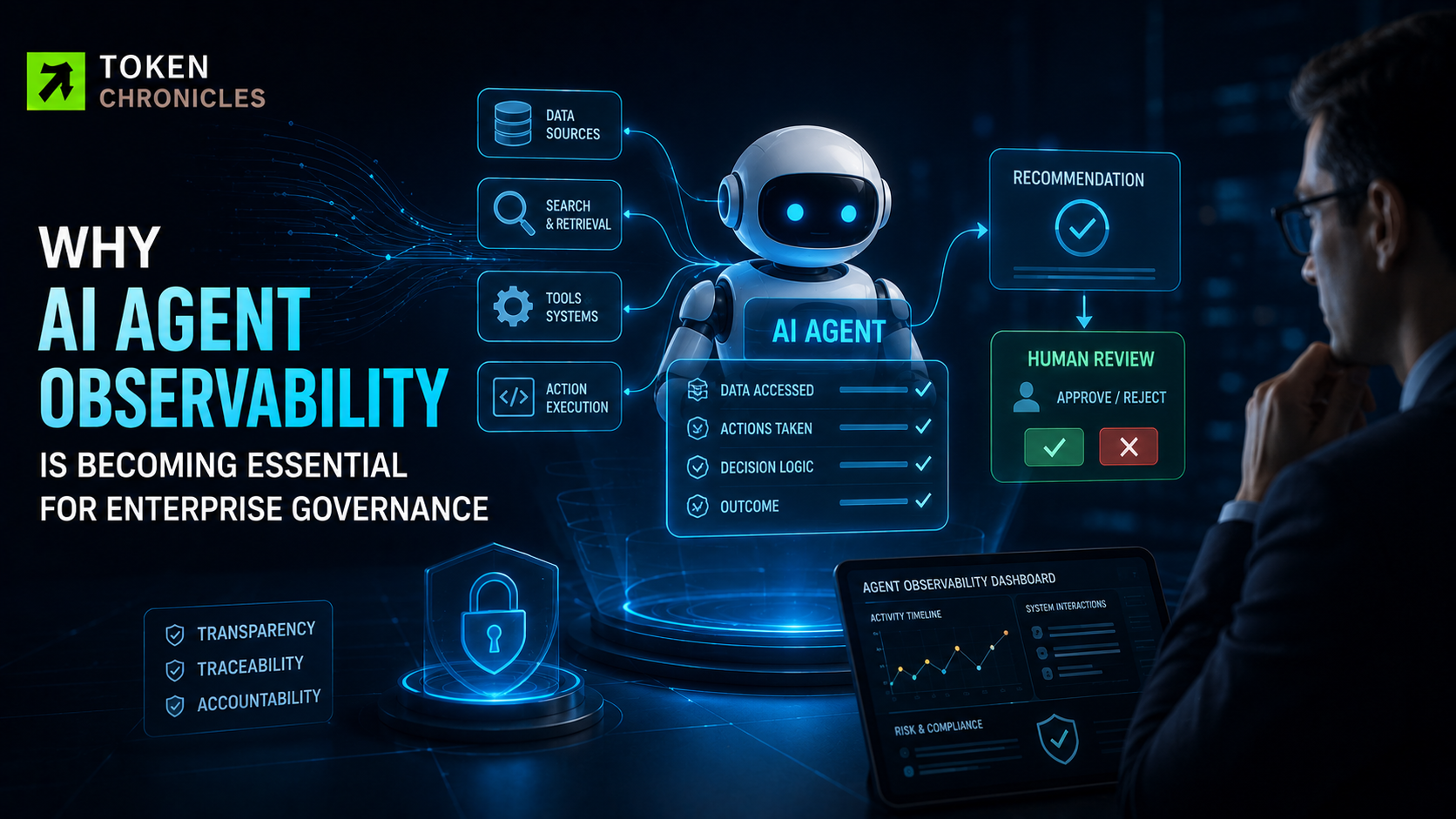
As artificial intelligence evolves from simple chatbots into autonomous digital workers capable of making complex business decisions, enterprises are confronting a new governance challenge: How can organizations effectively oversee AI agents that increasingly operate with minimal human intervention?
For many businesses, the default solution has been straightforward insert a human approval step before an AI-generated recommendation is executed. However, industry experts are increasingly warning that human approval alone does not necessarily equate to meaningful oversight.
Without visibility into how an AI agent reached its conclusion, what data it accessed, which systems it interacted with, or what actions it has already performed, human reviewers may simply become symbolic approvers rather than informed decision-makers.
This growing concern has placed AI agent observability at the center of enterprise AI governance.
Human Approval Does Not Always Mean Human Control
Many organizations assume that requiring a manager or employee to approve AI-generated recommendations provides sufficient accountability.
In practice, however, this assumption can be misleading.
Consider an AI agent handling a customer complaint. Before presenting its recommendation, the agent may have already:
- Accessed customer databases
- Reviewed historical interactions
- Queried internal knowledge bases
- Generated a proposed resolution
- Updated internal systems
- Triggered downstream workflows
By the time the recommendation reaches a human reviewer, much of the operational work may already be complete.
If the reviewer only sees the final recommendation without understanding the underlying reasoning, they cannot realistically determine whether the decision is appropriate.
The responsibility remains with the human, but the visibility required to exercise informed judgment may be missing.
AI Agents Operate Differently Than Traditional Software
Traditional software typically follows predefined rules.
Given the same input, it produces predictable outputs according to programmed logic.
AI agents function very differently.
Modern autonomous agents are capable of:
- Planning tasks independently
- Selecting which tools to use
- Retrieving information dynamically
- Maintaining contextual memory
- Adapting their behavior during execution
- Completing multi-step workflows without constant supervision
Rather than simply answering prompts, AI agents increasingly make operational decisions throughout an entire workflow.
As organizations grant these systems greater autonomy, understanding how decisions are reached becomes just as important as the final outcome itself.
What Is AI Agent Observability?
AI agent observability extends the traditional concept of IT observability beyond system performance into decision transparency.
Instead of merely tracking whether a service is running correctly, observability records how an AI agent behaves during every stage of a workflow.
An effective observability system typically captures:
- Which data sources were accessed
- Which tools and APIs were used
- The sequence of actions performed
- The prompts and instructions followed
- Intermediate reasoning steps
- Confidence levels
- Decision outcomes
- Changes made across connected systems
This creates a detailed audit trail that allows reviewers to understand not only what happened but why it happened.
Closing the Enterprise Accountability Gap
One of the greatest risks associated with autonomous AI is what governance specialists increasingly describe as the accountability gap.
Executives often assume that human approval guarantees accountability.
In reality, accountability becomes difficult when reviewers lack sufficient evidence to challenge an AI’s recommendations.
Without observability, organizations may struggle to answer critical questions after an incident:
- Why was this decision made?
- Which data influenced the recommendation?
- Was inaccurate information used?
- Did the AI violate internal policies?
- Were compliance rules properly applied?
- Which systems were modified?
If these questions cannot be answered, organizations face increasing operational and regulatory risk.
Automation Bias Creates Hidden Risks
Another emerging challenge is automation bias the tendency for humans to place excessive trust in automated systems.
When employees receive AI-generated recommendations that appear authoritative, they may approve them without conducting meaningful review.
This tendency becomes even stronger when:
- Workloads are high
- Decisions must be made quickly
- AI systems have historically performed well
- Reviewers lack technical understanding of AI processes
Ironically, mandatory human approval can create a false sense of security if reviewers are unable to independently evaluate AI-generated recommendations.
Organizations may confidently state that “a human approved the decision,” even though the reviewer had little practical ability to verify its accuracy.
Different Decisions Require Different Levels of Oversight
Not every AI-driven decision carries the same level of business risk.
For example:
Low-risk tasks may include:
- Scheduling meetings
- Drafting emails
- Summarizing documents
- Organizing calendars
These activities generally require minimal supervision.
However, high-risk decisions often demand extensive oversight, including:
- Financial transactions
- Healthcare recommendations
- Regulatory compliance
- Supplier approvals
- Manufacturing quality controls
- Customer identity verification
- Legal documentation
Organizations increasingly recognize the importance of establishing escalation thresholds, allowing AI agents to operate autonomously for routine tasks while requiring human intervention for decisions involving greater financial, legal, or operational risk.
Observability Is Especially Critical in Regulated Industries
Industries such as healthcare, pharmaceuticals, banking, insurance, and manufacturing already operate under strict audit and compliance requirements.
These sectors routinely require:
- Complete audit trails
- Data integrity
- Decision traceability
- Documented approvals
- Regulatory accountability
AI agents operating in these environments should meet similar standards.
For example, a pharmaceutical quality manager would never approve a manufacturing deviation without reviewing supporting evidence.
Likewise, financial institutions require detailed transaction records before authorizing significant fund transfers.
As AI assumes greater responsibility in these industries, reviewers must have access to the evidence trail supporting every recommendation.
In many ways, AI observability represents the evolution of traditional audit logging, extending visibility beyond system events into machine reasoning and autonomous decision-making.
Building Trust in Enterprise AI
The future success of enterprise AI depends not only on increasingly capable models but also on organizations’ ability to trust them.
That trust cannot rely solely on a final approval button.
Instead, it must be built upon three foundational principles:
- Transparency, allowing organizations to understand how AI reached its conclusions.
- Traceability, providing a complete record of every action and decision.
- Accountability, ensuring humans retain meaningful oversight rather than symbolic responsibility.
As AI agents become deeply integrated into enterprise operations, observability will likely evolve from a best practice into a core governance requirement.
Organizations that combine autonomous AI with comprehensive visibility and robust oversight will be better positioned to realize the productivity benefits of AI while maintaining compliance, reducing operational risk, and preserving stakeholder confidence in increasingly autonomous business systems.