
A new survey commissioned by crypto exchange OKX suggests that college students and their parents strongly support adding cryptocurrency and blockchain education to university programs. However, limited academic offerings mean many students are turning to social media and online influencers instead of professors for information.
Strong Demand for Crypto and Blockchain Courses
The survey found widespread support for incorporating digital assets and blockchain technology into higher education.
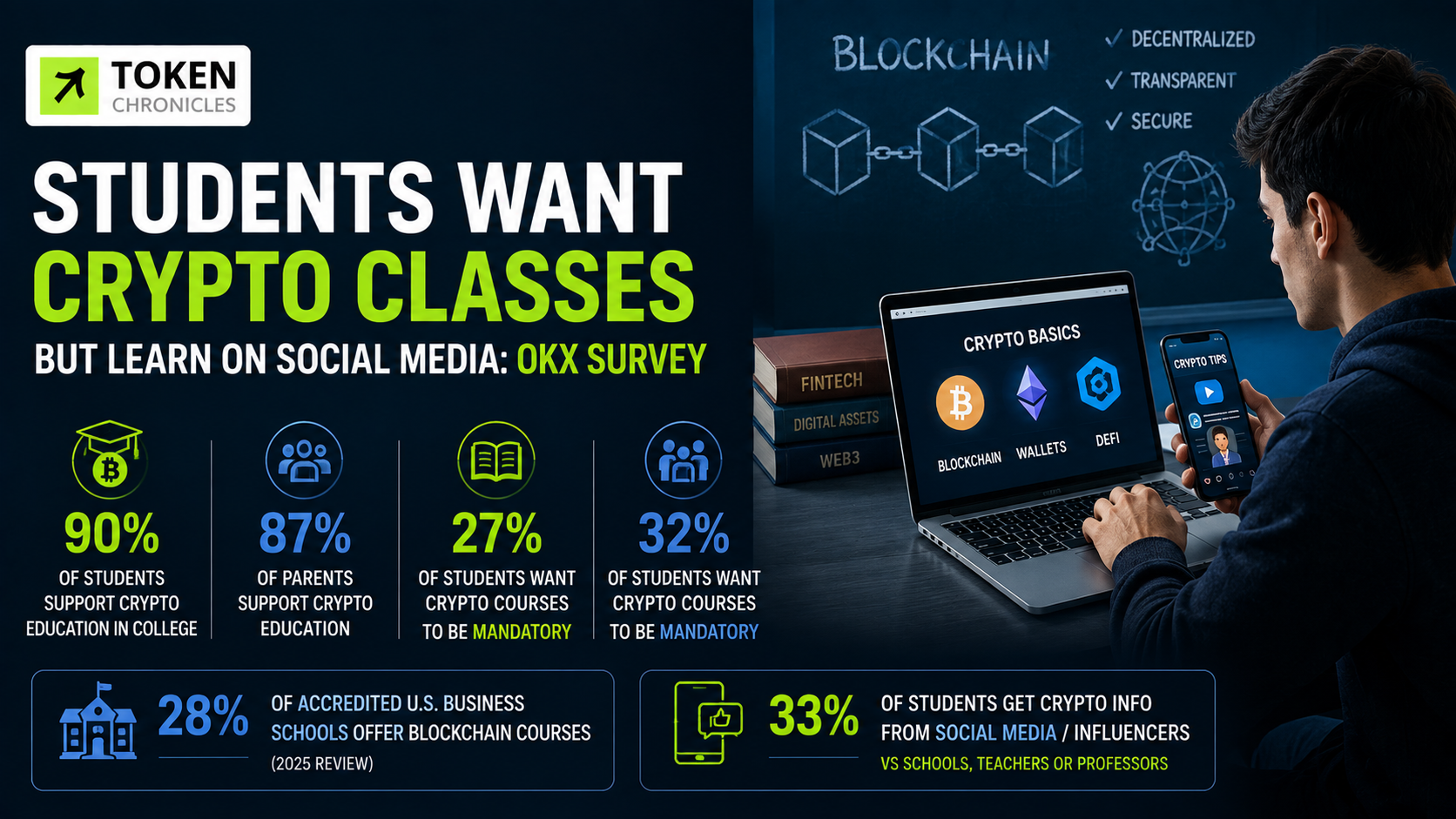
Around 90% of students surveyed said colleges should teach cryptocurrency and blockchain, while 87% of parents agreed. Support for making such education mandatory was lower but still notable, with approximately 27% of students and 32% of parents favoring compulsory instruction.
The findings point to a growing gap between student interest in emerging financial technology and the availability of structured academic programs covering the subject.
A separate 2025 review of 533 US universities with accredited business schools found that only about 28% offered blockchain-related courses, suggesting that formal education has not expanded at the same pace as interest in the technology.
Social Media Has Become the Classroom
With relatively few universities offering dedicated blockchain courses, students are increasingly relying on online sources to understand crypto.
According to the OKX survey, 33% of students identified social media platforms or influencers as their most important source of cryptocurrency information.
That figure was nearly five times higher than the share of respondents who identified schools, teachers or professors as their primary source.
The trend highlights the growing influence of platforms such as YouTube, X, TikTok and other online communities in shaping how younger people learn about digital assets.
While social media can provide rapid access to breaking developments and practical information, the quality of that education can vary significantly. Promotional content, speculation and inaccurate claims can appear alongside legitimate educational material, making critical evaluation increasingly important.
Parents Turn to Crypto Platforms and Apps
Parents reported somewhat different information habits.
Approximately 21% of parents identified cryptocurrency platforms and applications as their most important source of crypto-related information, making that category their leading source in the survey.
The difference between students and parents suggests that different generations are approaching digital assets through different channels. Younger users appear more heavily influenced by social networks and online personalities, while older participants may rely more heavily on dedicated financial and cryptocurrency platforms.
Universities Face a Growing Education Gap
The findings raise a broader question for colleges and universities: Should blockchain and digital assets become a standard part of financial education?
Blockchain technology now extends well beyond cryptocurrencies. It is increasingly being explored for payments, tokenized securities, stablecoins, decentralized finance, digital identity and other financial applications.
Understanding these systems may therefore become increasingly relevant for students pursuing careers in finance, technology, law, accounting and business.
Universities also have an opportunity to approach the subject from an academic perspective, covering both the potential benefits and risks of digital assets. Courses could address blockchain architecture, token economics, regulation, cybersecurity, market structure, financial crime and the broader economic implications of tokenization.
Survey Limitations Matter
The OKX study surveyed 500 students and 500 parents using Pollfish, an online survey-distribution platform. Participants were not recruited specifically from OKX’s customer base.
However, several methodological details were not disclosed, including the survey’s weighting methodology, margin of error and the proportion of respondents who already owned or used cryptocurrency.
As a result, the findings should be viewed as an indication of attitudes among the surveyed group rather than a definitive measure of crypto-education demand across the entire US college population.
Crypto Education Is Moving Outside the Classroom
The central takeaway is clear: interest in crypto education appears to be running ahead of university course availability.
As formal academic programs remain limited, social media, influencers, apps and online communities are filling much of the educational gap.
That creates both an opportunity and a challenge for universities. As blockchain and digital assets become increasingly connected to mainstream finance and technology, institutions that develop rigorous, balanced courses could give students a structured alternative to learning primarily through social media.
The question may no longer be whether students are interested in crypto education, but whether universities can provide credible education quickly enough to meet that demand.