
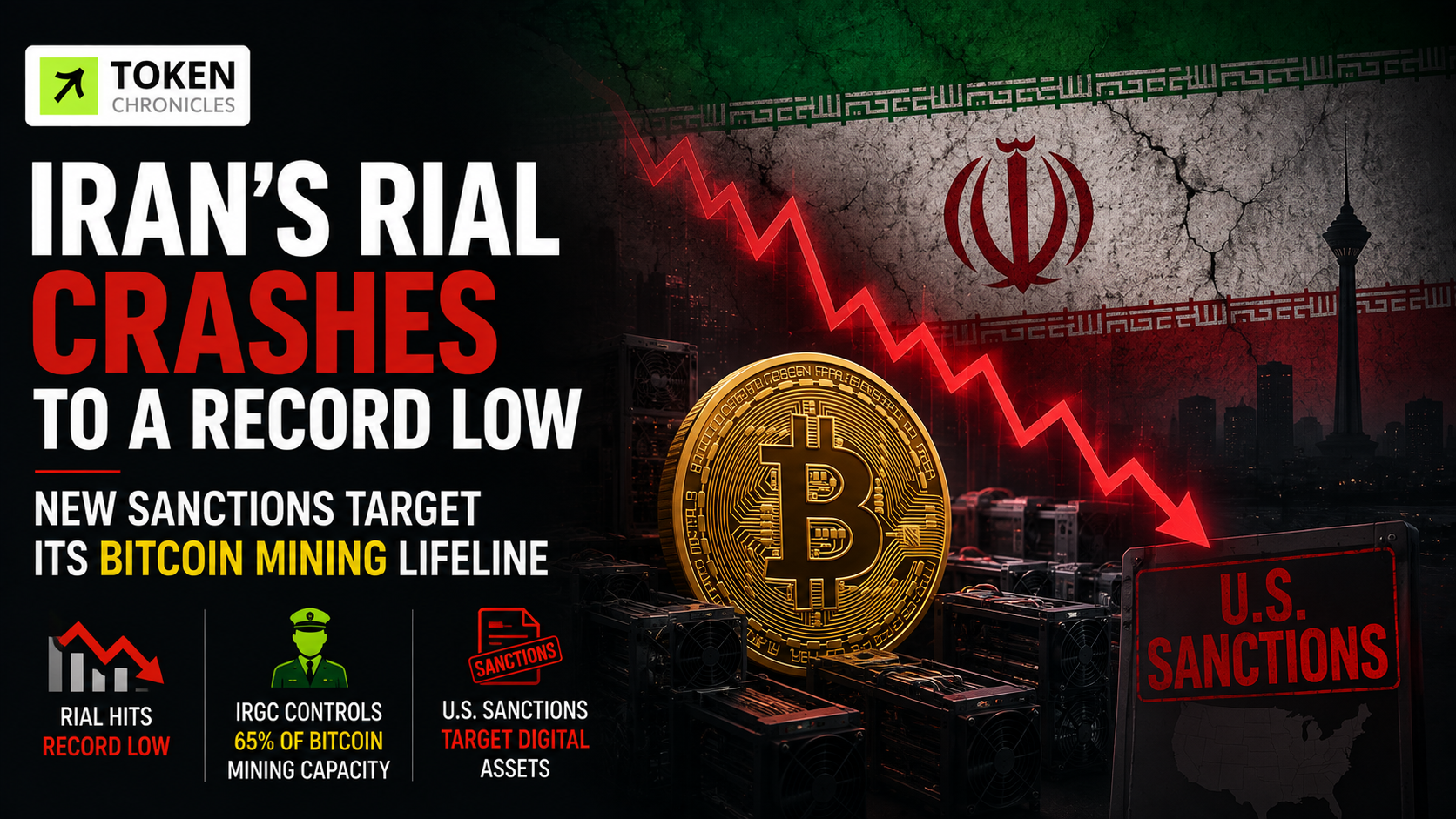
Iran’s currency has fallen to a new record low against the US dollar as Washington expands its sanctions campaign to explicitly include the country’s digital-asset sector. The move could put additional pressure on a crypto ecosystem that Tehran has used for years to access alternative sources of revenue, move value across borders and reduce its dependence on conventional financial channels.
- The Iranian rial reportedly fell to around 2.02 million per US dollar on Aug. 24.
- The latest US sanctions framework explicitly identifies Iran’s digital-asset sector as a target.
- State-linked entities are reportedly involved in a significant share of Iran’s Bitcoin-mining infrastructure.
- Previous US actions have targeted Iranian crypto exchanges, wallets and intermediaries.
- Further secondary sanctions could increase the difficulty of converting crypto proceeds into conventional currencies.
Rial Crisis Deepens as Washington Expands Sanctions
Iran’s currency has come under renewed pressure, with the open-market rial reportedly reaching approximately 2.02 million per dollar on Aug. 24, compared with around 1.53 million earlier in the year.
The deterioration coincides with a new US sanctions campaign targeting Iranian economic networks. Under the latest measures, Washington has expanded its focus beyond traditional sectors such as oil, shipping and aviation to explicitly include digital assets and related services.
The US Treasury’s approach could have consequences beyond Iranian companies directly named in sanctions announcements. Foreign businesses that provide services to Iran’s digital-asset ecosystem could also face greater exposure to secondary sanctions.
That creates a significant challenge for Iranian entities that rely on cryptocurrency to move money internationally while avoiding conventional banking channels.
The economic backdrop is already difficult. The International Monetary Fund has projected extremely high inflation for Iran in 2026 alongside an economic contraction, adding further pressure to households and businesses as the rial loses purchasing power.
Bitcoin Mining Became an Alternative Source of Revenue
Iran has long viewed Bitcoin mining as more than simply a private-sector cryptocurrency activity.
The country formally recognized cryptocurrency mining as an industrial activity in 2019, creating a licensing framework for miners. Licensed operators have historically benefited from comparatively inexpensive electricity while facing requirements concerning the use or sale of mined Bitcoin.
Over time, large-scale mining operations linked to state interests have emerged. Reports cited in the supplied material estimate that entities connected to the Islamic Revolutionary Guard Corps (IRGC) may account for a substantial portion of Iran’s domestic mining capacity.
Estimates of Iran’s contribution to global Bitcoin hashrate have varied considerably over the years, depending on electricity availability, enforcement, sanctions and the methodology used to identify Iranian mining activity.
The economic incentive is straightforward: Bitcoin can be produced domestically using electricity and subsequently transferred across borders without requiring the conventional correspondent-banking system.
For a country facing restrictions on access to international finance, that creates an alternative financial channel.
Stablecoins Add Another Layer to Iran’s Crypto Strategy
Mining is only one component of Iran’s broader cryptocurrency activity.
Stablecoins, particularly dollar-denominated tokens, can provide another mechanism for moving value when access to the traditional dollar-based banking system is restricted.
Blockchain-analysis firms have previously identified substantial cryptocurrency flows involving Iranian exchanges, businesses and wallets. Some of those addresses have subsequently been associated with sanctioned entities.
Stablecoins can be particularly attractive in an inflationary environment because their value is generally designed to track fiat currencies such as the US dollar. For Iranian users, access to dollar-linked digital assets can therefore provide an alternative store of value when the domestic currency is rapidly depreciating.
However, cryptocurrency does not eliminate sanctions risk.
Blockchain transactions create permanent public records, allowing investigators and compliance companies to trace movements between addresses. Once an address is linked to a sanctioned organization or individual, exchanges and other service providers can use that information to block transactions or freeze assets where legally required.
US Crackdown Has Already Targeted Iranian Exchanges
Washington’s latest action follows several earlier interventions against Iran’s crypto infrastructure.
US authorities have previously sanctioned major Iranian cryptocurrency exchanges and other intermediaries accused of facilitating transactions involving sanctioned entities.
One of the most prominent targets has been Nobitex, which has been described as one of Iran’s largest cryptocurrency exchanges. Authorities and blockchain investigators have examined its connections to Iranian financial networks and the movement of digital assets to international platforms.
The exchange also suffered a major cryptocurrency theft, adding another disruption to an ecosystem already facing growing regulatory pressure.
Iranian authorities and market participants have subsequently had incentives to diversify their transaction routes, use different blockchain networks and find alternative intermediaries.
That creates a recurring cycle: sanctions restrict one channel, participants search for another, and investigators then attempt to identify the replacement infrastructure.
Mining Faces a Different Kind of Risk
Sanctions are not the only challenge confronting Iran’s Bitcoin-mining sector.
Large-scale mining operations are heavily dependent on reliable electricity. Iran has experienced significant pressure on its power infrastructure, particularly during periods of extreme demand.
Mining farms consume substantial amounts of electricity, making them vulnerable to government restrictions, power shortages and rationing.
That means a combination of financial sanctions and domestic energy constraints could be more damaging to Iranian mining operations than either factor alone.
Even if miners can continue producing Bitcoin, converting those coins into usable fiat currency can become increasingly difficult if international exchanges, OTC brokers, payment companies and stablecoin issuers avoid sanctioned counterparties.
Secondary Sanctions Could Increase the Pressure
The most important development may be the potential expansion of enforcement beyond Iran itself.
If foreign companies believe that providing crypto-related services to Iranian businesses could expose them to US sanctions, they may choose to terminate those relationships even when they are not directly named in a sanctions announcement.
That could affect exchanges, brokers, custodians, payment providers and other financial intermediaries.
For Iran, the consequence would be a shrinking pool of institutions willing to provide the final connection between digital assets and the conventional financial system.
The challenge is particularly significant for stablecoins. While tokens can move globally through public blockchains, users ultimately need liquidity and counterparties if they want to convert those assets into goods, services or traditional currencies.
Iran’s Crypto Workaround Faces a New Test
Iran has demonstrated that cryptocurrency can provide alternative financial channels when conventional banking access is restricted. Bitcoin mining, cryptocurrency exchanges and dollar-linked stablecoins have all played different roles in that ecosystem.
But the latest sanctions strategy targets the infrastructure surrounding those activities rather than focusing exclusively on individual transactions.
That could make the next phase of the conflict more complicated.
Iran may continue searching for alternative exchanges, wallets, mining operations and cross-border intermediaries, while US authorities increasingly focus on identifying and disrupting those replacement networks.
The falling rial adds urgency to the situation. As domestic purchasing power deteriorates, demand for alternative stores of value may increase. At the same time, tougher international enforcement could make accessing those alternatives increasingly difficult.
The result is a growing contest between Iran’s ability to adapt its cryptocurrency infrastructure and Washington’s ability to identify, sanction and isolate the financial networks supporting it.
For the global crypto industry, the episode also highlights a broader reality: decentralized blockchain networks can make value transfer more resilient, but the businesses that provide fiat conversion, custody and liquidity remain exposed to traditional regulatory and sanctions regimes.