

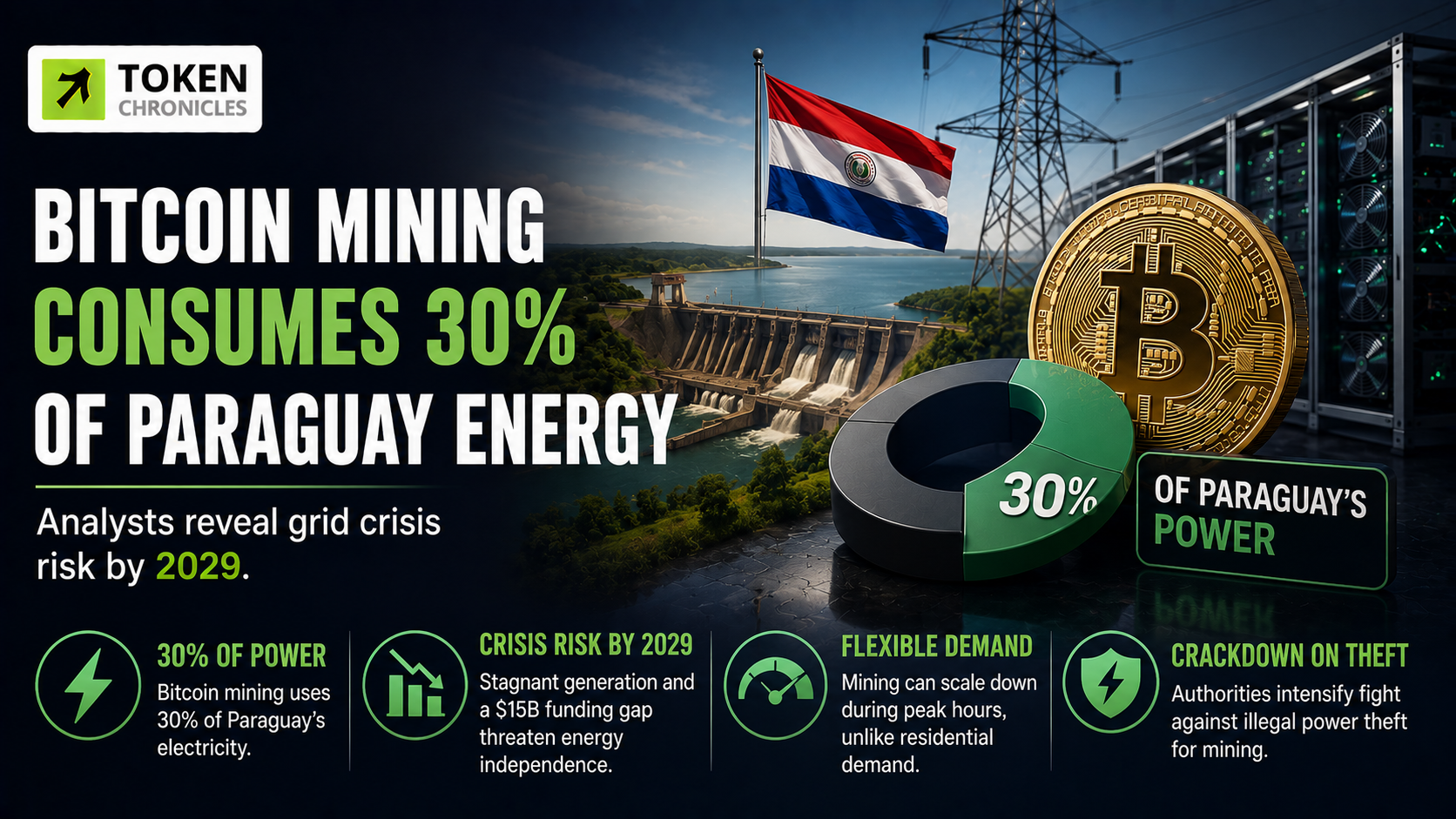
Paraguay’s rapidly expanding Bitcoin mining industry is putting increasing pressure on the country’s electricity system, with analysts warning that continued growth could create a serious power shortage by 2029. Mining operations are already estimated to consume around 30% of Paraguay’s available electricity, intensifying debate over how the country should balance crypto mining with future industrial and household demand.
Bitcoin Mining Puts Growing Pressure on Paraguay’s Energy System
Paraguay has become an attractive destination for Bitcoin miners because of its abundant hydroelectric power, much of which comes from the Itaipu Dam. The country generates electricity almost entirely from renewable sources, giving miners access to relatively low-cost energy.
But that advantage is increasingly creating a new challenge.
At the “Accelerating Bitcoin” conference, energy specialists examined the expanding role of cryptocurrency mining and its potential impact on Paraguay’s electricity infrastructure.
Energy researcher Victorio Oxilia said the country’s Bitcoin mining industry is consuming an amount of electricity comparable to the output of approximately one and a half turbines at the Itaipu hydroelectric facility.
According to the analysis presented at the event, Bitcoin mining now accounts for roughly 30% of Paraguay’s electricity consumption.
If mining demand continues increasing while electricity generation remains largely unchanged, analysts believe the country could face a significant supply imbalance by 2029.
The concern is particularly important because Paraguay has historically benefited from an electricity surplus. A prolonged increase in domestic demand could gradually erode that advantage.
2027 Could Become a Key Turning Point
Another uncertainty is the future of electricity agreements between Paraguay and cryptocurrency miners.
Many existing contracts with mining companies are scheduled to expire in 2027. Whether those agreements are renewed, modified or reduced could have a major effect on the country’s future electricity allocation.
The government therefore faces a difficult balancing act.
On one side, Bitcoin mining can generate economic activity and monetize Paraguay’s substantial hydroelectric resources. On the other, allocating such a large portion of the country’s electricity to mining could limit the amount available for manufacturing, businesses, households and other industries.
The debate is becoming more urgent as electricity consumption continues to rise.
Paraguay’s Power Generation Is Struggling to Keep Pace
Analysts say the problem is not simply Bitcoin mining.
Paraguay’s electricity generation capacity has remained relatively stagnant while overall demand has continued to expand.
The Aña Cuá expansion project is one of the country’s major ongoing energy developments, but its expected additional capacity of approximately 135 megawatts would provide only limited relief compared with projected long-term demand.
Energy analyst Cecilia Llamosas estimates that Paraguay could need between $11 billion and $15 billion in energy investment over the next 13 years to adequately meet future consumption.
The scale of the investment highlights the infrastructure challenge facing the country after decades of comparatively limited expansion of its power-generation system.
Bitcoin Mining Has One Major Advantage: Flexible Demand
Despite the concerns, analysts point out that Bitcoin mining has a characteristic that distinguishes it from most forms of electricity consumption.
Mining facilities can often reduce or shut down their operations when electricity demand on the grid becomes unusually high.
That makes Bitcoin miners potentially useful as flexible electricity consumers.
During periods of lower demand, miners can increase their operations and absorb excess electricity. When the grid becomes strained, they can reduce consumption and release power for households and other users.
Llamosas argued that this flexibility could make cryptocurrency mining easier to manage than residential electricity demand, which follows predictable consumption patterns and cannot simply be switched off during periods of grid stress.
The key issue, therefore, may not be mining itself but how effectively Paraguay regulates and manages its electricity allocation.
Illegal Mining Adds Another Layer of Pressure
Authorities are also dealing with a separate problem: illegal cryptocurrency mining powered by stolen electricity.
Paraguayan officials have intensified efforts to identify mining operations that illegally connect to the national power network or manipulate electricity infrastructure.
Several investigations have resulted in criminal prosecutions and convictions involving large-scale electricity theft.
Illegal mining is particularly problematic because it can bypass the country’s formal electricity allocation system while placing additional stress on local infrastructure.
It can also undermine legitimate miners that operate under regulated electricity contracts.
Paraguay Faces a Choice Over Its Energy Future
Paraguay’s Bitcoin mining boom illustrates the opportunities and challenges created by its enormous renewable-energy resources.
The country has an unusual advantage: vast hydroelectric generation capacity and a large supply of relatively inexpensive renewable electricity.
Bitcoin miners have moved quickly to capitalize on that advantage.
However, continued mining expansion could compete with other forms of electricity demand if new generation capacity does not come online quickly enough.
The coming years will therefore be crucial.
Paraguay must decide how much electricity should be dedicated to cryptocurrency mining, how mining contracts should be structured after 2027, and how much new generation and transmission infrastructure the country needs.
If investment accelerates, flexible mining demand could potentially coexist with industrial and residential growth. If generation remains stagnant while consumption continues climbing, however, the country could face a much tighter electricity market by 2029.
The debate ultimately extends beyond Bitcoin: Paraguay is deciding how to convert its enormous renewable-energy advantage into long-term economic growth without allowing rising demand to undermine the power surplus that made the country attractive to miners in the first place.