
The crypto sector has seen a fresh wave of developments spanning stablecoins, tokenized real-world assets, institutional infrastructure, network economics and regulated financial products. Banks and fintech companies are moving deeper into blockchain-based payments, while major networks continue refining their tokenomics and security models.
At the same time, renewed security concerns across decentralized finance and shared EVM infrastructure highlight the risks that accompany the industry’s rapid expansion.
Key Developments Across the Crypto Market
World Liberty Advances Toward a National Trust Bank
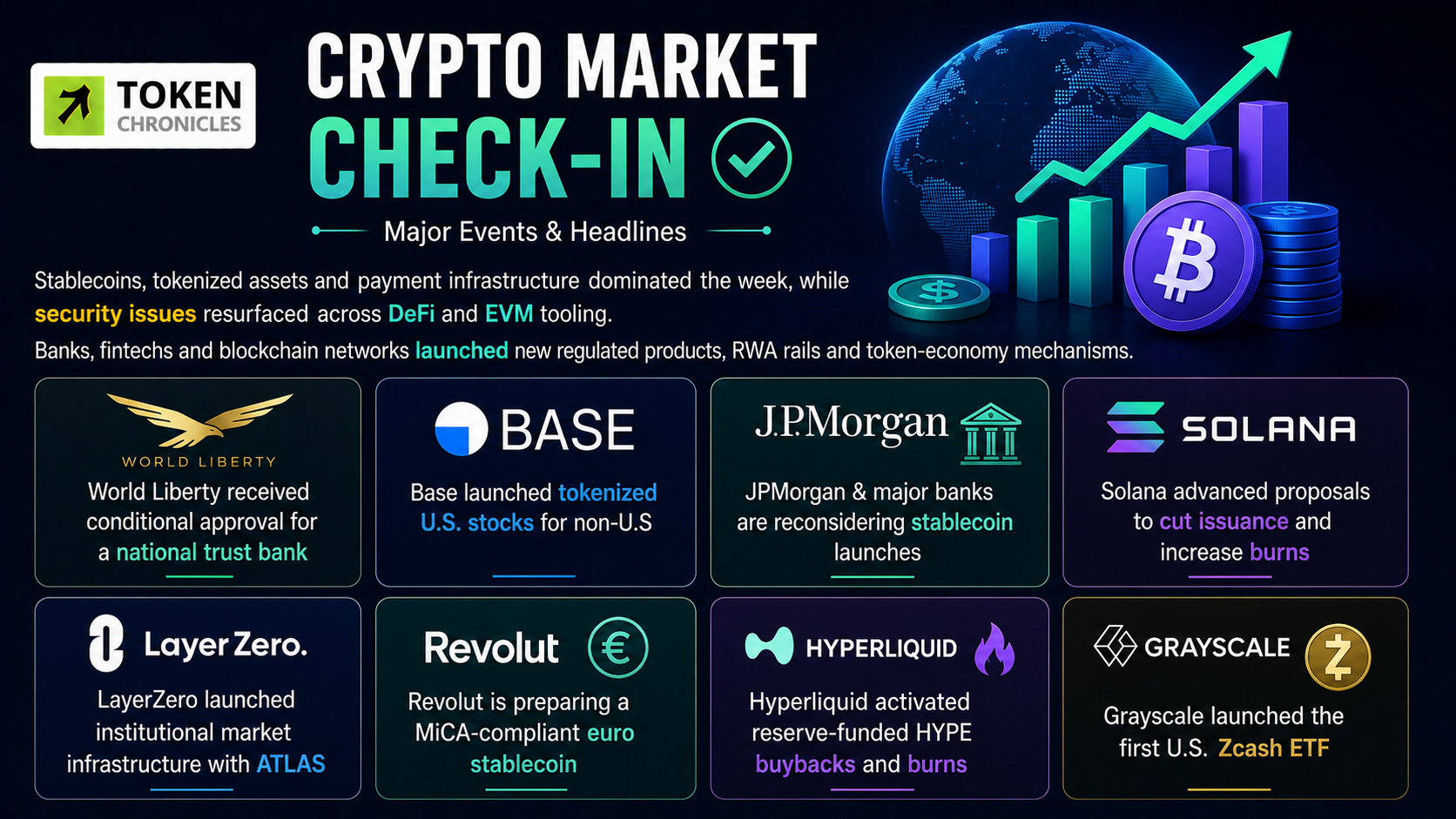
World Liberty Financial has received conditional approval to establish a national trust bank, marking another step toward bringing crypto-native financial services closer to the regulated banking system.
The approval remains conditional, meaning additional regulatory requirements must be satisfied before the institution can begin operating under the proposed structure.
Base Expands Tokenized U.S. Stocks
Base has introduced tokenized representations of U.S. equities for investors outside the United States.
The move expands the growing market for tokenized real-world assets, potentially allowing international users to gain blockchain-based exposure to traditional securities while benefiting from the settlement and programmability features of blockchain infrastructure.
Major Banks Revisit Stablecoin Strategies
Large financial institutions, including JPMorgan and other major banks, are reportedly reassessing their approach to issuing or supporting stablecoins.
The renewed interest reflects growing recognition that stablecoins could become an important layer of global payments, settlement and treasury infrastructure as regulatory frameworks become clearer.
Solana Moves to Change Its Token Economics
Solana is advancing proposals aimed at modifying its network’s monetary structure.
The proposals would seek to reduce new token issuance while increasing the amount of SOL removed from circulation through burns. If adopted, the changes could alter the balance between network inflation and supply reduction over time.
LayerZero Introduces Institutional Infrastructure
LayerZero has launched ATLAS, an institutional-focused market infrastructure initiative designed to connect financial institutions with blockchain-based markets.
The development reflects the broader push toward infrastructure capable of supporting institutional trading, settlement and tokenized financial products.
Revolut Develops a MiCA-Compliant Euro Stablecoin
European fintech giant Revolut is preparing a euro-denominated stablecoin designed to comply with the European Union’s Markets in Crypto-Assets (MiCA) framework.
The project comes as financial companies increasingly develop regulated digital currencies tailored to regional payment and settlement requirements.
A euro stablecoin could also provide Revolut with greater control over blockchain-based payment infrastructure while expanding its digital-asset offerings across European markets.
Hyperliquid Activates HYPE Buybacks and Burns
Hyperliquid has activated a mechanism that uses network reserves to purchase HYPE tokens and subsequently burn them.
The strategy is designed to connect protocol activity and accumulated reserves with token supply reduction, potentially creating a more direct relationship between ecosystem growth and HYPE’s token economics.
Grayscale Launches a U.S. Zcash ETF
Grayscale has introduced what is being described as the first U.S. exchange-traded fund providing exposure to Zcash (ZEC).
The launch represents another expansion of regulated crypto investment products in the United States, extending ETF access beyond the largest digital assets and into privacy-focused cryptocurrency exposure.
The Bigger Picture
Taken together, these developments point to several themes shaping the next stage of the crypto industry.
Stablecoins are moving toward mainstream financial infrastructure. Banks and fintech companies are exploring regulated digital currencies for payments, settlement and treasury operations.
Tokenization is expanding beyond crypto-native assets. U.S. equities and other real-world assets are increasingly being represented on blockchain networks, bringing traditional financial instruments into programmable digital markets.
Institutional infrastructure is becoming more sophisticated. Projects such as LayerZero’s ATLAS demonstrate the industry’s effort to build systems capable of connecting professional financial institutions with blockchain-based markets.
Meanwhile, token economics remain an active area of experimentation. Solana’s proposed issuance changes and Hyperliquid’s reserve-funded buybacks illustrate how major networks are attempting to align supply dynamics with ecosystem activity.
Finally, the arrival of additional regulated investment products shows that crypto’s integration with traditional finance is continuing across multiple fronts.
The overall trend is clear: the crypto market is increasingly shifting from speculative infrastructure toward regulated payments, tokenized assets, institutional markets and more deliberate economic design.