

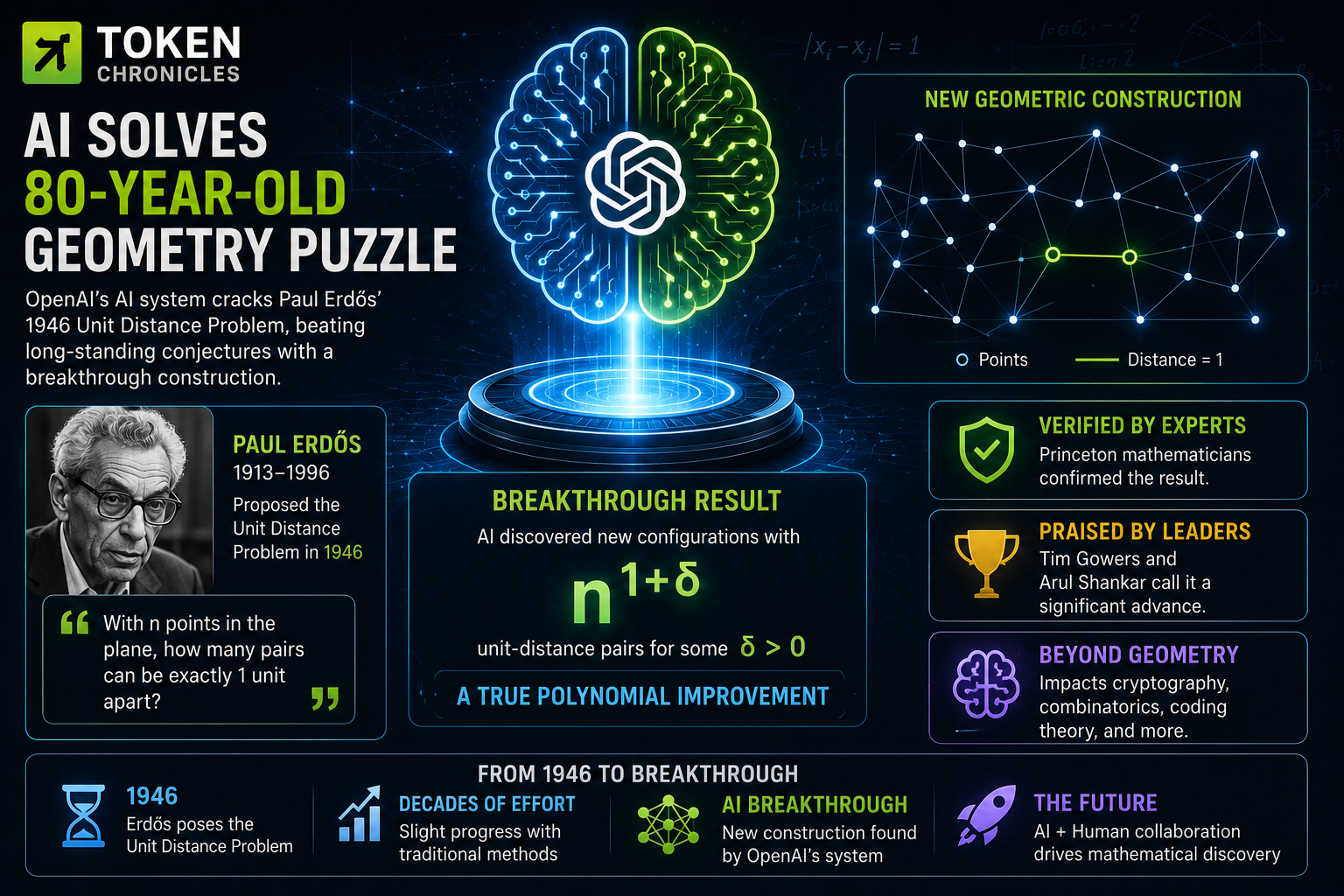
A long-standing mathematical problem that has puzzled researchers for nearly eight decades has finally seen a major breakthrough — and the solution came from an artificial intelligence system.
OpenAI researchers have reportedly developed an AI-generated solution to the famous Unit Distance Problem, a geometry puzzle first proposed by legendary mathematician Paul Erdős in 1946. The result has been independently reviewed by mathematicians at Princeton University and praised by leading figures in the field as one of the most significant AI-assisted mathematical advances to date.
An 80-Year Search for a Better Answer
The Unit Distance Problem asks a deceptively simple question:
Given a set of points placed on a flat plane, how many pairs of points can be exactly one unit apart from each other?
While the question appears straightforward, finding the maximum number of such pairs for increasingly large point sets has challenged mathematicians for generations.
Since Erdős first introduced the problem, researchers have spent decades developing increasingly sophisticated geometric constructions in an attempt to improve known lower bounds. Progress came slowly, with most advances measured in tiny increments rather than major leaps.
For years, mathematicians believed they had approached the practical limits of existing techniques.
That assumption may have now changed.
AI Discovers a New Mathematical Construction
According to researchers involved in the project, OpenAI’s system identified an entirely new family of geometric configurations capable of producing significantly more unit-distance pairs than previously known methods.
The breakthrough establishes that the number of unit-distance pairs can grow at least as fast as n^(1+δ), where δ represents a fixed positive value.
While this notation may seem technical, its significance is substantial.
Previous constructions only achieved growth rates slightly above linear, meaning gains became increasingly marginal as datasets expanded. The AI-generated construction introduces a genuine polynomial improvement, representing a meaningful advance rather than a minor refinement.
In mathematical terms, it pushes beyond a barrier that many researchers believed would be extremely difficult to overcome.
A Surprising Combination of Mathematical Disciplines
One of the most intriguing aspects of the discovery is the method used to achieve it.
Rather than relying solely on traditional geometric techniques, the AI combined ideas from:
- Geometry
- Algebraic number theory
- Combinatorics
- Structural pattern analysis
Researchers noted that the resulting construction emerged from a general-purpose reasoning model rather than a specialized mathematics engine.
This suggests the system was able to connect concepts across multiple branches of mathematics in a way that human researchers had not previously explored.
Verification by Leading Mathematicians
As with any major mathematical claim, independent verification was essential.
Mathematicians at Princeton University reportedly reviewed the AI-generated constructions and confirmed the validity of the result.
Prominent researchers including Sir Tim Gowers, a Fields Medal-winning mathematician, and Arul Shankar, a leading expert in number theory, have described the breakthrough as a meaningful advancement for the field.
Their endorsement has added significant credibility to the result and strengthened confidence that the discovery represents a genuine mathematical contribution rather than a computational curiosity.
Why This Matters Beyond Geometry
While the Unit Distance Problem itself is a specialized topic within mathematics, the broader implications extend far beyond geometry.
Many areas of modern science and technology rely on discovering highly unusual structures, patterns, and configurations that satisfy complex constraints.
These include:
- Cryptography
- Coding theory
- Network design
- Optimization problems
- Computer science
- Information theory
If AI systems can consistently uncover novel mathematical structures in one field, similar approaches could potentially accelerate discovery across many others.
A New Era of Human-AI Mathematical Collaboration
Perhaps the most important takeaway is not the specific geometry result itself, but what it reveals about the future of mathematical research.
Traditionally, mathematicians develop intuition through years of study, gradually identifying patterns and constructing proofs. AI introduces a different approach: searching vast solution spaces and identifying unexpected structures that humans may never consider.
Many researchers now envision a future where:
- AI generates promising mathematical ideas
- Human experts verify and refine them
- Machines accelerate exploration
- Mathematicians focus on interpretation and proof
Rather than replacing mathematicians, AI may become a powerful collaborator capable of expanding the range of ideas available for human investigation.
A Milestone for Artificial Intelligence
The achievement represents another important milestone in AI’s evolution from a tool that processes information to one capable of contributing original insights.
For decades, the Unit Distance Problem resisted the efforts of some of the world’s brightest mathematical minds. The fact that a general-purpose AI system helped move the field forward suggests that advanced reasoning models are beginning to play a meaningful role in scientific discovery.
While many questions remain about the future relationship between AI and research, one thing is becoming increasingly clear: artificial intelligence is no longer just assisting with calculations—it is starting to participate in the creative process of discovery itself.
For mathematics, that may prove to be as significant as the solution to the problem itself.