

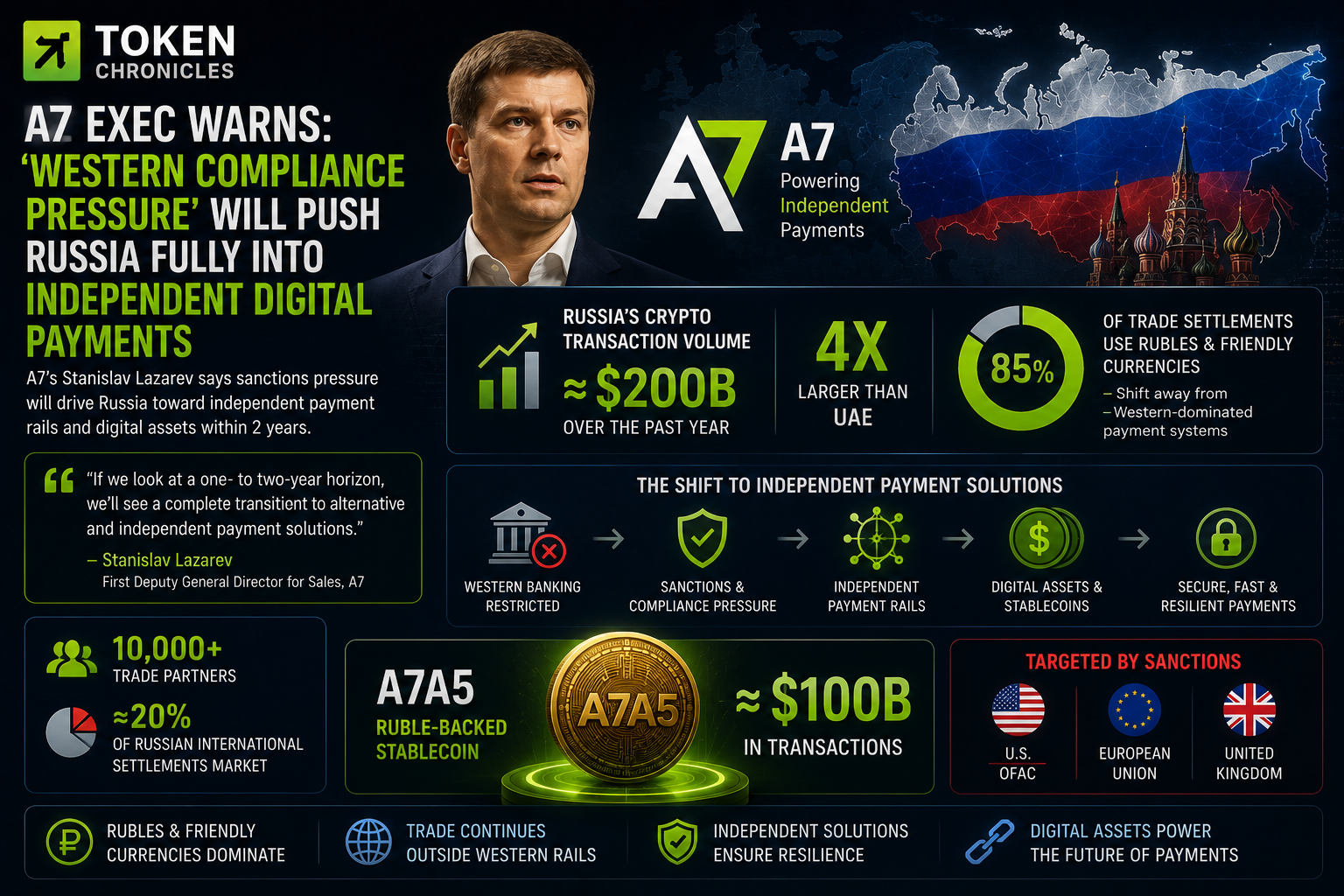
Russia’s cross-border payments landscape is undergoing one of the most significant transformations in its modern economic history, according to A7 executive Stanislav Lazarev, who believes growing sanctions pressure from Western nations will push businesses toward alternative payment infrastructure and digital asset-based settlement systems.
Lazarev, First Deputy General Director for Sales at A7, argues that traditional international payment channels have become increasingly difficult for Russian companies to access due to expanding sanctions, compliance requirements, and the growing threat of secondary sanctions imposed by the United States and European Union.
As a result, Russia’s trade ecosystem is steadily adapting by developing independent payment rails designed to operate outside conventional Western-controlled financial networks.
Russia’s Trade Settlement Structure Is Rapidly Changing
According to Lazarev, the composition of Russia’s international trade settlements has shifted dramatically in recent years.
Historically, global trade transactions were largely dominated by the U.S. dollar and the euro. However, sanctions imposed following geopolitical conflicts have significantly reduced Russia’s access to these traditional settlement channels.
Today, more than half of Russia’s import transactions are reportedly settled in Russian rubles. When combined with currencies from what Russia describes as “friendly countries,” these alternative settlement methods now account for approximately 85% of cross-border trade activity.
This shift reflects a broader trend toward financial de-dollarization and reduced reliance on Western banking infrastructure.
Rather than depending on traditional correspondent banking networks, Russian businesses are increasingly exploring regional currencies, bilateral payment arrangements, and digital settlement systems.
The Rise of Alternative Payment Rails
Lazarev believes this transition is only beginning.
Over the next one to two years, he expects businesses engaged in international trade to move further toward independent payment mechanisms that can operate with less exposure to Western financial oversight.
These alternatives could include:
- Digital assets and stablecoins
- Blockchain-based settlement systems
- Digital payment networks
- Electronic trade finance platforms
- Tokenized financial instruments
- Alternative clearing and settlement arrangements
The primary objective is to reduce vulnerability to sanctions-related disruptions and ensure uninterrupted cross-border commerce.
According to Lazarev, businesses increasingly view independent payment infrastructure not as a temporary workaround but as a long-term necessity.
Stablecoins and Digital Assets Gain Strategic Importance
One of the most notable aspects of this transition is the growing role of digital assets.
Stablecoins, in particular, are emerging as potential tools for facilitating international settlements because they can move value quickly across borders without relying on traditional banking intermediaries.
For companies operating in jurisdictions facing financial restrictions, blockchain-based payment systems offer several advantages:
- Faster settlement times
- Lower transaction costs
- Reduced dependence on correspondent banks
- Greater flexibility in international transactions
- Access to alternative liquidity channels
As global regulators continue debating how digital assets should be governed, some market participants are increasingly viewing blockchain technology as an alternative layer for international commerce.
A7’s Growing Role in Russian Trade Payments
Founded in 2024, A7 has rapidly expanded its presence within Russia’s cross-border settlement ecosystem.
The company reportedly works with more than 10,000 trade partners and is estimated to facilitate nearly 20% of Russia’s international settlement activity.
This places A7 among the most significant alternative payment providers operating within the country.
Its growth reflects increasing demand from businesses seeking payment solutions that can function despite ongoing restrictions on traditional financial channels.
The Controversial Rise of the A7A5 Stablecoin
One of A7’s most discussed initiatives is A7A5, a ruble-backed stablecoin issued on behalf of the company.
According to reports, the token has facilitated close to $100 billion in transaction volume involving entities operating under sanctions-related constraints.
The scale of this activity has drawn attention from regulators and governments worldwide.
As a result, A7A5 has become a target of sanctions from multiple jurisdictions, including:
- The U.S. Office of Foreign Assets Control (OFAC)
- The European Union
- The United Kingdom
In some cases, exchanges that supported trading activity involving the token have also faced regulatory scrutiny and enforcement actions.
A Broader Shift in Global Finance
The developments highlighted by A7 reflect a larger transformation occurring within global financial markets.
As geopolitical tensions reshape international trade relationships, countries and businesses are increasingly exploring alternatives to traditional payment systems.
While the U.S. dollar remains the dominant global reserve currency, growing interest in digital assets, central bank digital currencies (CBDCs), stablecoins, and regional payment networks suggests the future settlement landscape may become more fragmented and multipolar.
Supporters argue that these innovations can increase resilience and reduce dependence on any single financial system. Critics, however, warn that alternative payment networks could complicate sanctions enforcement, regulatory oversight, and anti-money-laundering efforts.
What Comes Next
Lazarev’s forecast suggests that the next two years could be a pivotal period for the evolution of cross-border payments.
If sanctions pressure remains elevated, businesses may continue accelerating their adoption of independent settlement infrastructure and blockchain-based payment solutions.
Whether these systems remain niche alternatives or evolve into significant components of global trade finance will depend on regulation, technological development, geopolitical dynamics, and market adoption.
For now, one thing appears increasingly clear: the search for alternative cross-border payment rails is no longer a theoretical discussion—it is becoming a central feature of international commerce in an increasingly fragmented financial world.