
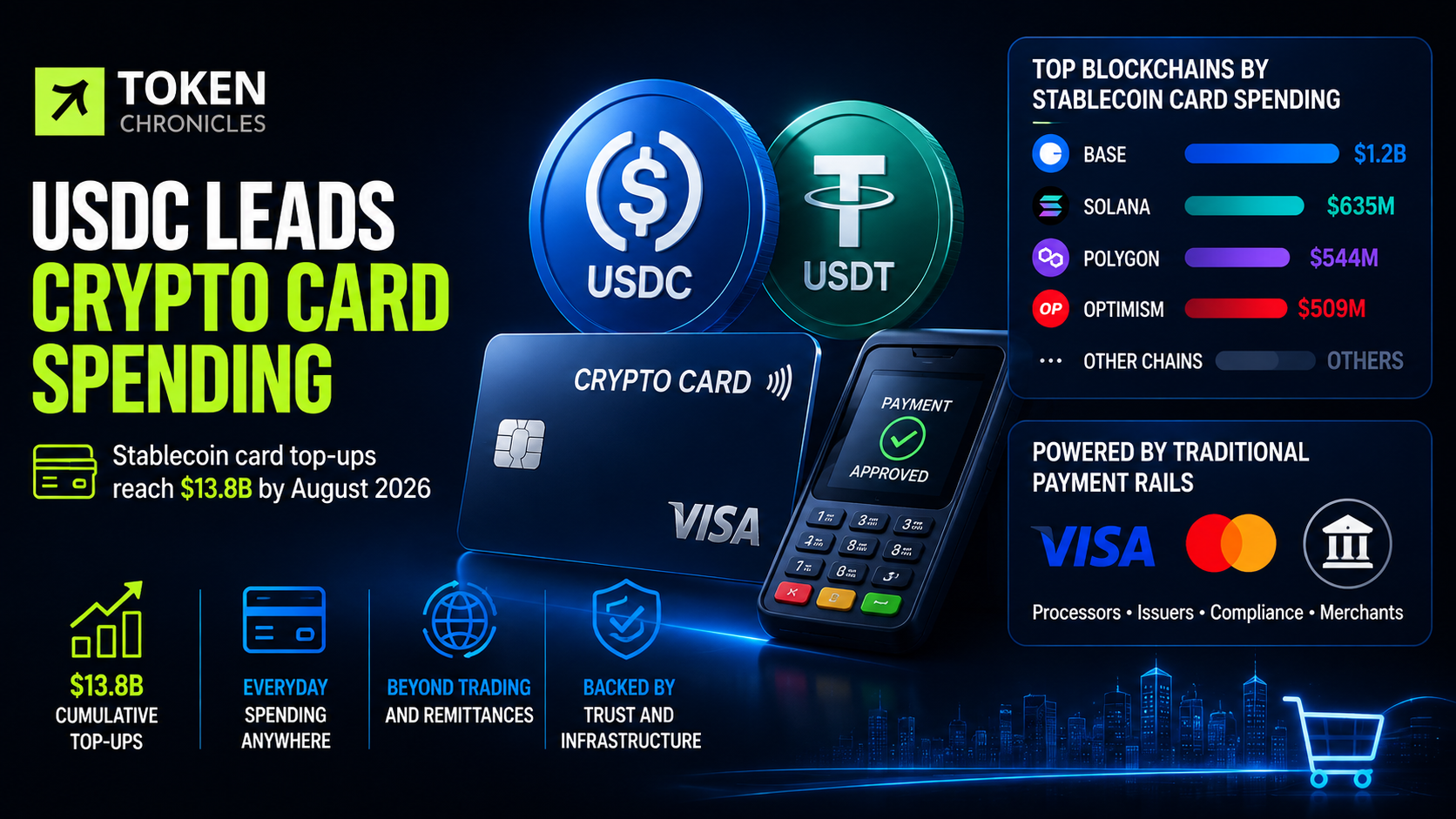
Stablecoin-powered payment cards are gaining traction as a bridge between crypto balances and everyday commerce. Cumulative top-ups on crypto cards reached approximately $13.8 billion by August 2026, with USDC leading tracked spending and USDT rapidly expanding its role. The trend suggests stablecoins are increasingly moving beyond trading and remittances into consumer payments.
Crypto Cards Turn Stablecoins Into Spendable Money
Stablecoins are gradually evolving from tools primarily used for trading, settlement and international transfers into payment balances that consumers can use for ordinary purchases.
Research from CryptoRank indicates that cumulative stablecoin card top-ups reached about $13.8 billion by August 2026, representing an increase of nearly $10 billion over the previous year. Growth has continued even through periods when the broader cryptocurrency market experienced weaker activity.
Crypto cards provide the connection between blockchain-based balances and conventional commerce. A user can hold USDC or USDT in a crypto account, load those funds onto a payment card and spend them at merchants that may never directly interact with the underlying blockchain.
This creates an important distinction between holding stablecoins and actually using them as money. Rather than remaining inside exchanges or decentralized finance applications, stablecoins can increasingly become part of everyday household spending.
USDC Takes the Lead While USDT Expands
USDC currently accounts for the largest share of tracked crypto-card spending, while USDT continues to gain ground.
The difference reflects the distinct ecosystems surrounding the two major dollar-pegged assets. USDC has benefited from expanding relationships with fintech companies, payment providers and blockchain applications. USDT, meanwhile, has an enormous presence across cryptocurrency exchanges, international transfers and emerging markets.
Crypto cards provide a potential bridge between these ecosystems and traditional retail commerce.
The underlying blockchain infrastructure is also becoming increasingly diverse. According to the reported data, Base generated roughly $1.2 billion in stablecoin card spending, followed by:
- Solana: approximately $635 million
- Polygon: approximately $544 million
- Optimism: approximately $509 million
Other networks, including Arbitrum, Scroll, Ethereum and Stellar, also contribute to the growing payment ecosystem.
For consumers, the underlying blockchain may eventually become largely invisible. The more important factors are whether transactions settle efficiently, whether fees remain low and whether users can convert or spend their balances without unnecessary foreign-exchange costs.
This could create opportunities for other stablecoin currencies as well. Euro-denominated assets, for example, could become increasingly relevant for consumers who want to avoid repeatedly converting dollar-based digital assets when making purchases in European markets.
Blockchain Funding Still Relies on Traditional Payment Networks
Despite using cryptocurrency as the funding source, most crypto cards do not completely replace conventional payment infrastructure.
Transactions generally continue to depend on card networks, regulated issuers, payment processors, compliance systems and merchant acceptance infrastructure. In many cases, the blockchain element operates behind the scenes while the merchant receives a familiar card payment.
That means much of the innovation is occurring before the transaction reaches the checkout.
Competition among crypto-card providers is therefore shifting toward areas such as:
- Lower foreign-exchange costs
- Faster settlement
- Stablecoin conversion
- Cashback and rewards
- Custody
- Credit facilities
- Integration with crypto wallets and exchanges
- Support for multiple blockchain networks
Some products are also experimenting with credit models in which users can borrow against digital assets instead of selling them. That potentially turns a crypto card from a simple spending product into a combination of payments, liquidity and credit infrastructure.
The Real Test Is Sustainable Spending
The next stage of the market may be less about how many cards are issued and more about whether people continue using them once promotional incentives decline.
Crypto-card companies have often relied on cashback and other rewards to attract users. Those incentives can drive rapid adoption, but they do not necessarily demonstrate that consumers genuinely prefer stablecoin payments.
A more meaningful test will be whether transaction volumes remain strong when rewards become less aggressive.
If stablecoin-funded purchases continue expanding without heavy subsidies, it would signal a deeper shift: stablecoins may be developing into practical consumer payment balances rather than remaining primarily instruments for crypto trading and settlement.
The underlying model is relatively simple. Users hold digital dollars, payment providers connect those balances to established card networks, and merchants continue receiving familiar forms of payment.
The consumer may never need to know which blockchain processed the transaction.
That could ultimately be the strongest sign of stablecoin adoption—not replacing the existing payments system overnight, but quietly becoming the financial layer underneath it.