

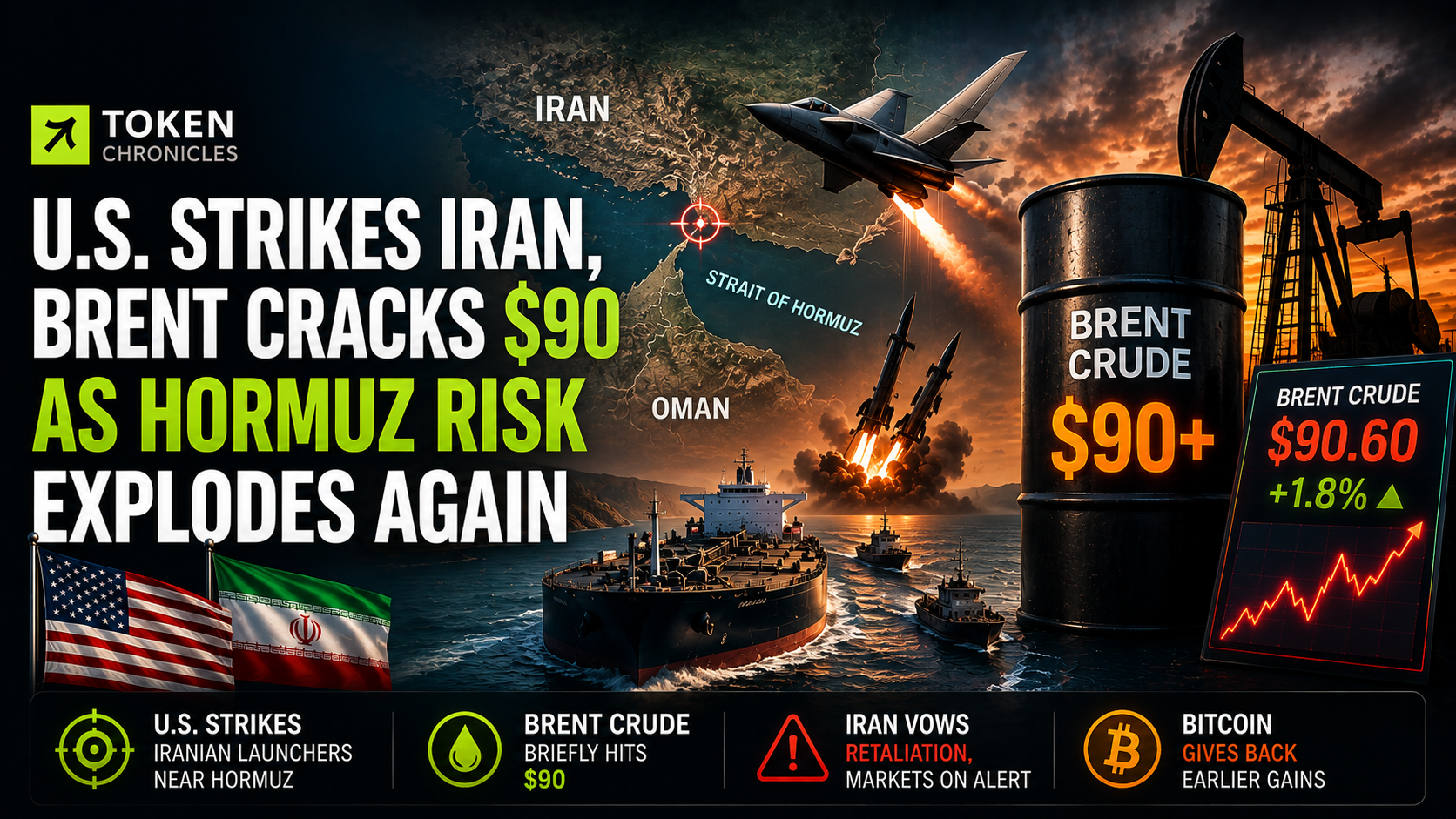
U.S. forces carried out strikes against Iranian rocket launchers near the Strait of Hormuz on Aug. 30 after detecting what Washington described as preparations for another attempt to deploy sea mines. The renewed confrontation ended an approximately monthlong pause in direct U.S.-Iran attacks, sending fresh concerns through global energy markets and briefly pushing Brent crude above $90 a barrel.
- U.S. Central Command said it struck Iranian launchers after detecting preparations to mine the Strait of Hormuz.
- Brent crude briefly moved above $90 as traders reassessed Gulf supply risks.
- Iran threatened retaliation, raising concerns about further attacks and disruption around the strategic waterway.
- Bitcoin gave up earlier gains as broader risk sentiment weakened following reports of the strikes.
U.S. Targets Iranian Launchers Near the Strait
The latest escalation began Sunday when U.S. Central Command said American forces had targeted Iranian launchers that were allegedly being prepared to deploy rockets equipped with sea mines.
According to CENTCOM spokesman Tim Hawkins, U.S. forces monitored the preparations before carrying out the strikes.
Washington described the operation as a preemptive action, arguing that another mining attempt could pose an immediate danger to commercial vessels traveling through the Strait of Hormuz.
The development came shortly after U.S. forces had completed efforts to clear Iranian mines from internationally recognized shipping routes, according to the supplied report.
Iran presented a sharply different account of the incident. An Islamic Revolutionary Guard Corps spokesman described the U.S. action as a serious mistake and warned that Tehran would respond.
Iranian media reported casualties and injuries, while semi-official reports described explosions near Larak Island.
Hormuz Again Becomes the Center of the Conflict
The strategic importance of the Strait of Hormuz makes even a limited military confrontation potentially significant for the global economy.
The narrow waterway connects the Persian Gulf with the Gulf of Oman and the Arabian Sea, making it a crucial route for international energy shipments.
The latest strikes come after months of intermittent conflict that began with U.S.-Israeli attacks on Iran on Feb. 28. A subsequent agreement announced in June was intended to reduce hostilities and facilitate the reopening of the strait while negotiations continued, but the arrangement broke down in July.
Since then, Washington has continued applying military and economic pressure on Tehran, while Iran has maintained its position around Hormuz as an important source of leverage.
The renewed confrontation now raises questions over whether the latest strike will remain an isolated incident or trigger another cycle of escalation.
Brent Crude Briefly Breaks Above $90
Oil markets reacted quickly to the renewed tensions.
Brent crude futures, which had ended Friday near $88.10, climbed into the $89.71-$90.60 range during Sunday trading, representing a gain of roughly 1.7% to 2%. Prices briefly crossed the psychologically important $90-per-barrel threshold.
West Texas Intermediate crude also advanced toward the mid-$84 range.
The reaction reflects concerns that further military activity could disrupt shipping through Hormuz. The number of vessels passing through the waterway has already fallen significantly on some days, according to the supplied report.
For energy traders, the primary concern is whether the latest confrontation could lead to renewed mining activity, attacks on commercial shipping, or a broader military escalation.
Broader Markets Show Limited Immediate Panic
Despite the sharp move in oil, U.S. equity futures showed relatively modest declines.
Dow futures were down approximately 0.1%, while S&P 500 futures slipped between roughly 0.1% and 0.17%. Nasdaq-100 futures remained close to flat, with a slight negative bias.
The restrained response suggested that investors were initially treating the strike as a contained geopolitical event rather than assuming an immediate return to the more intense bombing campaign seen earlier in the year.
That assessment could change quickly if Iran responds by targeting U.S. assets or attempting to disrupt shipping through Hormuz.
Bitcoin Gives Back Earlier Gains
Bitcoin also reacted to the sudden increase in geopolitical risk.
The cryptocurrency had posted gains earlier Sunday but subsequently declined approximately 0.6% within an hour of reports emerging about the U.S. strikes. By around 8 p.m. EDT, Bitcoin was trading in the low-$77,000 range.
The move illustrates how quickly geopolitical developments can affect cryptocurrency markets. When uncertainty rises, traders can reduce exposure to riskier assets, including digital currencies, alongside equities and other speculative investments.
Bitcoin’s response was relatively modest compared with the potential consequences of a prolonged disruption to global energy markets, but it highlighted the cryptocurrency’s continued sensitivity to major geopolitical developments.
Iran’s Response Could Determine What Comes Next
Attention now turns toward Tehran.
A limited Iranian response could allow the latest confrontation to remain contained. However, attempts to mine the Strait of Hormuz, attacks against U.S. military facilities, or strikes on commercial shipping could dramatically increase the risk of a wider conflict.
Financial markets will also be watching Washington’s next move. If Sunday’s operation is treated as a one-time effort to prevent an immediate threat, the impact could remain relatively limited. If additional strikes follow, investors could begin pricing in a much longer period of disruption.
Energy and Crypto Markets Remain on Alert
The return of Brent crude toward $90 demonstrates how quickly geopolitical developments around Hormuz can influence global commodity markets.
For cryptocurrency investors, Bitcoin’s reversal from earlier gains provides another indication that digital assets remain closely connected to broader risk sentiment during periods of geopolitical uncertainty.
The critical question now is whether Sunday’s strike represents an isolated military intervention or the beginning of another sustained escalation between Washington and Tehran.
Until Iran’s response becomes clearer, the Strait of Hormuz remains a major geopolitical risk for energy markets, financial assets, and the global economy.