

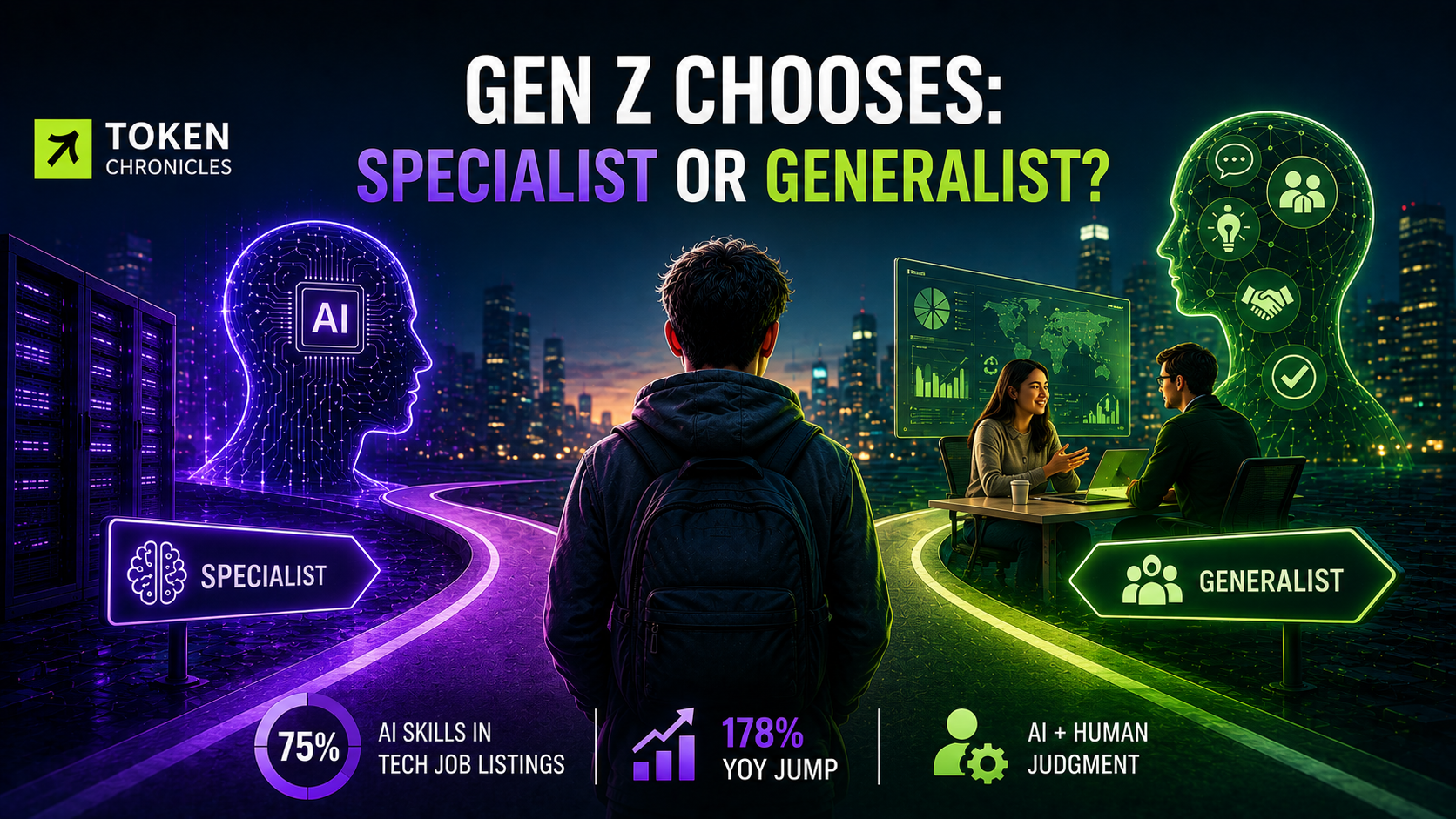
Artificial intelligence is rapidly changing what employers expect from technology workers. In June, 75% of tech job postings reportedly required explicit AI skills, up from 67% in March and 178% higher than a year earlier. The shift is putting younger workers under pressure to decide whether to pursue deep specialization in areas such as agentic AI and responsible AI or develop a broader skill set that combines technical expertise with communication and human judgment.
- AI skills appeared in 75% of tech job postings in June.
- Demand was up from 67% in March and 178% year over year.
- Economist Ed Yardeni believes AI could encourage companies to favor highly specialized talent.
- MIT economist Simon Johnson argues that combining technical skills with human judgment could provide a more durable career advantage.
AI Is Raising the Bar for Gen Z Workers
Gen Z is entering the technology workforce during a period of significant change.
Companies are increasingly integrating AI into software development, customer service, data analysis, IT operations, and other business functions. At the same time, many employers remain cautious about expanding their headcount.
That combination is particularly challenging for people seeking their first professional roles.
Recent hiring data cited in the source material shows just how quickly expectations are changing. In June, three-quarters of technology job listings explicitly sought AI-related skills, compared with 67% in March. The figure was also reported to be 178% higher than the previous year.
For young professionals, simply having a general technology background may no longer be enough. Employers increasingly want candidates who can demonstrate that they understand how to use, evaluate, deploy, or manage AI systems.
The Argument for Becoming a Specialist
One potential response is deep specialization.
Areas such as agentic AI, responsible AI, model evaluation, security, data infrastructure, and AI-related IT systems are becoming increasingly important as businesses move from experimenting with AI to deploying it at scale.
The technical infrastructure behind AI can be particularly valuable because successful implementation requires much more than simply accessing a powerful model. Organizations also need reliable data, security controls, computing resources, governance systems, and mechanisms for monitoring costs and performance.
Economist Ed Yardeni has argued that AI could encourage businesses to place greater emphasis on specialized expertise.
The reasoning is straightforward: if AI allows relatively small teams to accomplish work that previously required much larger departments, companies may become more selective about the people they hire.
That creates an unusual labor-market dynamic. Demand for specialized skills can increase even while overall hiring remains relatively restrained.
The Case for the “Geek Polyvalent”
Specialization is not the only strategy.
Another approach is to become what has been described as a “geek polyvalent”—someone with sufficient technical knowledge to work with AI tools while also possessing strong communication, analytical, and interpersonal abilities.
MIT professor and Nobel Prize-winning economist Simon Johnson has emphasized the potential value of workers who can move between technical systems and human problems.
Such employees might learn a new AI tool quickly, interact directly with customers, analyze information that is not neatly digitized, and turn different sources of information into practical decisions.
The advantage is not simply knowing how to operate the latest AI model. It is understanding when AI should be used, when its output needs verification, and when human judgment remains more valuable.
Technical Skills Plus Human Judgment
The growing demand for AI expertise does not necessarily mean traditional professional skills have become obsolete.
Instead, the labor market may increasingly reward workers who combine technical capabilities with skills that AI systems cannot easily replace end-to-end.
Writing, communication, customer understanding, critical thinking, problem-solving, and the ability to explain complex technical decisions to nontechnical colleagues can become valuable complements to AI expertise.
A worker who can build an AI system but cannot explain its limitations may struggle to lead its adoption. Conversely, someone who understands business problems but lacks enough technical knowledge to work effectively with AI may find it difficult to compete with increasingly capable teams.
Finding the Right Balance Between Depth and Breadth
For young professionals entering the technology sector, the choice does not necessarily have to be specialist versus generalist.
A more practical strategy may be to establish a strong technical specialty while deliberately developing complementary skills.
For example, someone could specialize in LLM infrastructure, privacy engineering, cybersecurity, or model evaluation, while also developing capabilities in writing, communication, customer research, and business analysis.
This creates a professional profile with both depth and flexibility.
The specialist provides expertise that employers need today, while broader skills make it easier to adapt when technologies, tools, and business requirements change.
AI May Reward Adaptability as Much as Expertise
The rapid evolution of AI means that today’s most valuable technical skill may not remain at the top of the hiring list indefinitely.
Tools and frameworks can change quickly, making the ability to learn and adapt increasingly important.
For Gen Z workers, the strongest strategy may therefore be to build deep expertise in one area while maintaining enough breadth to move across disciplines.
AI is raising the technical bar for entry-level technology jobs, but it is also creating demand for people who can connect technology with real-world decisions.
The emerging advantage may belong neither to pure specialists nor broad generalists, but to adaptable professionals who combine AI expertise with human judgment, communication, and the ability to keep learning as the technology evolves.