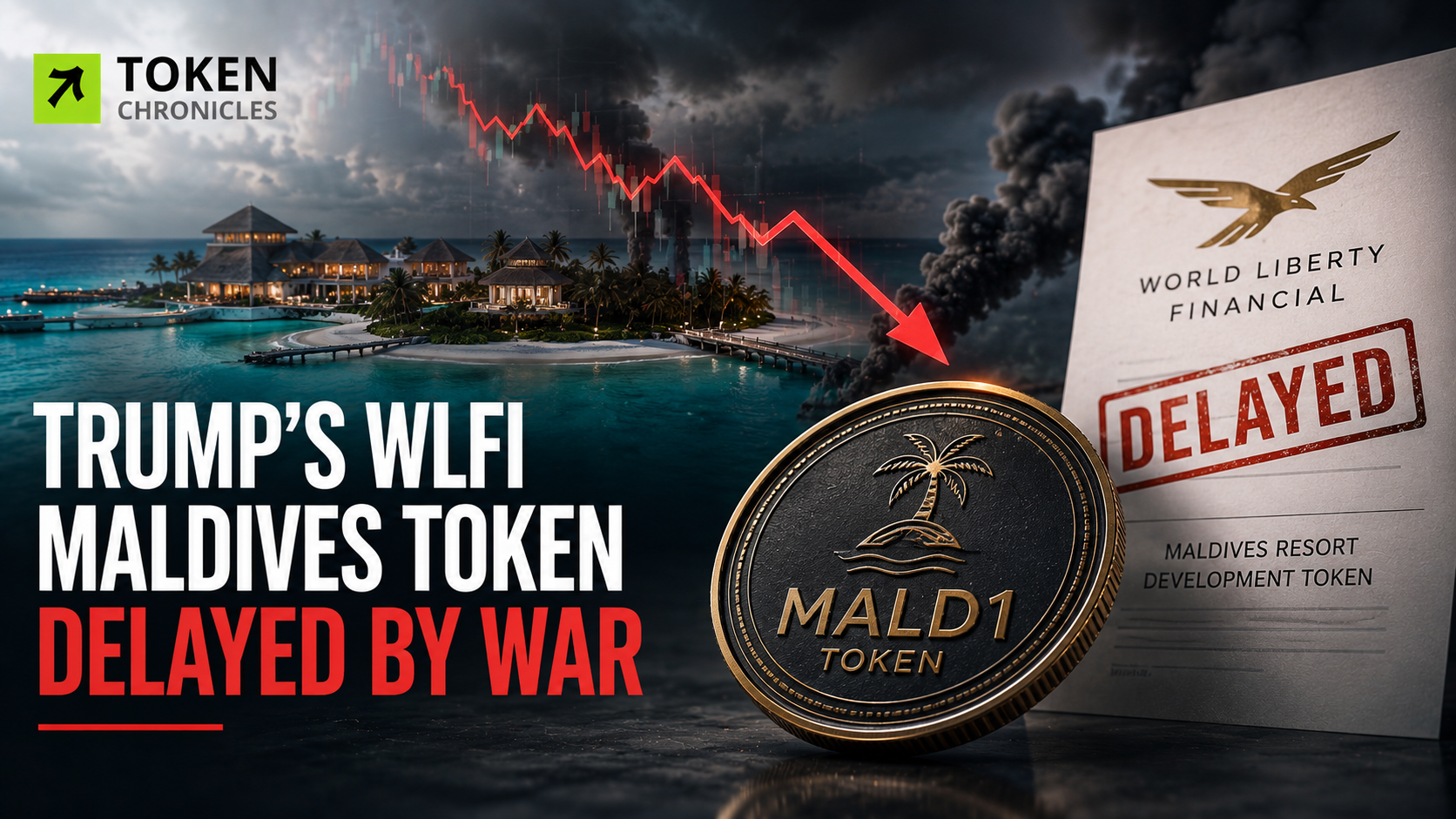
World Liberty Financial’s ambitious plan to tokenize revenue linked to a Trump-branded luxury resort in the Maldives has been pushed into indefinite limbo after conflict in the Middle East disrupted air travel and tourism across the region.
The project, announced in February 2026 in partnership with Securitize and London-listed developer Dar Global, was intended to become one of the most prominent experiments in real-world asset tokenization.
Six months later, however, MALD1 has not launched, no tokens have been sold, and there is no confirmed new launch date.
The delay highlights a fundamental challenge for the growing real-world asset market: blockchain can tokenize financial claims, but it cannot remove the physical, geopolitical and economic risks attached to the assets those tokens represent.
A token tied to a resort that has not yet opened
World Liberty Financial, Securitize and Dar Global announced the Maldives project on Feb. 19, 2026.
The proposed MALD1 token was designed to provide investors with exposure to loan-servicing revenue generated from construction financing for the Trump International Hotel and Resort, Maldives.
Rather than giving investors direct ownership of the resort, the structure would provide exposure to revenue associated with the loans financing its development.
Dar Global, a subsidiary of Saudi Arabia-based Dar Al Arkan Real Estate Development Company, is developing the project on a private island approximately 25 minutes by speedboat from Malé.
Plans call for roughly 100 luxury beach and overwater villas, with completion targeted for 2030.
The Trump Organization is licensing its brand and hospitality standards for the development, which would represent the Trump brand’s first property in the Maldives.
Securitize would provide the tokenization and compliance infrastructure, while World Liberty Financial would participate in the blockchain side of the offering.
The securities were planned to be offered under Regulation D Rule 506(c) for accredited U.S. investors and Regulation S for eligible non-U.S. investors.
MALD1 holders were expected to receive a fixed yield, a portion of ongoing loan proceeds and potential proceeds from the eventual sale of the underlying loan positions.
The structure was designed to avoid giving investors direct ownership of physical real estate, reducing some of the legal complications associated with tokenized property ownership across jurisdictions.
The original plan was to begin selling the tokens in spring 2026.
That deadline passed without a launch.
A regional conflict changed the economics
The delay illustrates why tokenizing an asset does not eliminate the risks associated with that asset.
The conflict involving the United States, Israel and Iran disrupted air travel across the region and created significant uncertainty for the Maldives tourism industry.
The Maldives relies heavily on international visitors, making aviation connectivity critical to the country’s economy.
Tourist arrivals reportedly declined sharply during the early stages of the disruption, while airlines altered or suspended routes through affected areas.
For a luxury resort still under construction, those disruptions create several interconnected problems.
Construction depends on the movement of workers, equipment and materials.
Financing depends on credible construction schedules.
Future loan economics depend on assumptions about resort occupancy, room rates and tourism demand.
And the value of a token linked to loan-servicing revenue ultimately depends on the performance of those underlying cash flows.
When tourism forecasts become uncertain, pricing a fixed-income-style token becomes significantly more difficult.
A Bloomberg report on Aug. 13 said the MALD1 launch had been indefinitely postponed because of the war-related disruption.
Dar Global CEO Ziad El Chaar reportedly indicated that project schedules were being reviewed but did not provide a new launch date.
That absence of a timeline is significant.
It suggests the partners are not yet confident enough in the operating environment to establish a credible timetable for the offering.
WLFI’s broader record adds another layer of scrutiny
The Maldives delay comes as World Liberty Financial faces broader questions about its business and token ecosystem.
WLFI launched its governance token sale in October 2024 with an initial target of $300 million.
Early demand was reportedly weak, prompting the project to reduce its initial fundraising target.
Interest subsequently increased, particularly as the Trump family became increasingly associated with the venture.
A second token tranche eventually helped push total fundraising to approximately $550 million, with participation from more than 85,000 investors.
The Trump family’s financial involvement is substantial.
Public disclosures indicate that the family receives a significant share of net proceeds from WLFI token sales, while Donald Trump is identified as a co-founder emeritus.
The governance token, however, has experienced significant volatility.
WLFI reached approximately $0.331 in September 2025 before falling substantially during the following months.
By late July 2026, the token was trading near $0.055, representing a decline of roughly 83% from its peak.
The project has also faced governance disputes.
Tron founder Justin Sun, one of WLFI’s major investors, filed a lawsuit alleging that the project froze hundreds of millions of his unlocked and locked tokens and restricted his governance participation.
WLFI subsequently countersued, disputing Sun’s allegations and accusing him of activities intended to pressure the token’s price.
The legal dispute remains unresolved.
USD1 has been a different story
WLFI’s USD1 stablecoin has delivered a stronger performance by supply metrics.
The token reportedly reached approximately $5.3 billion in circulation by mid-2026.
USD1 has also gained utility through its integration into Binance’s perpetual futures markets and its use in connection with Abu Dhabi-based investment firm MGX’s multibillion-dollar investment in Binance.
However, the stablecoin’s distribution remains highly concentrated.
Approximately 87% of USD1’s circulating supply is reportedly held by Binance.
That concentration creates its own risk because a substantial portion of the stablecoin’s market activity depends on a single major exchange relationship.
The contrasting trajectories of USD1 and the Maldives project illustrate an important point about WLFI’s business.
A digital asset can scale rapidly when its underlying infrastructure is primarily financial and digital.
A token connected to a physical development faces an entirely different set of constraints.
The real problem with tokenizing the real world
The Maldives project exposes a fundamental weakness in the current RWA narrative.
Tokenization can make ownership, settlement and compliance more efficient.
It cannot make a physical asset immune to reality.
Tokenized U.S. Treasury products, for example, are backed by assets held within mature financial and custodial infrastructure.
Their performance does not depend on whether tourists can reach a particular island.
Real estate is different.
A resort is physically fixed to one location.
It depends on construction.
It depends on local infrastructure.
It depends on transportation.
It depends on tourism demand.
And it remains exposed to political, environmental and geopolitical events.
The Maldives adds several additional risks, including extreme weather, climate-related concerns and dependence on international aviation.
The war-related disruption demonstrates how quickly those risks can move from theoretical assumptions into actual financial variables.
MALD1 adds several layers between investors and the resort
The structure of MALD1 makes the relationship with the physical asset even more indirect.
Investors would not own the resort itself.
They would hold a token representing an interest in loan-servicing revenue associated with financing the resort.
The economic chain therefore looks something like:
Token → loan-servicing revenue → construction financing → resort development → hotel operations → tourism demand.
Every stage introduces another potential point of failure.
A construction delay could affect financing.
Financing problems could affect loan payments.
Lower-than-expected occupancy could weaken the project’s economics.
A prolonged geopolitical disruption could reduce tourism demand.
And financial problems at any point in the chain could ultimately affect token holders.
That is the central lesson of the Maldives project.
Blockchain infrastructure can improve the wrapper around an asset. It cannot eliminate the risks inside the asset.
Tokenization still has structural challenges
The RWA sector has made substantial progress, but tokenized real estate has historically faced several obstacles.
Among the most persistent are:
- Legal uncertainty: Token ownership does not automatically equal legal ownership of the underlying property.
- Limited investor pools: Many offerings are restricted to accredited or qualified investors.
- Weak secondary markets: Creating a token does not guarantee sufficient liquidity for investors to exit.
- Operational complexity: Property management, financing, custody and compliance remain dependent on traditional institutions.
- Physical risk: Real estate remains vulnerable to weather, political instability, infrastructure failures and local economic conditions.
The MALD1 structure attempts to address several of these issues.
Securitize provides regulated tokenization and transfer infrastructure.
The loan-revenue model avoids some of the complexities surrounding direct tokenized property ownership.
But neither structure can hedge against a geopolitical event that disrupts the underlying tourism economy.
What the Maldives delay means for the RWA market
The most important takeaway is not that tokenization has failed.
It is that tokenization does not equal risk elimination.
The RWA industry often presents blockchain as a mechanism for making traditionally illiquid assets more accessible, transparent and transferable.
That can be true.
But investors still need to analyze the asset beneath the token.
A token backed by Treasury securities carries one set of risks.
A token tied to a private credit facility carries another.
A token connected to a resort under construction in a geopolitically exposed tourism market carries another entirely.
The distinction becomes particularly important as tokenization expands beyond financial assets and into infrastructure, real estate, private credit, commodities and other physical assets.
The Maldives project is therefore more than a delayed launch.
It is a real-world stress test for the RWA thesis.
The blockchain may be decentralized. The resort is not.
And when the physical world breaks, the token has to absorb the consequences.