

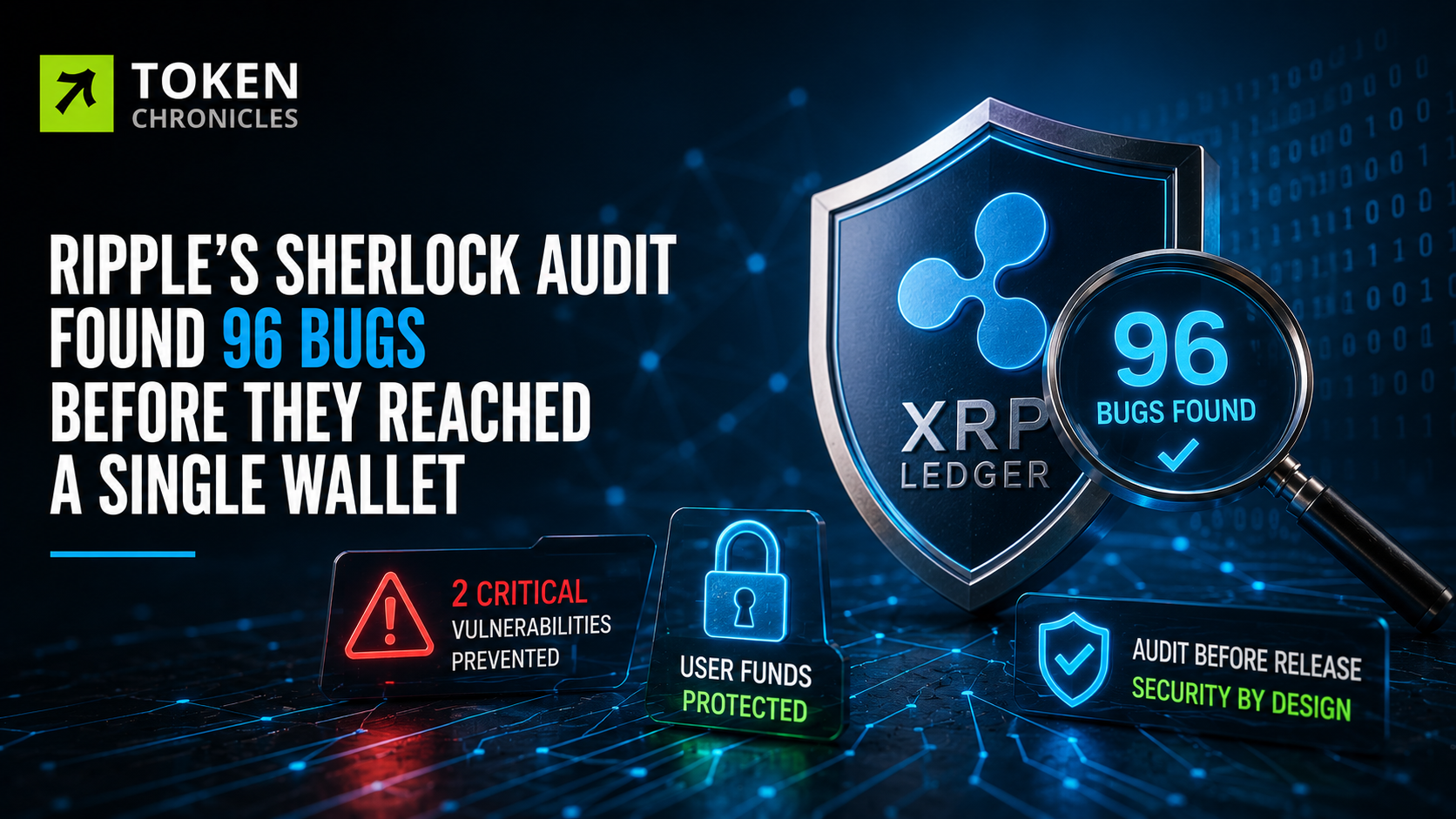
A $550,000 security contest uncovered two critical vulnerabilities in upcoming XRP Ledger features, including flaws that could potentially drain user accounts without exposing their private keys. The findings highlight a fundamental difference between Ripple’s pre-deployment security model and the broader crypto industry’s frequent reliance on patching vulnerabilities after they reach production.
XRP Ledger version 3.3.0 was released on August 6, 2026, introducing five proposed amendments alongside security fixes and legacy-code cleanup. Although the new features have not yet been activated, the release represents the end of an extensive security process involving internal testing, independent researchers, a Sherlock audit contest and additional reviews.
The process identified 96 valid security findings, including two critical, six high-severity, 29 medium-severity and 59 low-severity issues. Ripple ultimately distributed $309,000 in RLUSD to researchers.
The more important finding, however, is not simply the number of bugs discovered. It is that the most serious vulnerabilities were identified before the affected features could reach the live network.
That raises a broader question for blockchain infrastructure: Should protocol security be treated as a continuous pre-launch process rather than a response to exploits after deployment?
What the $550,000 Sherlock audit uncovered
The Sherlock contest focused on five major areas of upcoming XRP Ledger functionality:
- Batch Transactions
- Permission Delegation
- Multi-Purpose Token (MPT) DEX functionality
- Confidential Transfers for MPTs
- Sponsored Fees and Reserves
Sherlock launched the engagement on April 13, 2026, with a 550,000 RLUSD prize pool.
Over approximately two weeks, participating researchers examined the protocol-level code and submitted security reports. The resulting 96 valid findings were divided into four severity categories.
Two were classified as critical, six as high severity, 29 as medium and 59 as low.
The distribution illustrates why raw vulnerability counts can be misleading. Not every finding represents an exploitable attack. Lower-severity reports can involve edge cases, implementation weaknesses or code-quality issues that require additional investigation.
The critical and high-severity findings were different. These represented vulnerabilities that could have created meaningful security consequences if the affected functionality had reached production without remediation.
Ripple paid $309,000 to researchers whose findings qualified for rewards.
The engagement was also notable because Sherlock traditionally conducts security competitions across smart-contract ecosystems. Applying the model to C++ code underpinning a layer-1 blockchain introduced a substantially different auditing environment.
The five amendments also created several distinct attack surfaces at once. Each feature introduced different authorization mechanisms, transaction logic and cryptographic assumptions.
A Batch Transactions flaw could have bypassed account authorization
One of the most serious vulnerabilities involved the original implementation of Batch Transactions.
Batch Transactions are designed to allow multiple operations to execute atomically under a single outer transaction. The feature can simplify complex workflows by allowing several actions to succeed or fail together.
The problem was in the signature-validation logic surrounding those inner transactions.
In the original implementation, an early-exit condition could allow the outer transaction’s authorization checks to succeed without properly establishing that the submitting party controlled the accounts referenced by the individual operations.
That created a potentially dangerous scenario.
An attacker could construct a batch containing unauthorized operations, including payments directed at a victim’s account, without possessing the victim’s private keys.
Other operations, including AccountSet, TrustSet and AccountDelete, could also potentially have been affected by the authorization weakness.
The vulnerability was discovered before the feature became active.
Security researcher Pranamya Keskamat and Cantina’s autonomous AI auditing system Apex independently identified the problem on February 19, 2026, while the amendment was still undergoing validator voting.
RippleX responded quickly.
Version 3.1.1 was released on February 23 and prevented the affected Batch amendment and its associated fix from progressing toward activation.
Because the amendment had not reached the required validator threshold, no user funds were exposed through the vulnerability.
The replacement implementation, later included in version 3.3.0, removed the problematic early-exit behavior and introduced additional authorization checks. The revised system also requires signing validation to be performed independently against the appropriate inner transactions.
The episode illustrates the value of separating code deployment from feature activation.
The vulnerable code could exist in a software release without immediately becoming part of the live protocol.
Permission Delegation contained a different type of account-draining risk
The second critical vulnerability involved Permission Delegation and operated through XRP Ledger’s transaction-fee mechanics.
The XRP Ledger distinguishes between different classes of transaction failures. Certain tec-class failures can still result in a transaction fee being charged even though the intended operation does not succeed.
That behavior exists as an anti-spam mechanism. Properly signed transactions that fail because of business-logic conditions can still consume network resources and therefore incur fees.
The original Permission Delegation implementation created a problem around the order in which authorization and transaction validation occurred.
An attacker could potentially submit repeatedly invalid transactions associated with a delegated account before the appropriate signature verification occurred.
Because the transactions could specify unusually high fees, the attacker could theoretically cause the victim’s XRP balance to decline repeatedly without possessing the victim’s private key.
The attack therefore did not depend on stealing credentials.
Instead, it attempted to turn the protocol’s own fee mechanism against the account holder.
The fix changed the relevant error classification and reordered validation checks so that fees could not be deducted before the required signature verification succeeded.
Ripple also replaced the original implementation with a new PermissionDelegation version.
Importantly, the revised amendment carries a default “No” designation, meaning validators must explicitly approve it rather than automatically activating it.
That provides another layer of caution around functionality whose original implementation contained a critical security weakness.
Why Ripple bundled the fixes into version 3.3.0
Version 3.3.0 represents a broader architectural approach to protocol security.
The release contains code for several major features, but their presence in the software does not mean that they immediately became active on the XRP Ledger.
Under the XRPL amendment process, a feature must receive more than 80% validator support for two consecutive weeks before activation.
This creates a separation between three stages:
Development → deployment of code → protocol activation
That distinction is important.
The code can be released for further examination while validators retain the ability to prevent the feature from becoming operational.
The Batch and Permission Delegation replacements had already undergone the Sherlock contest, additional testing and further auditing before reaching this stage.
Ripple also removed several legacy amendments from the codebase, reducing obsolete code paths and potentially shrinking the protocol’s long-term attack surface.
The broader version includes five major feature amendments:
- Confidential Transfers, designed to protect MPT balances and transaction amounts using cryptographic techniques.
- Sponsored Fees, allowing applications or other entities to cover transaction costs for users.
- Dynamic MPT, allowing certain token properties to evolve after issuance.
- Batch Transactions, providing atomic execution of multiple operations.
- Permission Delegation, enabling controlled delegation of transaction capabilities.
Together, these capabilities are particularly relevant to financial institutions seeking privacy, automation and controlled access while operating on a public blockchain.
Audit before activation versus patching after an exploit
The XRPL security process contrasts with the architecture used by many smart-contract ecosystems.
On a conventional smart-contract network, deploying a contract generally makes it immediately available to users. If a vulnerability is discovered later, developers may need to migrate users, upgrade a proxy, pause the application or attempt to recover stolen assets.
The security process therefore often looks like:
Audit → deployment → exploit or vulnerability → emergency response
XRPL’s protocol amendment system offers another sequence:
Development → external audit → software release → validator review → activation
That difference can materially affect the consequences of discovering a vulnerability.
A critical flaw discovered before activation can be fixed without requiring users to migrate funds or interact with emergency contracts.
The broader crypto industry continues to experience the opposite problem.
Major exploits have repeatedly demonstrated that a project can undergo audits and still experience serious vulnerabilities after deployment. Auditing reduces risk, but it does not eliminate the possibility of implementation mistakes, overlooked attack paths or vulnerabilities introduced through subsequent upgrades.
This is why the XRP Ledger process should not be interpreted as simply having “better audits.”
Its more significant characteristic is the combination of independent review and delayed activation.
The security window remains open after the code becomes publicly available but before the feature can affect live user funds.
The model still has limitations
The XRPL approach is not a universal solution.
Its strongest protections apply to core protocol amendments. Applications built on top of the ledger remain responsible for their own smart-contract-like logic, integrations, custody systems and user interfaces.
A vulnerable application can still lose money even if the underlying XRP Ledger protocol remains secure.
The validator threshold also introduces trade-offs.
Requiring more than 80% support can prevent controversial or insufficiently tested features from activating, but it can also delay legitimate upgrades when validators fail to upgrade or disagree over implementation details.
There is also an ongoing debate over validator concentration and Ripple’s influence within the ecosystem.
Critics argue that a highly coordinated validator approval process can create governance risks of its own. Supporters counter that the ability to stop an amendment before activation is precisely what makes the model safer.
The appropriate conclusion is therefore not that XRPL is immune to security failures.
It is that the protocol has created an additional failure barrier between discovering a vulnerability and exposing users to it.
What the audit means for Ripple’s institutional strategy
The security findings arrive as Ripple continues building an infrastructure stack aimed at institutional finance.
The company has expanded beyond payments into custody, stablecoins, tokenized assets and institutional DeFi. XRPL 3.3.0 fits directly into that strategy.
Financial institutions generally require more than transaction throughput.
They need predictable governance, security controls, privacy mechanisms and clear operational processes.
Confidential Transfers could address privacy requirements for institutions that cannot expose transaction details publicly. Sponsored Fees can simplify onboarding by allowing applications to subsidize transaction costs. Permission Delegation can provide controlled access models for institutional workflows.
That makes the security process itself part of Ripple’s institutional proposition.
A protocol that discovers serious flaws before activation, pays external researchers to identify weaknesses and maintains an additional validator approval stage can present a different risk profile from infrastructure that deploys functionality immediately and relies primarily on post-launch monitoring.
The $309,000 paid to researchers is therefore more than a security expense. It represents an investment in adversarial testing before institutional users depend on the new functionality.
The strongest criticism: external researchers found what internal teams missed
There is an obvious counterargument.
The discovery of 96 vulnerabilities can be interpreted in two very different ways.
The positive interpretation is that Ripple created an effective process capable of finding vulnerabilities before deployment.
The negative interpretation is that internal development and testing failed to identify serious weaknesses that external researchers eventually discovered.
The Batch vulnerability is particularly relevant because it was identified by an independent researcher and an AI-powered auditing system rather than Ripple’s internal team.
That does not necessarily indicate poor engineering. Complex protocol software is difficult to test exhaustively, and adversarial researchers often approach systems with different assumptions and attack strategies.
But it does demonstrate why internal testing alone is insufficient.
External security researchers have different incentives, different methodologies and often a stronger motivation to search for unusual attack paths.
The Sherlock contest effectively turned those incentives into a structured security layer.
Security could become a competitive advantage for XRPL
The broader significance of the audit may extend beyond the 96 findings.
As blockchain infrastructure moves deeper into institutional finance, security architecture is becoming part of the competitive landscape.
Institutions do not simply ask whether a network can process transactions.
They increasingly ask how upgrades are reviewed, who can activate them, what happens when vulnerabilities are discovered and whether there is a credible process for preventing mistakes from reaching production.
XRPL’s audit-vote-activate model provides a clear answer to those questions.
It does not eliminate vulnerabilities.
Instead, it attempts to ensure that finding a vulnerability does not automatically mean users are exposed to it.
That distinction becomes particularly important as XRPL adds more sophisticated functionality.
Batch transactions increase transaction complexity. Permission delegation introduces new authorization relationships. Confidential transfers add cryptographic components. Sponsored fees create new economic relationships between applications and users.
Every additional capability expands the attack surface.
The security process therefore becomes increasingly important as the protocol becomes more capable.
What to watch next
Several indicators will determine whether Ripple’s approach ultimately delivers the security advantage it promises.
Validator approval for the rewritten amendments: Whether BatchV1_1 and PermissionDelegationV1_1 clear the 80% threshold will provide an immediate signal of validator confidence.
Post-activation vulnerabilities: The strongest test will come after the features become active. A clean first several months would provide stronger evidence that the pre-release security process worked.
Confidential Transfer adoption: Institutional usage will reveal whether demand exists for privacy-preserving transactions on XRPL.
Future security contests: If Ripple continues commissioning adversarial competitions for future protocol upgrades, it would suggest that external security testing has become a permanent part of its development process.
Security incidents across competing chains: Continued post-deployment exploits elsewhere could make XRPL’s delayed-activation architecture increasingly attractive to institutions.
Conclusion
The most important takeaway from Ripple’s Sherlock audit is not that XRP Ledger contained 96 bugs.
Complex financial infrastructure will always contain bugs.
The more meaningful question is when those bugs are discovered.
Two critical vulnerabilities were identified before the affected features reached production. One could potentially have enabled unauthorized account draining through Batch Transactions. Another could have allowed repeated fee-based depletion of delegated accounts.
Neither resulted in a reported loss of user funds because the features had not yet been activated.
That outcome demonstrates the value of combining external adversarial testing with a protocol-level activation barrier.
For Ripple, the security process could become an important part of its institutional pitch as XRPL evolves into a more sophisticated financial infrastructure platform.
For the wider blockchain industry, the lesson is broader: security should not end when an audit report is published, and deployment should not automatically mean activation.
The strongest protocol security models may ultimately be those that assume vulnerabilities will be found and build enough time, incentives and governance safeguards into the system to ensure that discovery happens before users pay the price.