

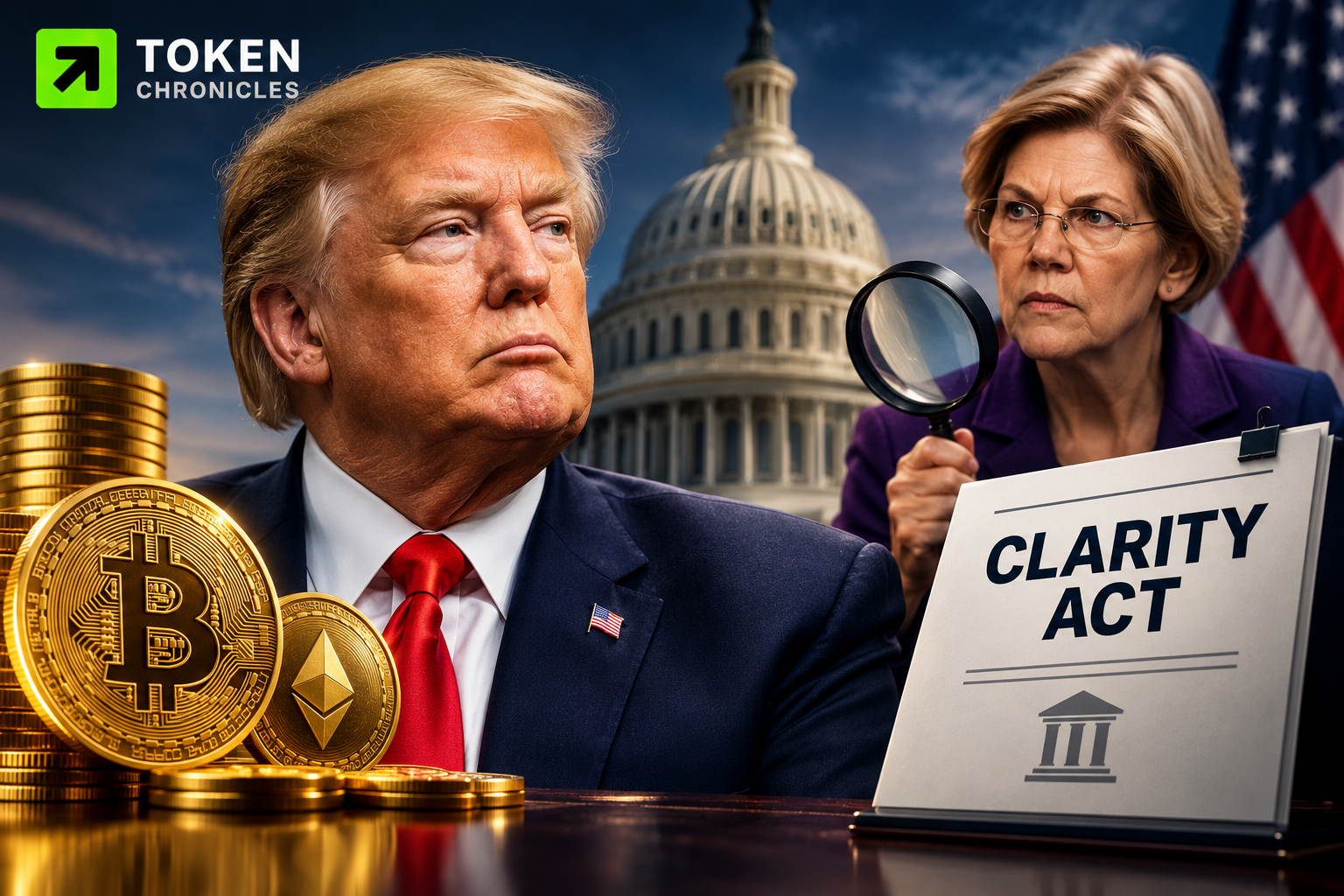
President Donald Trump’s extensive cryptocurrency interests are drawing renewed scrutiny in Washington as lawmakers debate the CLARITY Act, a major piece of legislation that could reshape the regulatory framework for digital assets in the United States.
U.S. Senator Elizabeth Warren has requested updated information about Trump’s cryptocurrency earnings and financial interests through the first half of 2026. Her request follows a 2025 financial disclosure that reported approximately $1.4 billion in crypto-related income, according to Warren’s letter.
The dispute adds a new dimension to the Senate’s crypto market structure debate, with some lawmakers arguing that stronger ethics and conflict-of-interest safeguards should accompany any comprehensive digital asset legislation.
Warren seeks updated crypto financial disclosures
Warren, the ranking Democrat on the Senate Banking Committee, asked Trump to provide a comprehensive update covering his cryptocurrency earnings through July 15, 2026.
The existing annual disclosure primarily covers financial activity through the end of 2025, meaning it does not provide lawmakers with a complete picture of transactions, income, or ownership changes that may have occurred during the first half of 2026.
Warren argues that more recent information is relevant because Congress is considering legislation that could materially affect the regulatory environment and potentially the value of crypto-related businesses and assets.
Her concerns extend beyond Trump specifically. The broader question is whether presidents, vice presidents, senior government officials, members of Congress, and their families should be permitted to maintain significant financial interests in industries directly affected by policies they influence.
Trump’s 2025 filing shows extensive crypto income
Trump’s annual public financial disclosure for 2025, released by the Office of Government Ethics in June 2026, revealed substantial financial exposure to the cryptocurrency sector.
According to Warren’s characterization of the filing, approximately $1.4 billion of Trump’s reported income was connected to cryptocurrency-related ventures, representing a significant portion of his disclosed earnings.
The financial interests include businesses and entities associated with World Liberty Financial and other digital asset ventures linked to the Trump family.
The scale of those holdings has intensified questions about potential conflicts as the administration and Congress make decisions that could influence cryptocurrency regulation, stablecoins, token markets and the broader digital asset industry.
Trump has rejected suggestions that his crypto activities are improper, maintaining that his involvement in digital assets is legal and that financial institutions manage his investments.
World liberty financial links expand the debate
The disclosure also outlined a network of entities connecting the Trump family to cryptocurrency ventures.
One of those entities, DT Marks DeFi LLC, serves as a holding structure for financial interests associated with World Liberty Financial.
According to the disclosure details cited by Warren, Trump family members held a 30% interest in DT Marks DeFi LLC, while the entity reported significant digital asset-related holdings and ownership interests.
The filing indicated that DT Marks DeFi received more than $590 million in income during 2025.
The Trump family also reportedly maintained indirect interests in other entities associated with World Liberty Financial and stablecoin-related activities.
These interconnected holdings illustrate why lawmakers are seeking greater transparency around how crypto legislation could affect officials with direct or indirect financial exposure to the industry.
CLARITY Act raises conflict-of-interest questions
The controversy comes as the Senate considers the CLARITY Act and related efforts to establish a comprehensive U.S. crypto market structure framework.
The legislation seeks to clarify regulatory responsibilities, particularly between the Securities and Exchange Commission (SEC) and Commodity Futures Trading Commission (CFTC), while establishing clearer rules for digital asset companies and investors.
Supporters argue that regulatory clarity could encourage innovation, strengthen consumer protections and keep crypto businesses operating in the United States.
However, critics say comprehensive crypto legislation should also include robust ethics safeguards preventing senior government officials from personally benefiting from policies they help shape.
For Warren and other lawmakers raising these concerns, Trump’s crypto interests have made ethics provisions an increasingly important part of the legislative debate.
Updated 2026 earnings could provide a clearer picture
One major limitation of Trump’s existing financial disclosure is timing.
While the filing provides extensive information about 2025, it does not fully capture financial developments during 2026.
That gap could be significant in the rapidly changing cryptocurrency market, where token valuations, ownership structures, business revenues and investment positions can shift substantially within months.
An updated disclosure could reveal whether Trump’s crypto-related income has increased or decreased, whether ownership positions have changed, and whether new financial interests have emerged while Congress debates market structure legislation.
Warren is therefore seeking more current information before lawmakers make decisions that could significantly reshape the industry.
Crypto ethics could become a key hurdle for CLARITY
The debate illustrates how crypto regulation and political ethics are becoming increasingly interconnected.
The CLARITY Act is primarily designed to answer long-standing questions about regulatory jurisdiction and market oversight. But Trump’s expanding involvement in digital assets has introduced another issue: how should policymakers handle situations where government officials have substantial financial exposure to the industry they regulate?
That question could influence negotiations over the final legislation.
Some lawmakers are pushing for stronger restrictions on crypto holdings and business interests involving senior officials, while supporters of the broader market structure framework want to avoid ethics disagreements derailing regulatory reform.
As the Senate continues negotiations, Trump’s reported $1.4 billion in crypto-related income is likely to remain part of the political debate.
The outcome could determine not only the future structure of U.S. crypto regulation, but also whether Congress establishes new rules governing how senior public officials and their families participate financially in the digital asset economy.