

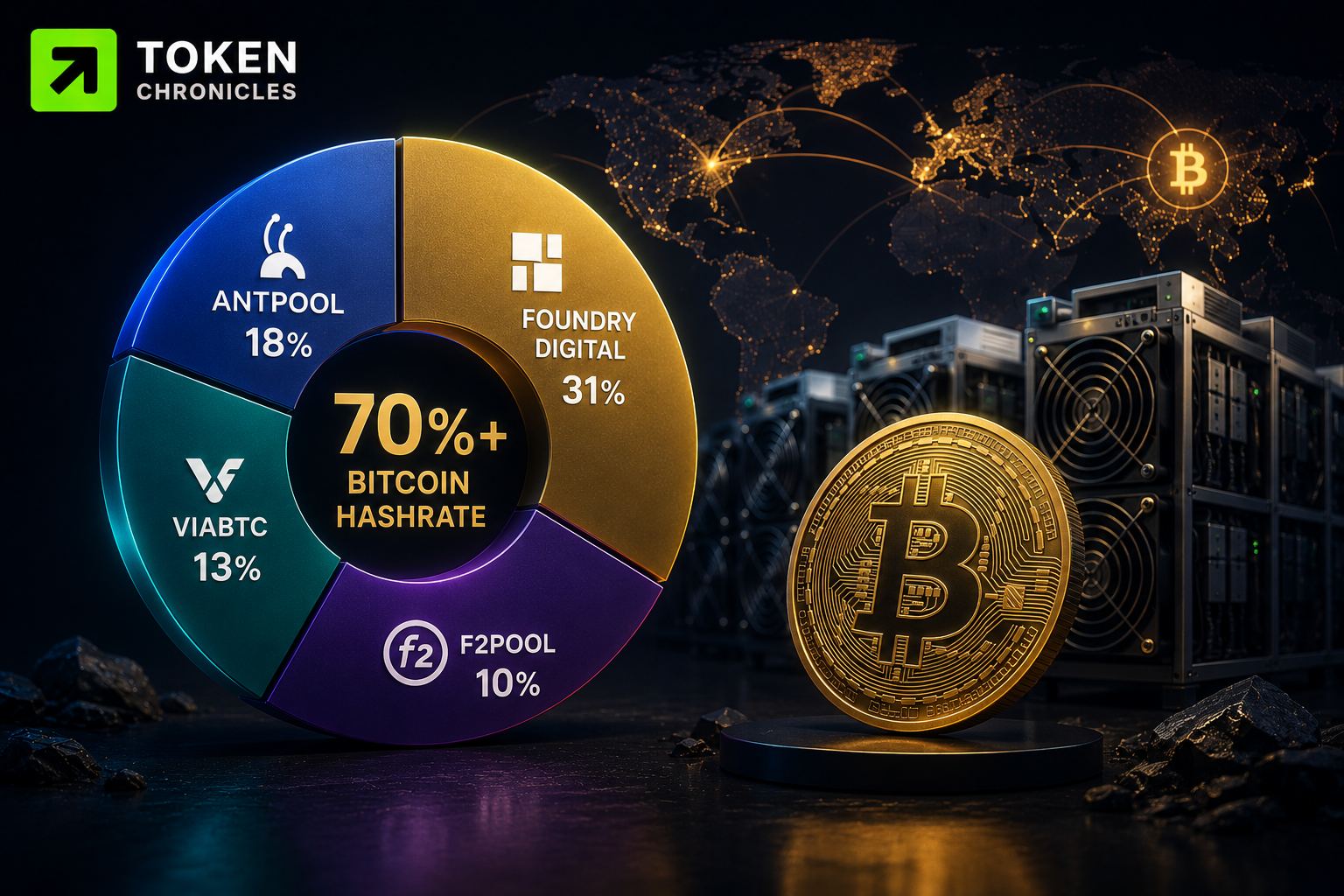
Bitcoin’s mining landscape is becoming increasingly concentrated, with four major mining pools accounting for more than 70% of the network’s total hashrate, raising fresh concerns about centralization and the growing dominance of large institutional mining operations.
According to a June 23, 2026 snapshot cited from MiningPoolStats, Foundry Digital, AntPool, ViaBTC, and F2Pool collectively controlled the majority of Bitcoin’s computing power.
At the time, Foundry reportedly accounted for roughly 31% of hashrate, followed by AntPool at 18%, ViaBTC at 13%, and F2Pool at 10%. While pool shares fluctuate continuously as miners redirect computing power, the broader trend points toward increasing concentration among a relatively small group of operators.
Bitcoin mining is becoming more concentrated
Mining pools allow individual miners to combine computing resources and receive more predictable rewards instead of competing independently to discover blocks.
As industrial-scale Bitcoin mining has expanded, however, the largest pools have gained significant influence over how much of the network’s hashrate is coordinated through their infrastructure.
This does not mean the pools directly own all the mining equipment represented by their hashrate. Individual miners and mining companies generally retain their hardware and can redirect their computing power to another pool.
Still, high concentration matters because mining pools coordinate block construction and distribution of mining rewards. If too much hashrate becomes concentrated among a small number of operators, concerns can emerge around censorship resistance, transaction selection and the decentralization of Bitcoin’s mining infrastructure.
A Two-Tier mining market is emerging
The growing dominance of major pools is also contributing to what some industry observers describe as a two-tier mining market.
Large pools increasingly serve institutional miners operating massive fleets of specialized mining equipment. These customers often require sophisticated payout systems, regulatory compliance, enterprise support and highly reliable infrastructure.
Foundry Digital, for example, has developed a significant presence among large North American mining operations.
Smaller and mid-sized miners may have different priorities, including lower pool fees, flexible onboarding, payout structures and fewer operational barriers.
As major pools become increasingly oriented toward institutional customers, independent miners may reconsider where they direct their hashrate.
Nakamoto coefficient highlights centralization concerns
Another metric has added to the debate.
According to a D-Central analysis covering the first half of 2026, Bitcoin mining had a Nakamoto coefficient of approximately three based on pool-level block production.
In this context, that means the combined activity of roughly three major mining pools could account for more than half of blocks produced during the measured period.
The metric does not necessarily mean three organizations independently control the Bitcoin network, because mining pools coordinate hashrate contributed by many separate miners who can theoretically switch pools.
Nevertheless, the figure illustrates how concentrated block production has become at the pool coordination level.
Miners explore alternative pools
Regulatory requirements, fees and operational policies are also influencing how miners choose pools.
ViaBTC has reportedly faced increased scrutiny affecting some miners in certain jurisdictions, with issues around compliance requirements and account verification potentially encouraging miners to explore alternatives.
Smaller competitors are attempting to capitalize on this shift by competing on fees, payout structures and accessibility.
EMCD, for example, has promoted its FPPS mining model with fees starting around 1.5%, positioning itself as an alternative to larger pools that may charge higher fees depending on their services and payout structures.
However, switching pools involves more than comparing fees. Miners must also evaluate payout reliability, infrastructure stability, compliance requirements, geographic connectivity and counterparty risk.
Pool rankings continue to shift
Bitcoin mining pool rankings are not static.
A separate seven-day snapshot from July 16 showed Foundry USA maintaining the largest share at approximately 27%, while F2Pool and AntPool each accounted for around 17.2%. ViaBTC represented roughly 9.5%, followed by smaller competitors including SpiderPool.
These fluctuations demonstrate that miners can and do redirect hashrate between pools.
The bigger concern is the longer-term structural trend: despite changes in individual rankings, a relatively small group of large pools continues to coordinate a substantial majority of Bitcoin’s computing power.
Bitcoin’s underlying mining hardware remains distributed among many independent companies and operators, but pool-level concentration is emerging as an important decentralization issue.
As institutional mining grows and the largest pools consolidate their positions, the ability and willingness of miners to redirect hashrate toward smaller competitors could become increasingly important for maintaining a competitive and decentralized Bitcoin mining ecosystem.