

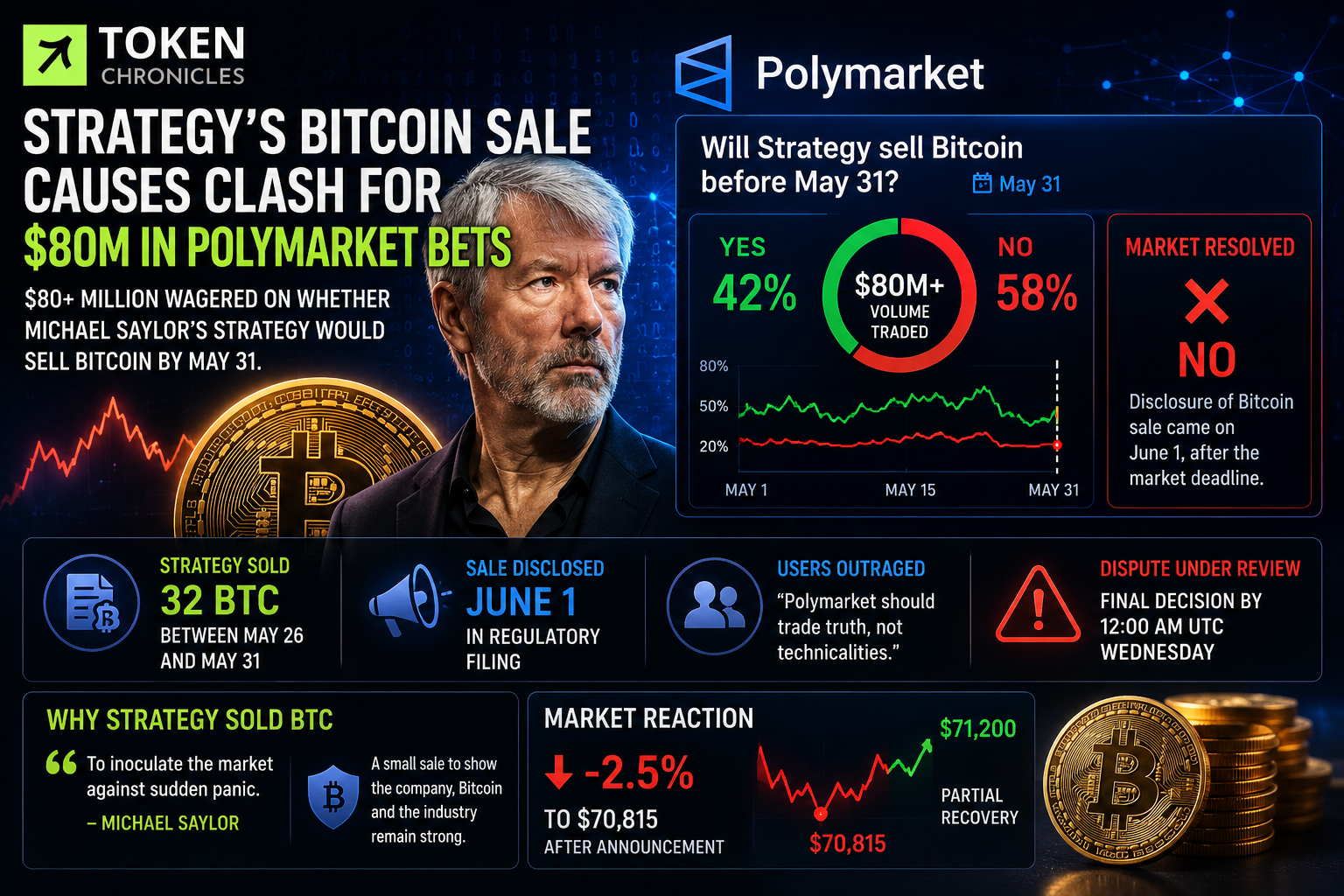
A heated dispute has erupted on prediction market platform Polymarket after Strategy’s recent Bitcoin sale triggered confusion over the resolution of a high-profile betting market that attracted more than $80 million in trading volume.
The controversy centers on a market asking whether Michael Saylor’s Strategy would sell Bitcoin before May 31. Thousands of traders took positions on both sides of the prediction, expecting a clear outcome based on the company’s actions during the month.
However, the situation became complicated when Strategy later revealed in a regulatory filing that it had sold 32 Bitcoin between May 26 and May 31, while the disclosure itself was not made public until June 1.
Because the information became available after the market’s deadline, Polymarket resolved the contract in favor of “No,” arguing that there was no publicly confirmed evidence of a Bitcoin sale within the specified timeframe.
Traders Challenge the Outcome
The decision immediately sparked backlash from users who had wagered on “Yes,” arguing that the event in question had actually occurred before the deadline, regardless of when it was disclosed.
To address the controversy, Polymarket added clarification to the market, stating that confirmations released outside the designated resolution period would not be considered valid evidence for settlement purposes.
According to the platform, neither company statements, blockchain data, nor credible reporting publicly confirmed the sale before the market expired.
Many traders disagreed with that interpretation.
Several users criticized the decision on social media, claiming the platform had prioritized technical rules over factual outcomes. Some participants said the incident damaged their trust in prediction markets, arguing that markets should resolve based on what actually happened rather than when the information became public.
Final Resolution Still Pending
The dispute has now entered a secondary review process, with a final ruling expected after another challenge period concludes.
If no successful dispute is submitted before the deadline, the current market outcome will remain unchanged and all positions will settle accordingly.
The case has quickly become one of the most closely watched governance disputes in Polymarket’s history due to the significant amount of money involved and the broader questions it raises about how prediction markets should handle delayed disclosures.
Why Strategy Sold Bitcoin
The Bitcoin sale itself was notable because it marked a departure from Strategy’s long-standing reputation as one of Bitcoin’s most committed corporate holders.
During the company’s first-quarter earnings call in May, Michael Saylor suggested that conducting a small Bitcoin sale could help demonstrate the resilience of both the company and the broader Bitcoin ecosystem.
Saylor argued that a limited sale would show investors that neither Strategy nor Bitcoin depends on an absolute “never sell” philosophy and that the market could absorb such transactions without triggering systemic panic.
The move contrasted with years of messaging that emphasized Strategy’s commitment to accumulating and holding Bitcoin for the long term.
Market Reaction
Following disclosure of the sale, Bitcoin briefly came under pressure, falling roughly 2.5% to around $70,800 within hours of the announcement.
The decline was relatively short-lived, with Bitcoin later recovering part of its losses as traders reassessed the significance of the transaction.
While the sale itself was small relative to Strategy’s massive Bitcoin holdings, the controversy surrounding its timing has generated far more attention than the transaction’s market impact.
A Test Case for Prediction Markets
Beyond the immediate financial stakes, the dispute highlights a growing challenge for prediction markets: determining whether contracts should resolve based on when an event occurs or when that event becomes publicly verifiable.
As prediction markets continue gaining popularity across finance, politics, and sports, cases like this may shape future standards for market design, dispute resolution, and user trust.
For now, traders are awaiting the final decision, while the debate over “truth versus technicality” continues to divide the Polymarket community.