

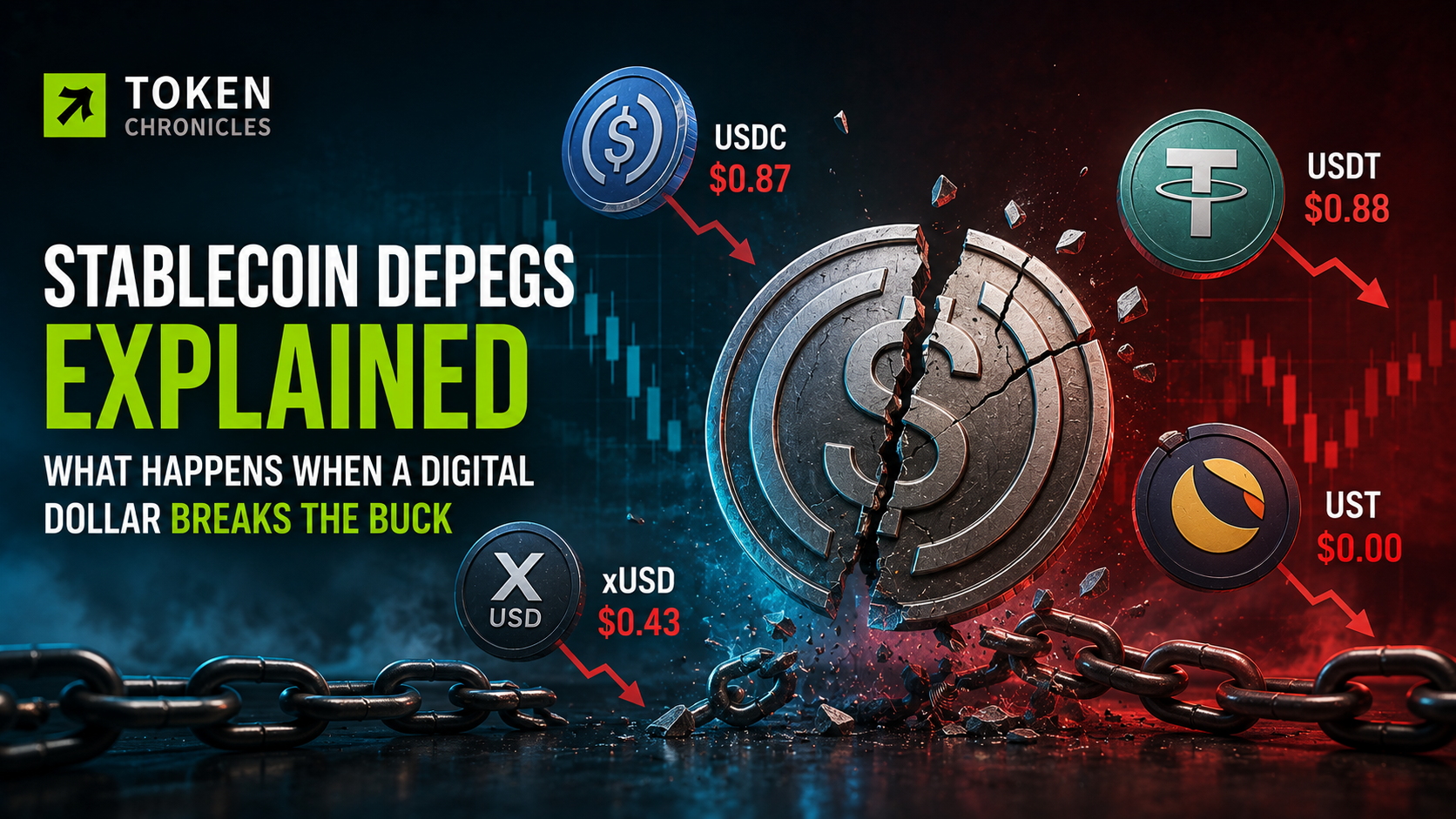
Stablecoins are designed to maintain a value close to $1, but history shows that the peg can break for very different reasons. USDC briefly fell to $0.87 in 2023, USDT traded as low as $0.88 during a 2018 confidence crisis, and TerraUSD (UST) collapsed almost completely in 2022, destroying roughly $40 billion in value.
More recently, Stream Finance’s xUSD plunged below $0.50 in November 2025 after losses at an external fund manager exposed weaknesses in its yield-generating strategy.
- USDC: Fell to $0.87 in March 2023 after $3.3 billion of reserves were caught at Silicon Valley Bank.
- xUSD: Dropped to roughly $0.24–$0.43 in November 2025 following a reported $93 million loss at an external fund manager.
- Stablecoin market: Total supply declined by roughly $14.6 billion from its 2026 peak of about $322 billion.
A $1 Peg Depends on Economics, Not Code
A stablecoin does not automatically remain worth $1 simply because its design says so.
For reserve-backed stablecoins, the peg relies on an economic mechanism built around redemption and arbitrage. If a token falls to $0.99, traders can potentially purchase it at a discount and redeem it for $1, earning the difference. That buying pressure should push the market price back toward parity.
The reverse happens when a stablecoin trades above $1. New tokens can be created at the redemption price and sold into the market, increasing supply and pushing the price back down.
The system works only when market participants trust that the underlying redemption process will function.
There is also an important distinction between direct redemption and simply holding a stablecoin. Issuers such as Tether and Circle operate redemption systems with eligibility requirements and institutional access, meaning many retail holders and DeFi users depend on secondary-market liquidity and arbitrageurs rather than having a direct claim they can immediately exercise themselves.
That is why a stablecoin can trade below $1 even when its issuer continues processing redemptions normally.
Four Major Depegs, Four Different Failure Modes
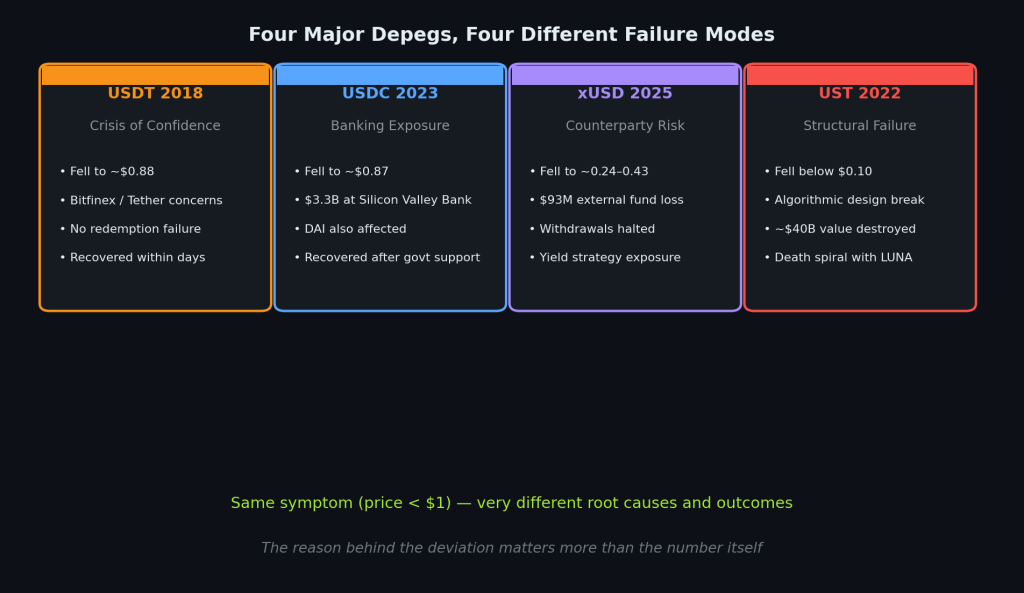
Not every depeg is caused by the same problem.
USDT: A Crisis of Confidence
In October 2018, concerns surrounding Tether and its relationship with Bitfinex caused USDT to fall sharply on some exchanges, reaching approximately $0.88.
The episode was largely driven by market confidence rather than an actual failure to honor redemptions. Once concerns subsided and liquidity returned, USDT recovered its peg within days.
USDC: Banking Exposure
The March 2023 USDC crisis had a different origin.
Circle disclosed that approximately $3.3 billion of its reserves were held at Silicon Valley Bank when the bank failed. Uncertainty over access to those funds caused USDC to fall to around $0.87.
The U.S. government’s intervention to protect depositors helped restore confidence, and USDC subsequently returned toward $1.
The shock also spread beyond USDC. DAI, which had significant USDC exposure within its collateral structure, also traded below its intended value.
xUSD: Counterparty Risk
The November 2025 collapse of Stream Finance’s xUSD highlighted another risk: yield strategies and external counterparties.
Unlike a conventional fully cash-backed stablecoin, xUSD relied on strategies managed by outside parties to generate returns for holders.
After an external fund manager reported a loss of approximately $93 million, Stream Finance halted withdrawals. The token subsequently plunged from around $1 to as low as $0.24, while substantial customer funds became inaccessible.
The episode demonstrated that a stablecoin can inherit risks from the strategies and counterparties sitting behind its yield mechanism.
TerraUSD: A Structural Failure
TerraUSD was fundamentally different from reserve-backed stablecoins.
UST attempted to maintain its dollar value through an algorithmic relationship with LUNA rather than through conventional cash and liquid-asset reserves.
When selling pressure pushed UST below $1, users could exchange it for LUNA. But the resulting increase in LUNA’s supply weakened the system further, creating a destructive feedback loop.
The mechanism ultimately failed. UST fell below $0.10, while LUNA’s value collapsed alongside it.
Approximately $40 billion in combined value was wiped out, and the fallout spread through crypto lenders, hedge funds and other interconnected businesses.
Stablecoin Supply Has Also Contracted
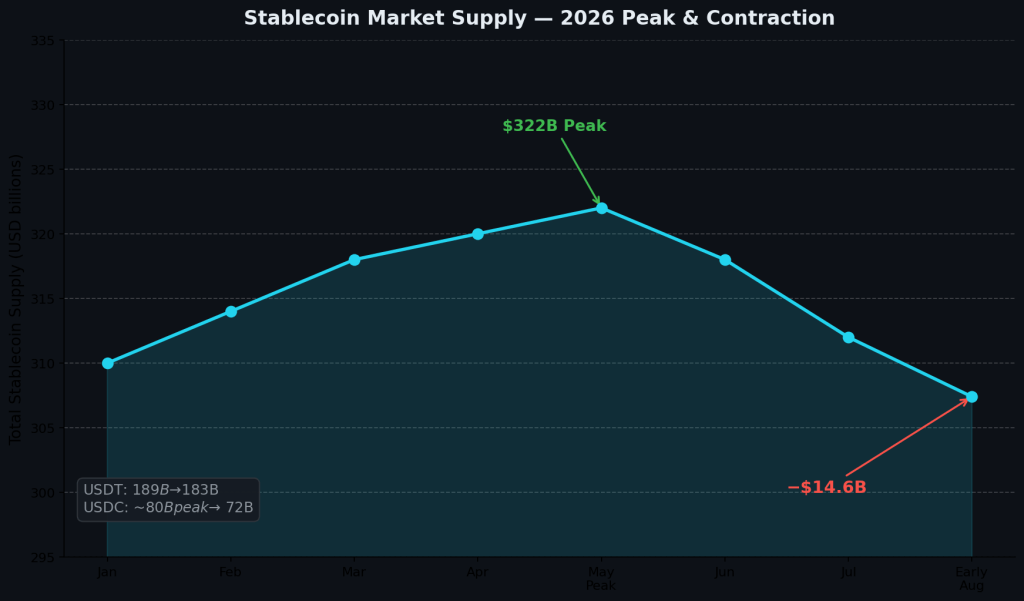
The stablecoin market has experienced a different form of stress in 2026.
Rather than a sudden loss of the $1 peg, the broader market has experienced a decline in circulating supply.
Total stablecoin capitalization began the year around $310 billion, climbed above $320 billion and reached approximately $322 billion around May before reversing.
By early August, roughly $14.6 billion had disappeared from the overall supply.
USDT also declined from approximately $189 billion to about $183 billion, while USDC fell from a March peak near $80 billion to roughly $72 billion.
A reduction in supply does not automatically indicate that stablecoins are losing their peg. It can, however, reduce the amount of liquidity and arbitrage capital available to absorb future market shocks.
Concentration Creates Systemic Risk
The stablecoin market is highly concentrated.
USDT and USDC together represent the overwhelming majority of the sector’s capitalization. That concentration creates efficiency and deep liquidity, but it also means that problems affecting either issuer could have consequences far beyond a single token.
A banking disruption, regulatory intervention, reserve controversy or operational failure involving one of the major issuers could quickly transmit through exchanges, DeFi protocols and other financial applications that use stablecoins as collateral or settlement assets.
The same interconnectedness that makes stablecoins useful can therefore amplify stress.
How to Evaluate the Next Depeg
A stablecoin falling below $1 should not automatically be interpreted as a collapse. The reason behind the deviation matters more than the number itself.
1. Identify the source of the stress.
A temporary liquidity or confidence problem involving a reserve-backed stablecoin can be very different from a structural failure in the underlying design.
2. Watch redemptions and reserves.
Price alone does not tell the whole story. If an issuer continues processing redemptions and has sufficient liquid reserves, a temporary discount may simply reflect market imbalance.
3. Track contagion.
The most important question may be what happens elsewhere. A stablecoin can be used as collateral across thousands of DeFi positions, meaning a relatively small pricing disruption can trigger liquidations and additional losses.
4. Examine the collateral structure.
Stablecoins backed by transparent, liquid reserves have a different risk profile from systems dependent on volatile tokens, leverage or complex external investment strategies.
The Bigger Lesson
A stablecoin’s $1 value is ultimately a function of trust, liquidity, collateral quality and redemption mechanisms.
The history of USDT, USDC, xUSD and UST demonstrates that depegs can originate from very different sources: market panic, banking exposure, counterparty losses or fundamental design flaws.
For investors, the key question is therefore not simply “Is this stablecoin trading at $1?”
It is “What makes the $1 credible, and what happens if that mechanism is tested?”
That distinction becomes increasingly important as stablecoins evolve from simple trading instruments into core infrastructure for payments, DeFi and the broader digital financial system.