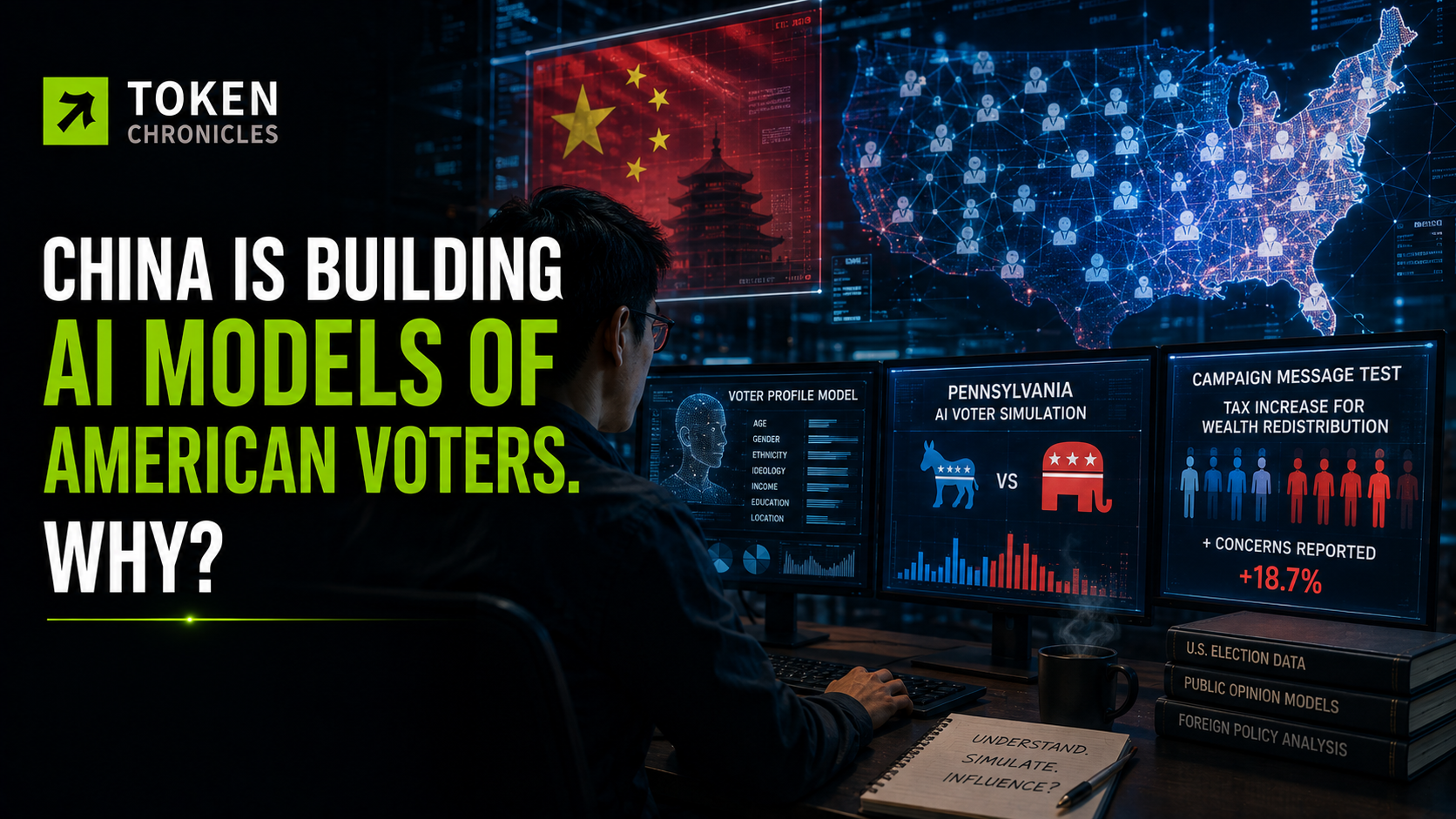
Chinese universities, research institutions and government-linked think tanks are developing increasingly sophisticated models of American voters, using social-media data, public opinion surveys and artificial intelligence to simulate how U.S. citizens might think, vote and respond to political messages.
The research goes well beyond traditional polling. Projects described in Chinese academic papers have analyzed millions of social-media accounts, generated synthetic voter profiles, simulated presidential elections across individual states and tested political messages on AI-generated populations.
Other studies have examined the motivations behind support for Donald Trump and analyzed how “America First” attitudes influence views on tariffs, alliances, international institutions and U.S. foreign policy.
Taken together, the work points toward a broader effort to understand the political forces shaping American decision-making, particularly on issues affecting China.
Building a Synthetic U.S. Voter Population
One of the most ambitious projects comes from researchers at Fudan University.
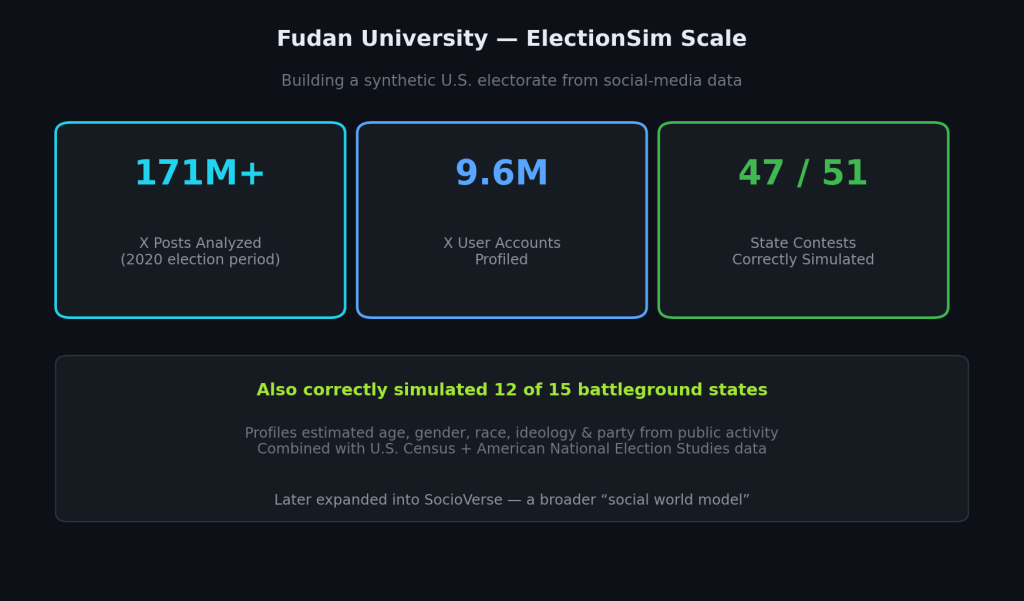
Their ElectionSim project reportedly collected more than 171 million posts from nearly 9.6 million X users during the 2020 U.S. election period. Researchers used machine-learning techniques to estimate characteristics such as age, gender, race, political ideology and party affiliation from publicly available activity.
Those profiles were combined with U.S. Census information and American National Election Studies data to construct simulated electorates.
The researchers say their latest system was able to reproduce the winning candidate in 47 of 51 state-level contests and 12 of 15 battleground states in its simulations.
The system can also create subsets of voters based on demographic and political characteristics and allow researchers to interact with them through simulated conversations.
The topics extend well beyond voting preferences, covering immigration, firearms, defense, race, LGBTQ issues, gender attitudes and democratic institutions.
The work later became part of SocioVerse, a broader Fudan-led research initiative described as a social “world model” built using data from millions of real-world social-media users.
AI-Generated Pennsylvania Voters Put to the Test
Another Chinese research effort took the concept further by using synthetic voters in an experimental political study.
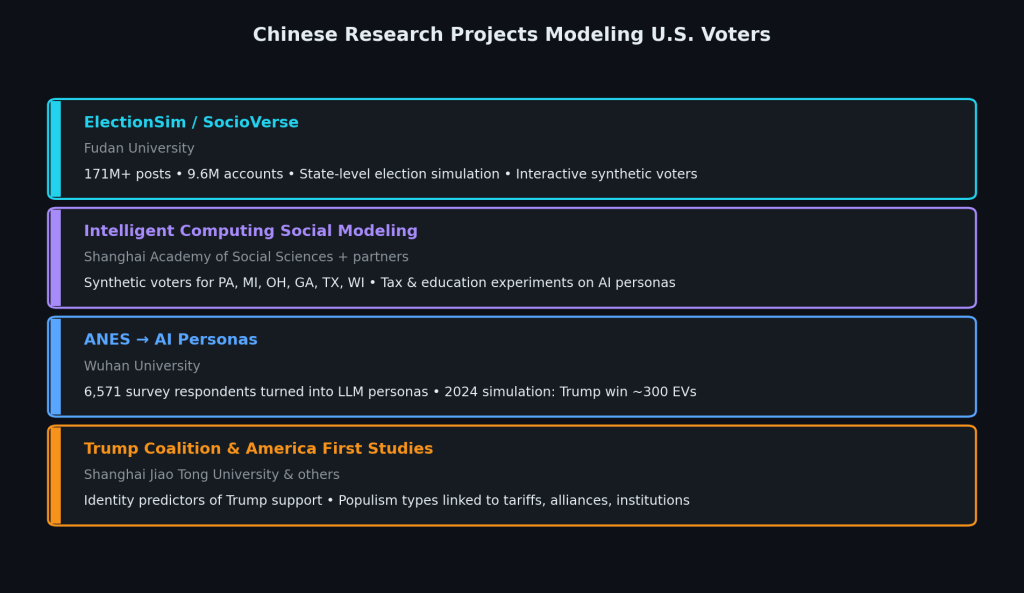
Researchers associated with the Shanghai Academy of Social Sciences, Shanghai Institutes for International Studies, Nanjing University and Shanghai Jiao Tong University developed a framework known as Intelligent Computing Social Modeling.
Using demographic distributions from the 2019 American Community Survey, the researchers created artificial voters based on characteristics including age, gender, ethnicity, education, occupation, region and industry.
The simulated populations covered several U.S. states, including Pennsylvania, Michigan, Ohio, Georgia, Texas and Wisconsin.
Researchers created hundreds of artificial voters for each state and asked the models to choose between Democratic and Republican candidates. They then conducted a separate experiment involving simulated Pennsylvania voters.
One group was presented with a hypothetical candidate who supported higher personal-income taxes to fund redistribution, while another group served as a control.
The researchers reported differences in the concerns expressed by the two groups and used the results to examine how economic and demographic characteristics might influence political attitudes.
A separate experiment involving 100 simulated Pennsylvania voters explored differences between hypothetical Biden supporters with varying levels of education. The study reported that the simulated responses emphasized different concepts depending on educational background.
The significance of the experiment is less about whether an AI-generated voter behaves exactly like a real person and more about how such systems could be used as tools for testing political hypotheses at scale.
Studying the Foundations of Trump’s Support
Other Chinese academic research has focused specifically on the political coalition behind Trump.
A 2024 study by Shanghai Jiao Tong University scholar Shu Fu examined American National Election Studies data from 2012, 2016 and 2020 to investigate the political, economic and identity-related factors associated with support for Trump.
The research attempted to develop a detailed profile of Trump’s core electorate.
Among its conclusions, the study identified identity-related concerns, particularly attitudes toward immigration and the perceived status of white Americans, as important predictors of Trump support.
More importantly, the research explicitly connected understanding American voters with Chinese policymaking.
The author argued that studying the forces behind Trump’s support could improve understanding of U.S. domestic politics and provide analytical input for China’s approach to the United States.
A subsequent study examined the longer-term influence of “America First” on U.S. foreign policy.
Researchers combined data from the 2020 ANES survey with information from the Chicago Council on Global Affairs to estimate different forms of populism among American respondents.
The analysis then examined how those attitudes related to views on tariffs, alliances, international organizations and democracy promotion abroad.
The findings suggested different relationships between political, economic and cultural populism and foreign-policy preferences.
For Chinese policymakers, that type of research could provide insight into how domestic political pressures may influence Washington’s future approach to trade, alliances and international affairs.
Turning Survey Respondents Into AI Personas
The approach is not limited to a handful of major research projects.
A Wuhan University study transformed the demographic characteristics of 6,571 participants from the 2020 ANES dataset into AI-generated personas.
Researchers instructed language models to adopt the characteristics of individual anonymized respondents and simulate how those personas would have voted in the 2016 and 2020 presidential elections.
The simulated votes were then aggregated geographically.
The researchers subsequently used the same methodology ahead of the 2024 election to model a contest between Trump and Kamala Harris. Their simulation predicted a Trump victory and approximately 300 electoral votes.
Such experiments highlight both the potential and limitations of synthetic electorates. AI personas can rapidly generate large numbers of hypothetical responses, but their outputs remain dependent on the underlying data, model assumptions and prompts used by researchers.
From Political Research to Strategic Intelligence
The potential applications extend beyond academic forecasting.
Documents associated with Chinese technology company GoLaxy, preserved in a Vanderbilt University archive, describe technology intended for what the company characterized as “cognitive-domain confrontation and guidance.”
The documents reportedly reference Chinese security and military organizations and include an American-election component featuring political-influencer rankings, follower information, polling data, prediction markets, Federal Election Commission records, swing-state histories and voter-support profiles.
Other materials reportedly contain databases related to political movements and organizations in the United States.
The existence of such systems does not, by itself, demonstrate how they are being used operationally or whether every capability described in the documents has been deployed. But the material illustrates the potential transition from passive political observation to active computational modeling of foreign populations.
Why Build These Models?
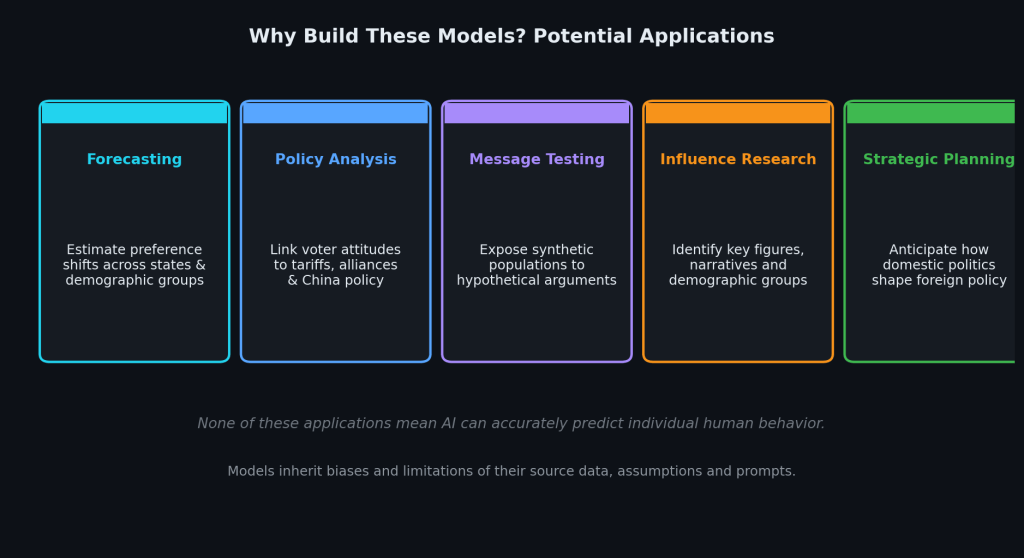
There are several potential uses.
Forecasting: Synthetic electorates can help researchers estimate how political preferences might shift across states, demographic groups or election scenarios.
Policy analysis: Modeling the relationship between voter attitudes and issues such as tariffs, alliances or China policy can help researchers anticipate political pressure on U.S. policymakers.
Message testing: Artificial populations can be exposed to hypothetical political arguments before researchers examine them in real-world surveys or campaigns.
Influence research: Detailed models of political communities could potentially help identify influential figures, narratives and demographic groups.
Strategic planning: Understanding how domestic American politics translates into foreign-policy decisions can provide policymakers with another analytical tool when assessing Washington’s future direction.
None of these applications necessarily means that AI can accurately predict individual human behavior. Political attitudes are highly dynamic, and synthetic models can reproduce the biases and limitations contained in their source data.
The Bigger Shift
The more important development may not be any single Chinese voter model. It is the convergence of large-scale social data, generative AI and political analysis.
Traditional polling provides snapshots of public opinion. AI-based social simulations attempt to create continuously queryable representations of populations.
That difference is significant.
Instead of asking thousands of people a question once, researchers can construct millions of modeled individuals and repeatedly test hypothetical scenarios. The resulting systems could become increasingly useful for understanding how demographic groups, political identities and policy preferences interact.
For China, the strategic value is particularly apparent when the subject is the United States.
American elections influence trade policy, technology restrictions, military alliances, sanctions and the broader U.S.-China relationship. Understanding the electorate behind those decisions therefore has implications well beyond election forecasting.
The central question is no longer simply whether Chinese researchers are using AI to model American voters. The more consequential question is how accurate, scalable and actionable these models become—and how they might eventually be used.