

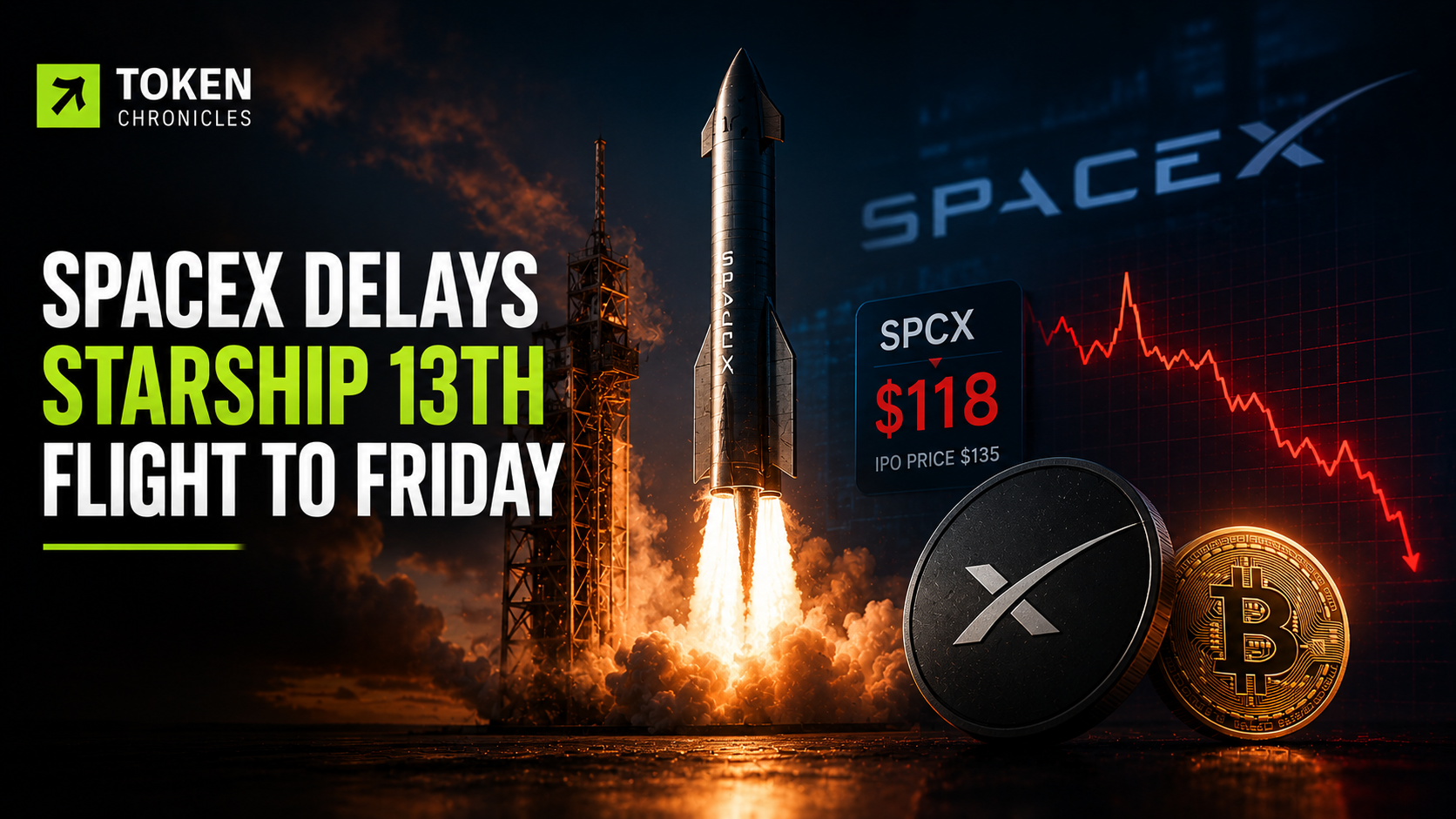
SpaceX has postponed the 13th test flight of its Starship rocket to Friday, July 24, following a series of technical and weather-related disruptions. The delay comes as the Elon Musk-led aerospace company’s stock trades around $118, below its reported $135 IPO price.
The upcoming mission is particularly significant because Starship is expected to attempt the deployment of 20 Starlink V3 satellites, which would mark an important operational payload milestone for the spacecraft.
Starship faces multiple launch setbacks
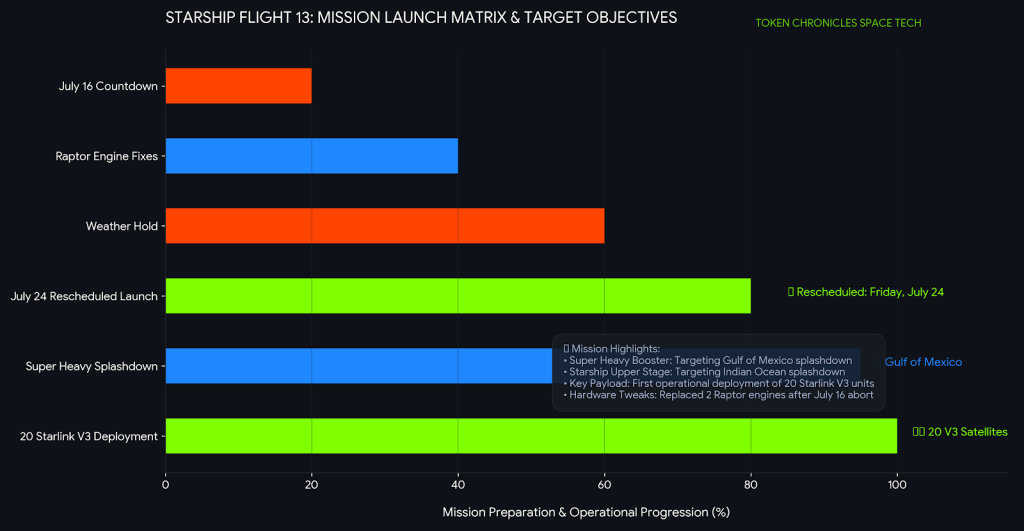
The latest delay follows several disruptions within a little more than a week.
An earlier launch attempt on July 16 was reportedly aborted in the final moments of the countdown after several Raptor engines on the Super Heavy booster failed to ignite as expected.
The automated system halted the launch, and engineers subsequently replaced two engines before preparing the vehicle for another attempt.
A later launch opportunity was postponed because of weather conditions. Clear skies were considered important for ground-based cameras to capture detailed imagery of Starship’s heat-shield tiles during flight.
That data is critical to SpaceX’s efforts to understand how the spacecraft performs during atmospheric reentry and whether its thermal protection system can support the company’s long-term goal of rapid reusability.
Starship targets first operational satellite deployment
The rescheduled launch window is expected to open Friday evening from SpaceX’s Starbase facility in South Texas.
If the mission proceeds as planned, the Super Heavy booster will separate from Starship, conduct a boostback maneuver and target a controlled splashdown in the Gulf of Mexico.
The Starship upper stage is expected to continue into space and deploy 20 Starlink V3 satellites before attempting a controlled atmospheric reentry and splashdown in the Indian Ocean.
A successful satellite deployment would represent a major step forward for Starship, demonstrating its ability to move beyond experimental test flights toward practical payload missions.
SpaceX’s Bitcoin holdings add a crypto connection
SpaceX also has a notable connection to the cryptocurrency market through its reported corporate Bitcoin holdings.
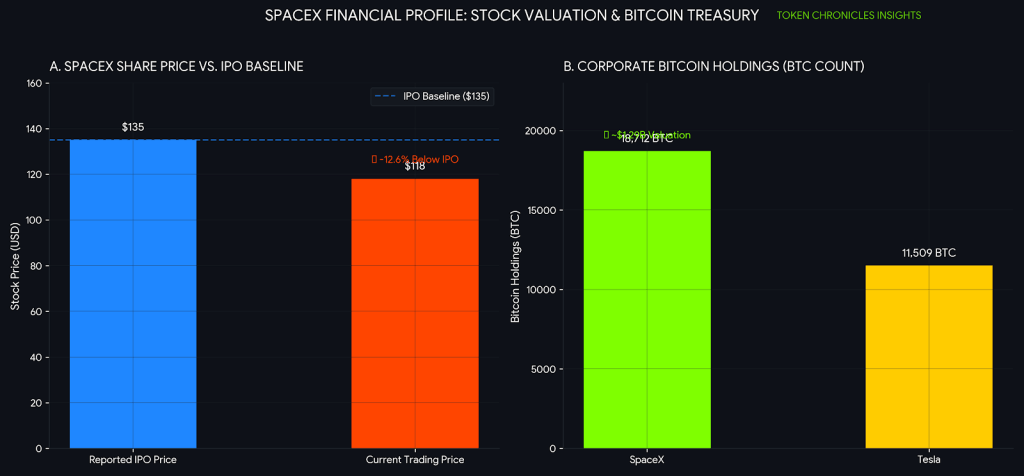
According to the figures cited in the report, the company holds approximately 18,712 BTC, making Bitcoin a significant asset on its balance sheet.
At the valuation cited in its reported regulatory disclosures, the holdings were worth roughly $1.29 billion.
Musk’s other major company, Tesla, was also reported to hold 11,509 BTC, reinforcing the entrepreneur’s long-standing corporate exposure to the cryptocurrency.
SpaceX’s Bitcoin treasury adds another dimension to the company’s financial profile, particularly as institutional and corporate Bitcoin holdings become an increasingly important part of the digital asset market.
SpaceX shares trade below reported IPO price
The report also describes a challenging period for SpaceX shares following the company’s reported public-market debut.
After reportedly pricing its IPO at $135 per share, the stock has since fallen below that level and was cited as trading near $118.
That puts additional attention on Starship’s operational progress.
Major technical milestones could influence investor perceptions of SpaceX’s ability to turn Starship into a reliable platform supporting satellite deployment, lunar missions and eventually broader deep-space ambitions.
Starship’s next flight could be a critical test
The upcoming mission carries greater significance than another experimental rocket launch.
A successful flight would allow SpaceX to test several critical systems while attempting Starship’s first operational satellite payload deployment.
It could also provide valuable data on engine reliability, stage separation, heat-shield performance and controlled reentry.
For SpaceX, demonstrating consistent Starship operations remains central to its long-term ambitions in satellite deployment, reusable spaceflight, lunar exploration and eventually Mars missions.
With multiple launch disruptions behind it and reported shares trading below their IPO level, Friday’s test could become an important moment for both Starship’s technical development and investor confidence in SpaceX’s broader strategy.