
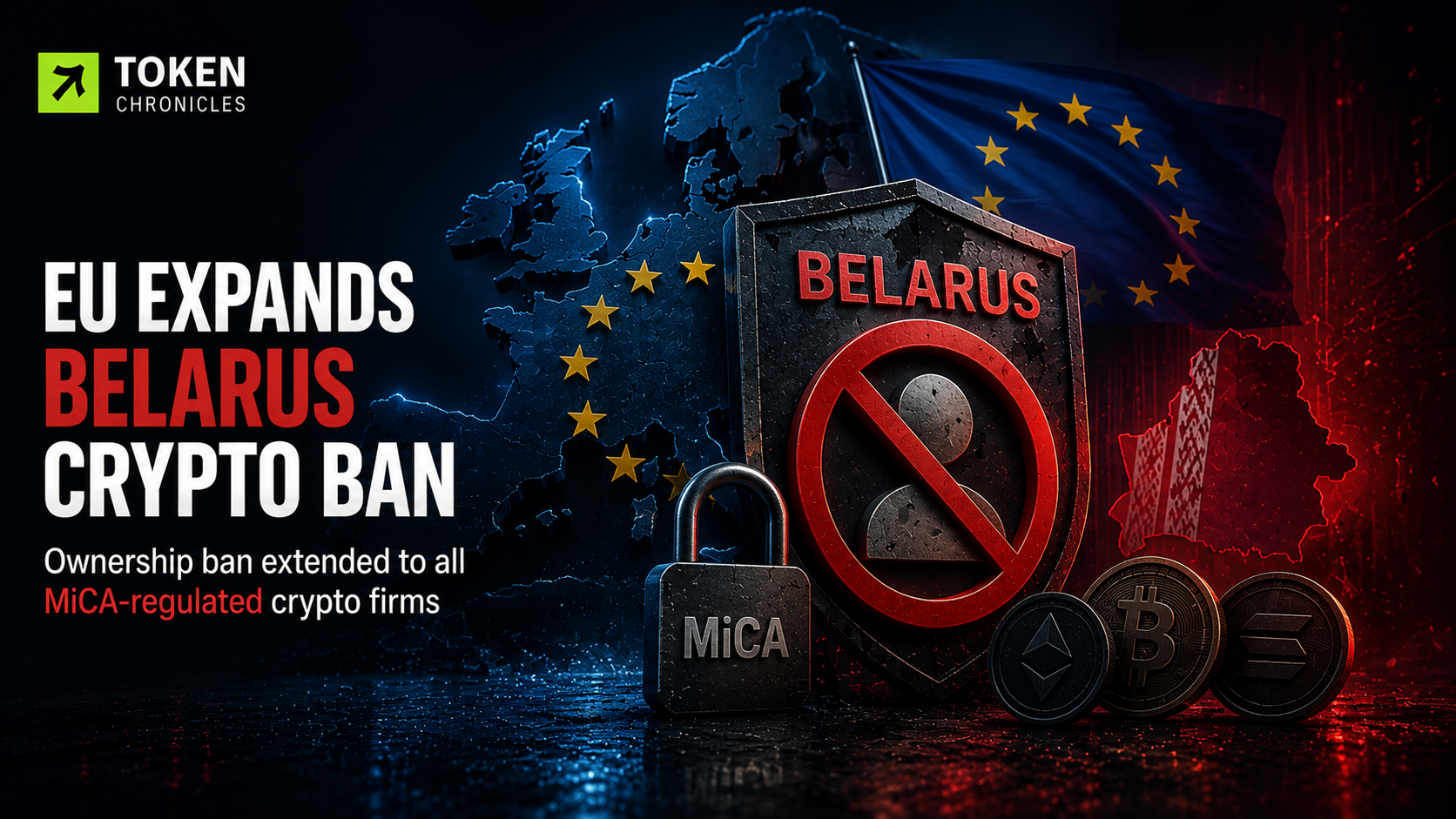
The European Union is expanding its sanctions against Belarus by restricting Belarusian nationals and residents from owning, controlling, or managing EU-based crypto service providers regulated under the Markets in Crypto-Assets framework, or MiCA.
The expanded restrictions are set to apply from August 25, 2026, broadening earlier measures that primarily covered businesses providing crypto wallet, account, and custody services.
The move comes as the EU increasingly targets cryptocurrency infrastructure that authorities believe could be used to circumvent financial sanctions connected to Russia’s war against Ukraine.
EU broadens restrictions across crypto services
The expanded measures were introduced through Council Decision (CFSP) 2026/1847, adopted as part of changes to the EU sanctions framework concerning Belarus.
Previously, restrictions focused more narrowly on entities offering crypto wallet, account, or custody services.
The new rules significantly widen that scope.
Belarusian nationals and residents will be prohibited from owning or controlling EU-based entities providing covered crypto-asset services or holding positions on their governing bodies.
Because MiCA regulates a broad range of crypto businesses, the restrictions could apply across much of the digital asset industry.
Covered activities include operating crypto trading platforms, exchanging digital assets, executing and transmitting client orders, transferring crypto assets, placing tokens, providing investment advice, and offering portfolio management services.
The decision enters into force on July 24, with the expanded crypto restrictions taking effect on August 25.
Restrictions arrive after MiCA transition ends
The sanctions expansion comes shortly after a major regulatory milestone for Europe’s cryptocurrency industry.
MiCA’s transitional period ended on July 1, increasing pressure on crypto companies operating across the bloc to secure the necessary authorization or wind down activities where required.
This means the EU’s crypto sector is entering a more tightly regulated environment at the same time that sanctions-related controls are expanding.
MiCA provides regulators with a more standardized framework for identifying and supervising crypto-asset service providers, potentially making sanctions enforcement across the sector more systematic.
EU intensifies focus on crypto and sanctions evasion
The Belarus restrictions form part of a broader European effort to prevent digital asset infrastructure from being used to bypass sanctions.
As part of its latest sanctions measures against Russia, the EU has also expanded restrictions targeting crypto-related platforms outside the bloc.
The measures reportedly extend transaction restrictions to 14 crypto-related service platforms and introduce a mechanism allowing authorities to prohibit dealings with foreign crypto providers believed to be facilitating Russian sanctions evasion.
This gives the EU greater flexibility to target crypto infrastructure even when providers operate outside European jurisdiction.
Crypto platforms face growing compliance pressure
European sanctions policy increasingly demonstrates that crypto regulation is extending beyond licensing and consumer protection.
Exchanges and other digital asset businesses must now navigate overlapping requirements involving MiCA authorization, anti-money laundering controls, sanctions screening, ownership restrictions, and cross-border compliance.
The trend also increases scrutiny of who owns and controls regulated crypto companies, not simply how those platforms process transactions.
For crypto businesses operating in Europe, compliance is therefore becoming a broader institutional requirement rather than merely a transaction-monitoring function.
Europe builds a more restrictive crypto compliance framework
The expanded Belarus restrictions illustrate how the EU is integrating cryptocurrency more deeply into its broader financial sanctions architecture.
As digital assets become increasingly connected with traditional finance, regulators are applying many of the same geopolitical and compliance controls that already govern banks and other financial institutions.
Beginning August 25, the restrictions on Belarusian ownership and management will extend across a much broader range of MiCA-regulated crypto services.
The development signals a wider shift in European crypto regulation: MiCA is becoming not only a framework for regulating digital asset markets, but also an infrastructure through which broader financial, ownership, and sanctions policies can be enforced across the crypto industry.