
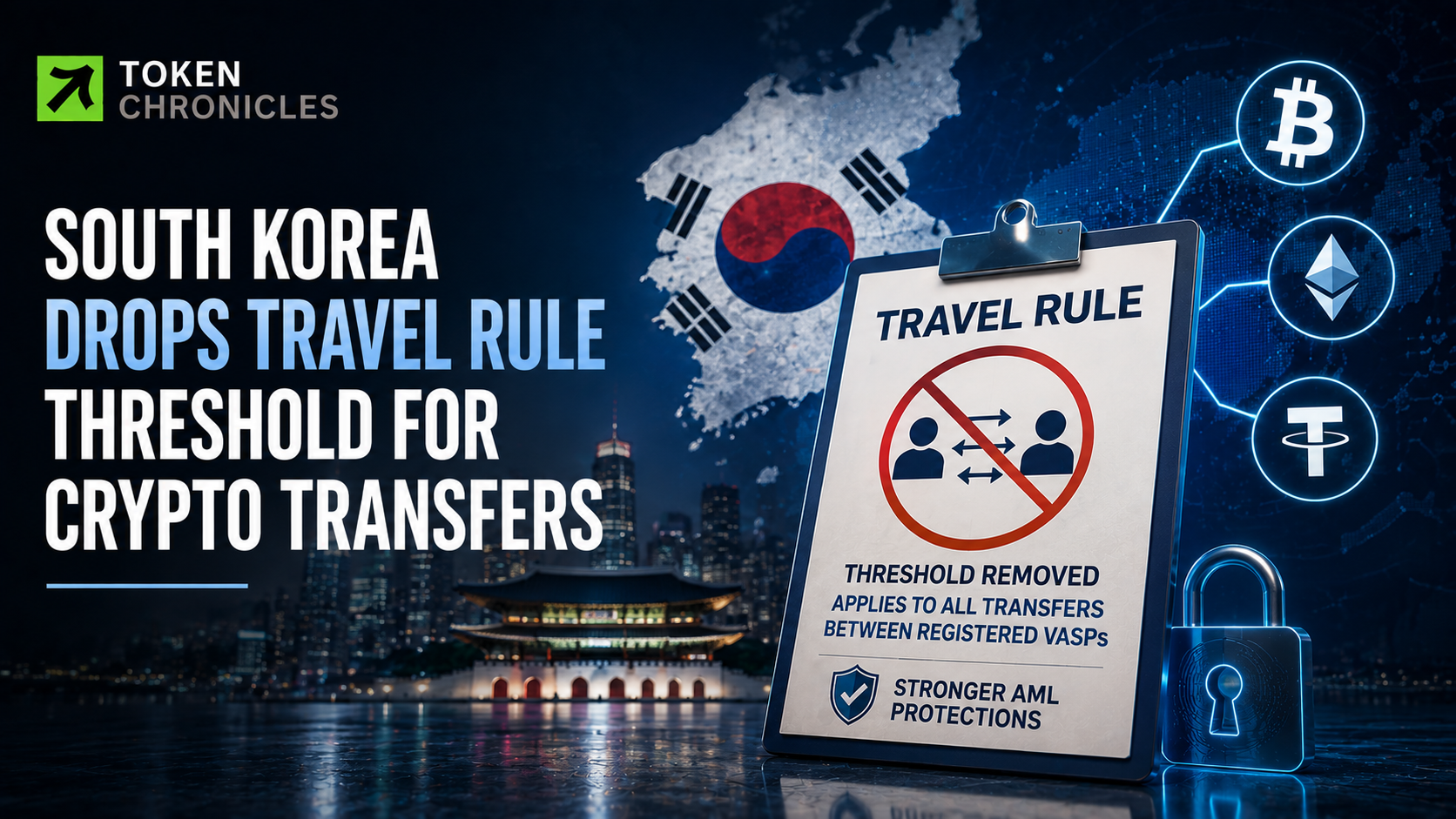
South Korea is tightening its cryptocurrency anti-money-laundering framework by removing the 1 million won threshold for Travel Rule requirements.
Under amendments approved by the Cabinet, information-sharing requirements will apply to all crypto transfers between registered virtual asset service providers (VASPs), regardless of transaction size.
The changes are designed to prevent criminals and other users from bypassing compliance requirements by splitting large transfers into smaller transactions.
Travel Rule to Apply to Every VASP Transfer
South Korea’s Cabinet approved amendments to the Enforcement Decree of the Act on Reporting and Using Specified Financial Transaction Information.
Once implemented, registered crypto platforms will have to exchange required sender and recipient information for every transfer between domestic VASPs, rather than only transactions exceeding the existing 1 million won threshold.
Receiving platforms will also be required to obtain transaction information and can request missing details or reject transfers when the necessary information is unavailable.
The Financial Intelligence Unit said the change is intended to close a loophole that allowed users to divide larger transfers into multiple smaller transactions.
Authorities cited one example in which an individual deposited around 200 million won into a crypto exchange, purchased Tether’s USDT and then made 216 withdrawals, each below the 1 million won threshold.
New Rules Cover Overseas Exchanges and Personal Wallets
The amendments also introduce additional AML requirements for transactions involving foreign crypto exchanges and self-hosted wallets.
South Korean VASPs will need to assess counterparties based on their risk profiles before allowing transfers.
Transactions involving low-risk overseas exchanges can be permitted, while transfers involving other foreign platforms or personal wallets will generally be allowed when the sender and recipient are the same person.
Transfers involving counterparties classified as high risk will be prohibited.
Crypto platforms will also be required to establish suspicious-transaction monitoring systems for transfers of at least 10 million won involving overseas exchanges or personal wallets.
South Korean authorities said illicit activity involving foreign platforms and personal wallets has increased as criminals have taken advantage of gaps in existing AML controls.
Stricter Requirements for Crypto Service Providers
The regulatory changes extend beyond transaction monitoring.
South Korea will also strengthen the requirements companies must meet to register as virtual asset service providers, including standards covering:
- Financial stability
- Internal controls
- Staffing
- Technology infrastructure
- Major shareholder oversight
The government said the expanded requirements are intended to strengthen the overall reliability of South Korea’s digital asset sector while improving the ability of regulators to identify suspicious activity.
When the New Rules Take Effect
The strengthened VASP registration requirements will take effect Aug. 20, although existing providers will receive an additional year to comply with certain financial, staffing, infrastructure and internal-control requirements.
The expanded Travel Rule and other transfer-related AML requirements will take effect six months after the amended decree is formally promulgated.
The move represents another step in South Korea’s broader effort to bring cryptocurrency transactions under tighter financial surveillance while closing loopholes that allow users to avoid existing reporting requirements.