
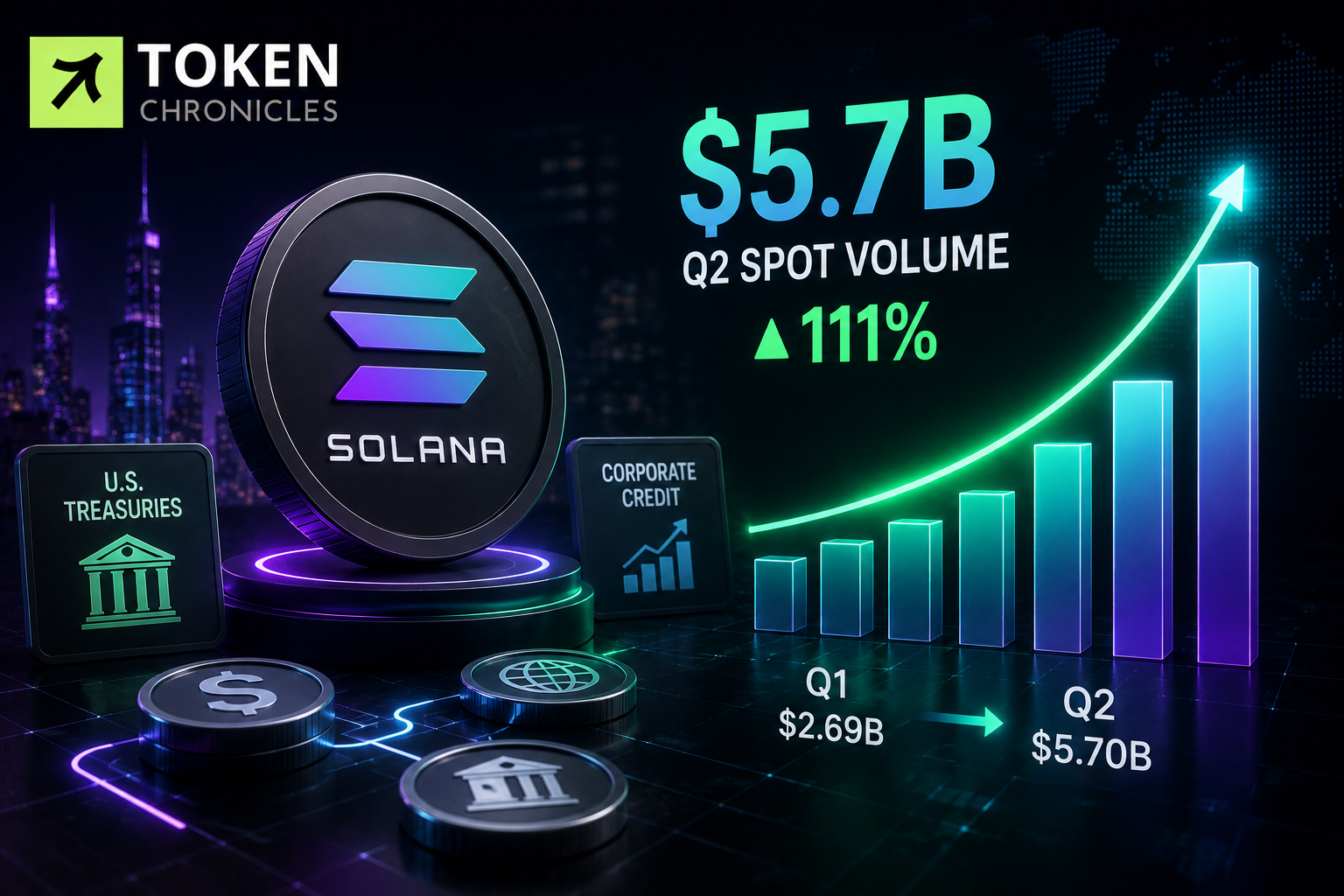
Solana is rapidly strengthening its position in the tokenized real-world asset (RWA) market after on-chain spot trading volume for tokenized assets surged to $5.7 billion in the second quarter of 2026, more than doubling from $2.69 billion recorded in the previous quarter.
The 111.8% quarter-over-quarter increase highlights growing institutional interest in using Solana as a high-speed, low-cost settlement network for tokenized financial assets, including government securities, money market funds, and yield-generating instruments.
Institutional Adoption Accelerates
The sharp rise in trading activity reflects a broader shift in how financial institutions are interacting with blockchain-based assets.
Rather than simply issuing and holding tokenized assets, institutional investors are increasingly trading them on secondary markets, creating deeper liquidity and more efficient capital allocation.
Solana’s high throughput and low transaction costs have made it an attractive platform for these activities, particularly as demand grows for blockchain-based financial infrastructure capable of handling institutional-scale transactions.
Tokenized Treasuries Lead Growth

Much of the increase in trading volume has been driven by the expanding adoption of tokenized U.S. Treasury products and other yield-bearing financial instruments.
As global interest rates remain elevated, institutions are seeking alternatives to traditional stablecoins by allocating capital into tokenized government debt and cash management products that generate yield while remaining fully on-chain.
These assets are increasingly being used for:
- Treasury management
- Institutional cash reserves
- Collateral in decentralized lending markets
- Cross-border settlements
- Portfolio rebalancing
This growing utility is helping transform tokenized assets from passive investments into actively traded financial instruments.
Solana’s Infrastructure Supports High-Frequency Trading
One of Solana’s key advantages is its ability to process thousands of transactions per second while maintaining extremely low network fees.
This combination allows institutional trading firms, market makers, and arbitrage desks to move capital efficiently between tokenized assets without facing the congestion or high gas costs often associated with other blockchain networks.
As a result, investors can rebalance portfolios, manage collateral, and execute trades more frequently, contributing to the rapid growth in spot trading volume.
Secondary Markets Continue to Mature
The latest figures suggest the tokenized asset market is entering a new phase of development.
Early blockchain adoption focused primarily on issuing tokenized securities.
Today, the emphasis is shifting toward building liquid secondary markets where investors can actively trade tokenized financial products throughout the day.
Growing liquidity also improves price discovery, reduces transaction costs, and makes tokenized assets more attractive to institutional investors entering the market.
Competition in the RWA Sector Intensifies
While Ethereum continues to dominate the broader tokenized asset ecosystem, Solana is emerging as a strong competitor by leveraging its high-performance infrastructure.
The network’s ability to process large transaction volumes efficiently positions it as an increasingly important platform for institutions seeking scalable blockchain solutions for traditional financial products.
As more banks, asset managers, and fintech firms expand their tokenization initiatives, competition among blockchain ecosystems to host these assets is expected to intensify.
Why It Matters
Tokenized real-world assets are widely viewed as one of blockchain’s largest long-term growth opportunities, with global financial institutions increasingly exploring the tokenization of government bonds, money market funds, equities, private credit, and other traditional assets.
Solana’s 111.8% surge in tokenized asset trading volume demonstrates that institutional adoption is moving beyond experimentation and into active market participation.
If this momentum continues, Solana could become one of the leading blockchain networks supporting the next generation of digital capital markets, where traditional financial assets trade seamlessly on decentralized infrastructure alongside cryptocurrencies.