
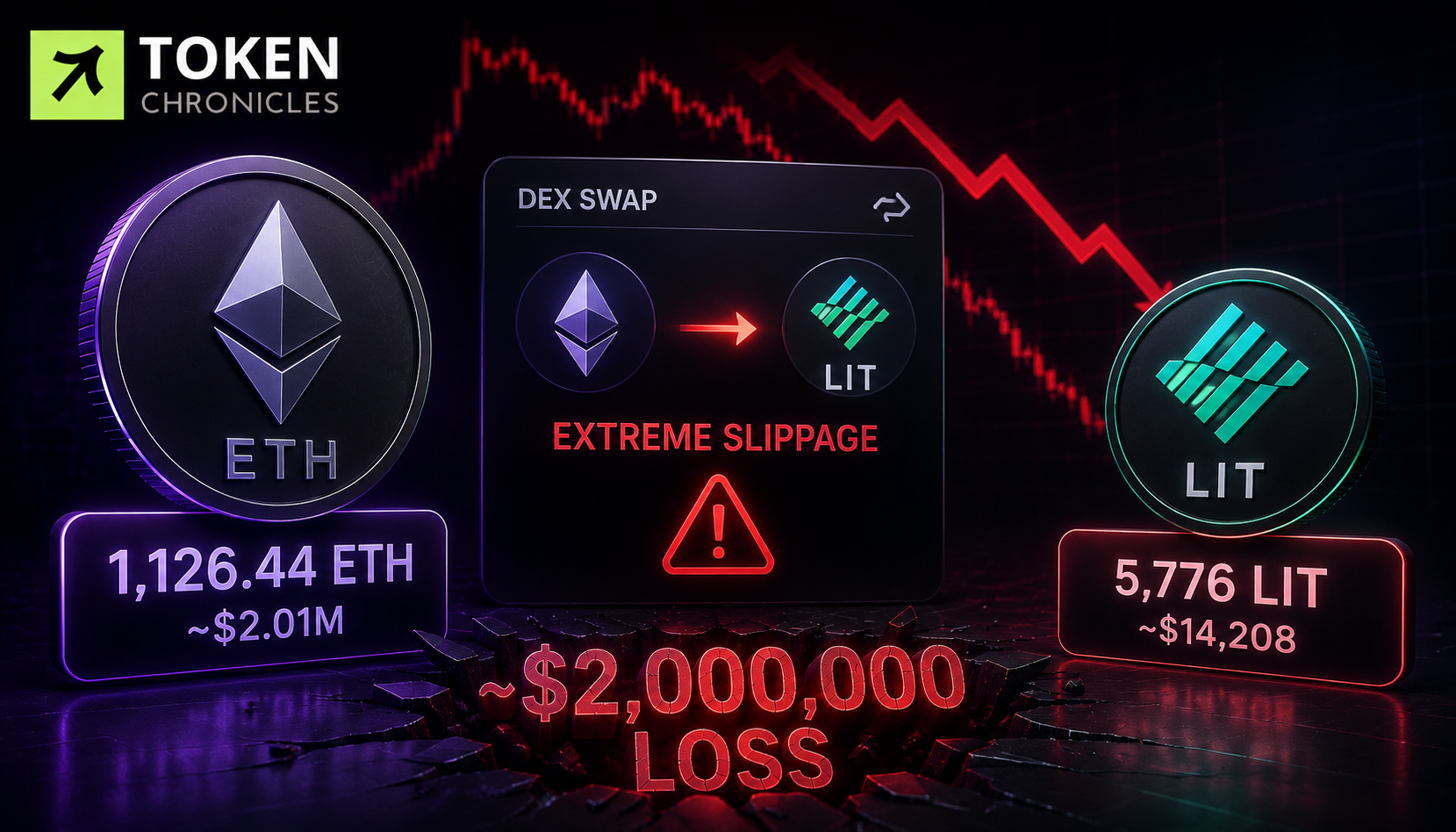
A cryptocurrency trader suffered an extraordinary loss after executing a large trade on a decentralized exchange (DEX), swapping 1,126.44 ETH, worth approximately $2.01 million, for just 5,776 Litentry (LIT) tokens valued at around $14,200.
The transaction resulted in an estimated loss of nearly $2 million, highlighting the risks of executing oversized trades in low-liquidity decentralized markets.
Low Liquidity Triggered Massive Slippage
According to on-chain data, the trader attempted to swap a large amount of Ether into LIT through a liquidity pool that lacked sufficient depth to absorb the transaction.
Because decentralized exchanges rely on automated market makers (AMMs), large orders can significantly move prices when liquidity is limited. In this case, the enormous trade consumed nearly all available liquidity in the pool, causing the execution price to deviate dramatically from the market price.
As a result, the trader received only a fraction of the expected value in LIT tokens.
Test Transaction Came First
Interestingly, blockchain records show the trader initially carried out a small test transaction, swapping approximately 1 ETH for around 737 LIT before executing the much larger trade.
While the test swap completed successfully, the subsequent multi-million-dollar order overwhelmed the liquidity pool, leading to catastrophic slippage.
A Reminder of DEX Trading Risks
The incident underscores one of the key differences between decentralized exchanges and traditional trading venues. Unlike centralized exchanges that use order books with deep liquidity, DEXs execute trades against liquidity pools, making large transactions highly sensitive to available liquidity.
Market participants typically split large trades across multiple transactions or use specialized routing and aggregation tools to minimize slippage and achieve better execution prices.
Why It Matters
As decentralized finance (DeFi) continues to grow, this incident serves as a cautionary example of the importance of understanding liquidity dynamics before executing high-value trades. Even experienced traders can incur substantial losses if transaction size exceeds available market depth, reinforcing the need for proper risk management when trading on decentralized exchanges.