
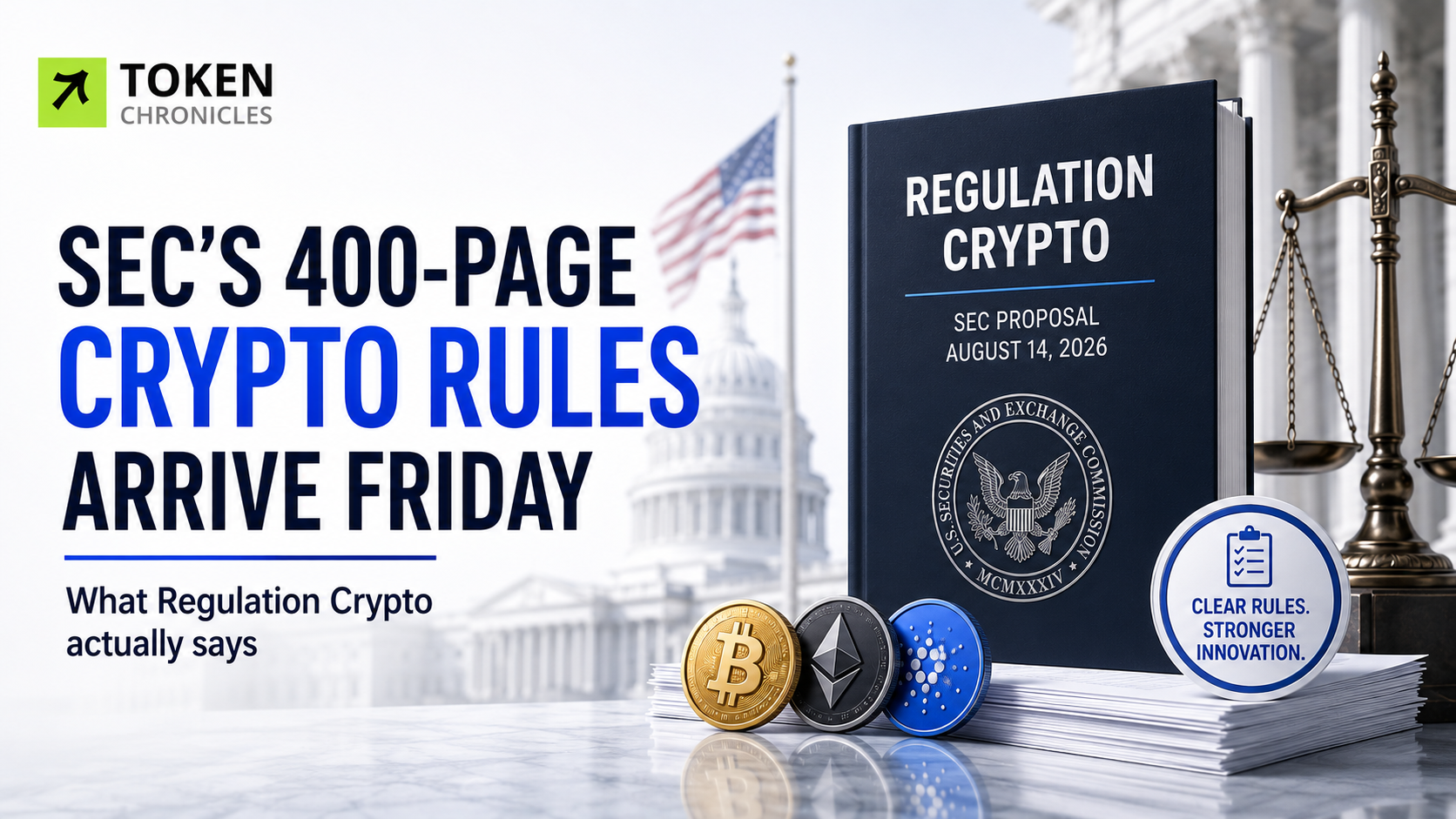
The U.S. Securities and Exchange Commission is preparing to take a major step toward a formal regulatory framework for crypto assets, with the agency scheduled to consider “Regulation Crypto Assets” on August 14, 2026.
The proposal would mark a significant shift away from relying primarily on enforcement actions and toward establishing clearer rules for crypto projects seeking to raise capital and eventually operate outside the securities framework.
Importantly, the August 14 vote would only determine whether the SEC publishes the proposal for public comment. It would not make the framework effective immediately. A final rule would require a subsequent rulemaking process.
SEC Chairman Paul Atkins previewed the framework in March, describing potential pathways that could allow crypto innovators to raise capital under tailored exemptions while establishing clearer conditions for when an investment contract involving a crypto asset could end. (SEC)
Three proposed pathways for crypto projects
Atkins’ March remarks outlined three central components of the potential framework: a startup exemption, a fundraising exemption and an investment-contract safe harbor.
1. Startup exemption
The proposed startup pathway would provide early-stage crypto projects with a limited regulatory runway.
Atkins suggested an exemption lasting up to four years, during which qualifying projects could raise up to approximately $5 million while providing principles-based disclosures similar to the information commonly found in crypto white papers.
The objective would be to give developers time to build a network without immediately subjecting an early-stage token project to the full registration requirements traditionally associated with securities offerings.
Projects would still be expected to provide material information about the investment contract and the underlying crypto asset.
2. Fundraising exemption
The second proposed pathway would be aimed at projects seeking substantially more capital.
Atkins suggested allowing qualifying issuers to raise up to approximately $75 million during a 12-month period.
In exchange for the higher fundraising ceiling, projects would face stronger disclosure requirements, potentially including information about their financial condition and financial statements.
The approach would create a middle ground between a small startup exemption and a full securities registration.
It could give larger crypto projects a structured way to raise capital while maintaining reporting obligations designed to give investors more information.
3. Investment-contract safe harbor
The third component could prove the most consequential for established crypto networks.
The proposed safe harbor would address the question of when an asset initially sold through an investment contract can cease being subject to the federal securities laws.
Under the framework described by Atkins, the safe harbor could apply once the issuer has completed or permanently ceased the essential managerial efforts it had represented or promised to perform.
In practical terms, this could create a regulatory path for a crypto project to evolve from a centrally managed startup into a sufficiently autonomous network.
That concept traces directly back to Commissioner Hester Peirce’s Token Safe Harbor proposal, which Atkins explicitly identified as the intellectual foundation for the framework. (SEC)
The decentralization question
The safe-harbor concept addresses one of the industry’s longest-running legal questions.
A token can initially be sold to finance the development of a network, creating an investment contract under the circumstances described by the Howey framework.
But what happens if the network subsequently becomes decentralized?
Developers may gradually lose control over the protocol, governance may become distributed, validators or other participants may assume greater responsibility, and users may interact with an autonomous network rather than relying on a central management team.
The proposed framework attempts to establish a more predictable endpoint for that transition.
Rather than leaving projects to determine their status through litigation or informal regulatory discussions, the SEC could establish objective requirements for demonstrating that the managerial efforts underlying the original investment contract have ended.
That could transform token regulation from a one-time classification question into a project lifecycle:
Capital formation → network development → decentralization → potential exit from securities treatment.
Regulation Crypto is not a final rule yet
One of the most important distinctions for the industry is that the August 14 action would be a proposal, not an immediate regulatory change.
If the SEC votes to publish the framework, it would enter the public notice-and-comment process.
Developers, exchanges, investors, lawyers, academics and industry organizations would then have an opportunity to submit feedback.
The SEC could substantially modify the proposal before considering a final rule.
That means crypto companies should not treat the proposed exemptions or safe harbor as currently available legal protections.
As of the latest available information, the framework remains at the proposal stage. A legal analysis published in July likewise noted that “Regulation Crypto” had not yet become an operative rule. (Astraea Counsel)
Why Congress still matters
The SEC’s initiative does not eliminate the importance of congressional legislation.
The CLARITY Act seeks to establish a broader statutory framework for digital assets, including a division of regulatory responsibilities between the SEC and Commodity Futures Trading Commission.
That distinction is important because an SEC rulemaking operates within the agency’s existing statutory authority.
Congress, by contrast, can establish new legal definitions and jurisdictional boundaries that agencies cannot create on their own.
The Senate’s version of the legislation has also contemplated its own Regulation Crypto framework for certain ancillary assets. A May Senate Banking Committee document described a proposal allowing qualifying companies to raise the greater of $50 million per calendar year for four years or 10% of outstanding ancillary-asset value, subject to a $200 million overall ceiling and disclosure requirements. (United States Senate Banking Committee)
This creates the possibility of two parallel tracks: SEC rulemaking in the near term and congressional legislation for a broader, statutory market structure framework.
DeFi could become the hardest issue
One of the biggest unresolved questions is how any new SEC framework would apply to decentralized finance.
Traditional securities regulation assumes identifiable issuers, intermediaries and managers.
DeFi protocols can operate very differently.
A single protocol may involve developers, governance participants, validators, liquidity providers, front-end operators and users distributed across multiple jurisdictions.
Determining who qualifies as the responsible regulatory entity can therefore become difficult when no single organization controls the system.
The SEC’s broader crypto work has already been examining questions surrounding decentralized exchanges, tokenized assets and the application of securities laws to blockchain-based systems. Public submissions to the agency’s Crypto Task Force have specifically urged the SEC to create objective, repeatable standards rather than rely on case-by-case enforcement. (SEC)
The final scope of Regulation Crypto will therefore be particularly important for DeFi developers.
Investor protection remains the central criticism
The proposed exemptions are likely to attract criticism from investor-protection advocates.
A lighter disclosure regime could reduce costs for legitimate startups, but critics could argue that fewer disclosure requirements also make it easier for poorly managed or fraudulent projects to raise money.
The policy challenge is therefore finding the right balance.
A framework that is too restrictive could prevent legitimate blockchain projects from developing in the United States.
A framework that is too permissive could expose retail investors to projects with inadequate disclosures, weak governance or unsustainable economics.
The SEC’s proposed approach attempts to address that tension by combining limited fundraising exemptions with disclosure obligations and conditions for eventual decentralization.
Why the August 14 vote matters
The significance of August 14 is therefore less about immediate changes to crypto regulation and more about whether the SEC formally begins the rulemaking process.
If commissioners approve publication, the industry will gain its first opportunity to examine the agency’s detailed proposed framework and submit formal comments.
The proposal could also provide an important indication of how the SEC intends to distinguish between:
- traditional securities represented on blockchain;
- crypto assets sold through investment contracts;
- early-stage token projects;
- mature decentralized networks; and
- activities that may fall outside the SEC’s securities jurisdiction.
Atkins has emphasized that the framework is intended to provide innovators with tailored ways to raise capital while maintaining investor protections. He has also acknowledged that Congress remains essential for a durable, comprehensive market-structure framework. (SEC)
What to watch next
Several developments will determine how consequential Regulation Crypto ultimately becomes.
The August 14 SEC vote: Approval would begin the formal proposal and public-comment process, not immediately implement the rules.
The full proposal: The detailed text will determine exactly which projects qualify, what disclosures are required and how decentralization is measured.
DeFi provisions: The treatment of decentralized protocols could determine whether the framework reaches beyond traditional token fundraising.
The CLARITY Act: Congressional legislation could eventually supersede or complement portions of the SEC’s framework.
The final rule: The most important question will ultimately be whether the SEC converts the proposed framework into enforceable rules and how substantially the final version differs from the proposal.
The broader significance is clear: the SEC is moving toward prospective crypto rulemaking rather than relying solely on enforcement to define the boundaries of securities law.
If the proposal advances, it could give U.S. crypto developers something the industry has lacked for years: a clearer regulatory pathway for raising capital, building networks and potentially transitioning a token away from securities treatment as a project’s managerial control diminishes.
But the August 14 vote would be the beginning of that process, not its conclusion.