

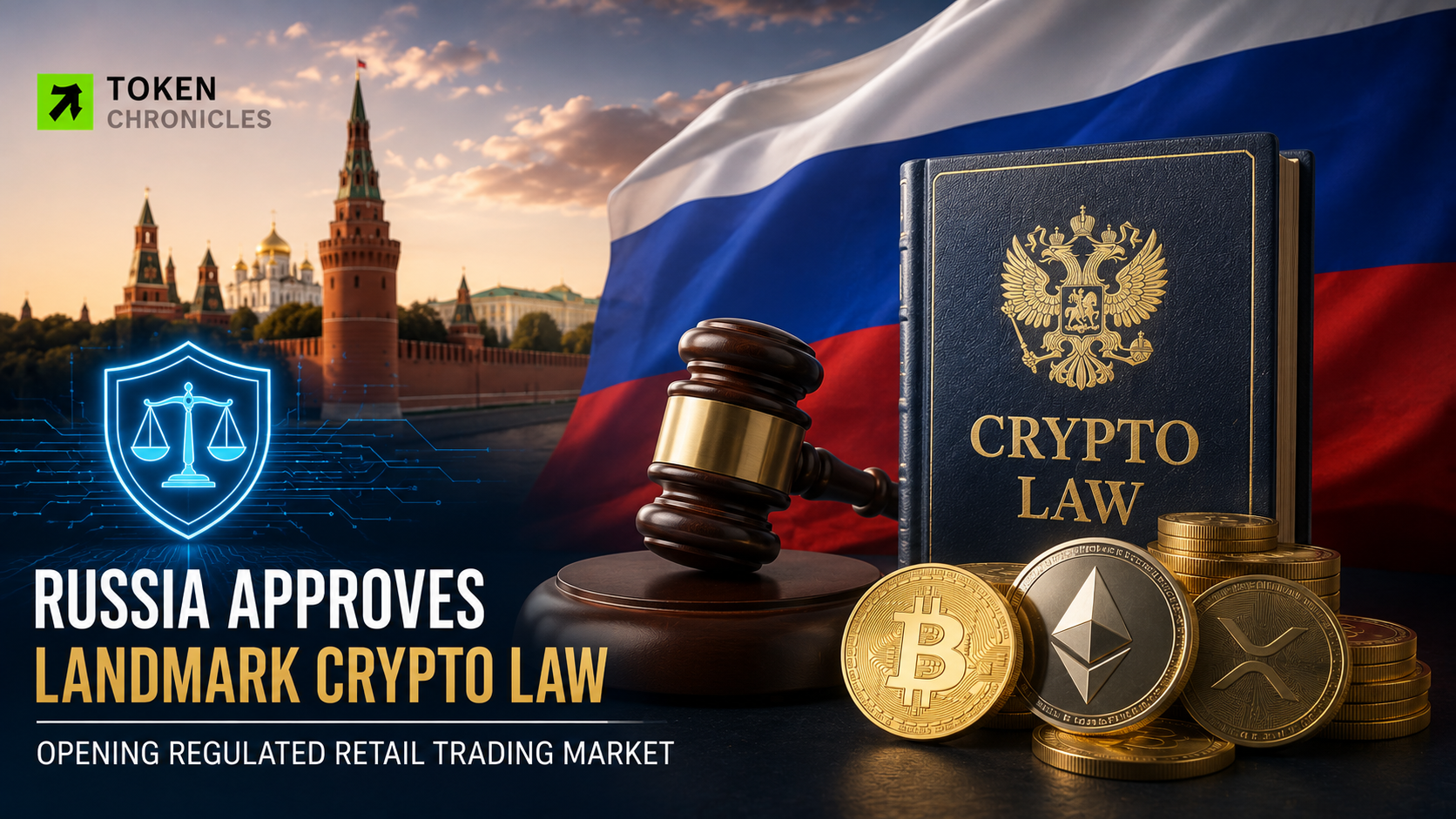
Russian President Vladimir Putin has signed a landmark cryptocurrency law that establishes the country’s first comprehensive regulatory framework for digital assets. The legislation introduces clear rules for crypto exchanges, brokers, custodians, investors, and other market participants while formally permitting regulated retail cryptocurrency trading.
Although the law marks a major step toward legitimizing the crypto industry in Russia, it continues to prohibit the use of cryptocurrencies as a domestic means of payment, maintaining the country’s long-standing restrictions on crypto transactions for everyday goods and services.
Russia Introduces Comprehensive Crypto Framework
The newly signed legislation creates a legal structure governing nearly every aspect of Russia’s digital asset ecosystem.
The framework covers:
- Cryptocurrency exchanges
- Digital asset custodians
- Crypto brokers
- Clearing organizations
- Licensed intermediaries
- Retail and institutional investors
By establishing formal licensing and operational standards, Russia aims to bring cryptocurrency trading under greater government oversight while creating a regulated environment for market participants.
Retail Investors Can Access Crypto Under Annual Limits
For the first time, ordinary Russian investors will be able to purchase cryptocurrencies through licensed intermediaries under a regulated system.
Retail investors will be permitted to buy up to 300,000 rubles (approximately $3,700) worth of approved cryptocurrencies each year through each authorized intermediary.
The legislation does not specify which cryptocurrencies will initially qualify, with regulators expected to determine eligible digital assets through future guidance.
Before investing, retail participants must also complete mandatory suitability assessments designed to evaluate their understanding of digital asset risks.
Qualified Investors Face No Purchase Limits
The law also creates a separate category for qualified investors, who will be allowed to purchase cryptocurrencies without annual investment limits.
Individuals may qualify based on factors such as their investment experience and cryptocurrency transaction history.
Like retail participants, qualified investors must satisfy regulatory suitability requirements before gaining unrestricted access to digital asset markets.
New Rules for Crypto Exchanges
Under the legislation, cryptocurrency exchanges wishing to operate legally in Russia must register with a newly established government registry.
To receive authorization, exchanges must:
- Maintain minimum capital of 15 million rubles (approximately $185,000)
- Join an approved financial market self-regulatory organization
- Comply with ongoing regulatory oversight and reporting requirements
Existing crypto trading platforms will have until March 1, 2027, to comply with the new regulatory framework.
Domestic Crypto Payments Remain Prohibited
Despite opening regulated investment opportunities, the law maintains Russia’s prohibition on using cryptocurrencies as legal tender for domestic commerce.
Businesses and consumers will continue to be barred from using digital assets to pay for goods and services within Russia.
However, the legislation continues to permit cryptocurrency use for certain cross-border trade settlements, allowing businesses engaged in international commerce to utilize digital assets in transactions with foreign counterparties.
Russia has increasingly explored cross-border crypto payments as part of broader efforts to reduce reliance on traditional international financial systems amid ongoing Western sanctions.
Law Takes Effect in Stages
Most provisions of the legislation will become effective on September 1, 2026.
Additional rules governing the issuance and circulation of digital assets are scheduled to take effect on September 1, 2027, providing regulators and market participants with additional time to implement the new framework.
Major Shift in Russia’s Crypto Policy
The legislation represents one of the most significant changes in Russia’s digital asset policy to date.
The law follows approval by the State Duma after months of legislative review and builds upon recent initiatives by the Bank of Russia, which has been developing detailed regulations for organized digital asset trading, licensed exchanges, and digital depositories.
Together, these efforts signal a transition from regulatory uncertainty toward a structured and government-supervised cryptocurrency market.
Mining Restrictions Continue Alongside Market Liberalization
While Russia is opening its regulated crypto investment market, authorities continue tightening oversight of cryptocurrency mining.
Earlier this year, the Russian government announced restrictions on crypto mining operations in Moscow, the surrounding Moscow region, and parts of the Kursk region, with the ban scheduled to remain in effect until 2032.
The contrasting policies reflect Russia’s evolving digital asset strategy: encouraging regulated investment and financial innovation while maintaining strict control over cryptocurrency payments, mining activity, and market participants.
With the new legislation, Russia joins a growing number of countries implementing comprehensive crypto regulations, providing greater legal certainty for investors while expanding government oversight of the rapidly developing digital asset industry.