

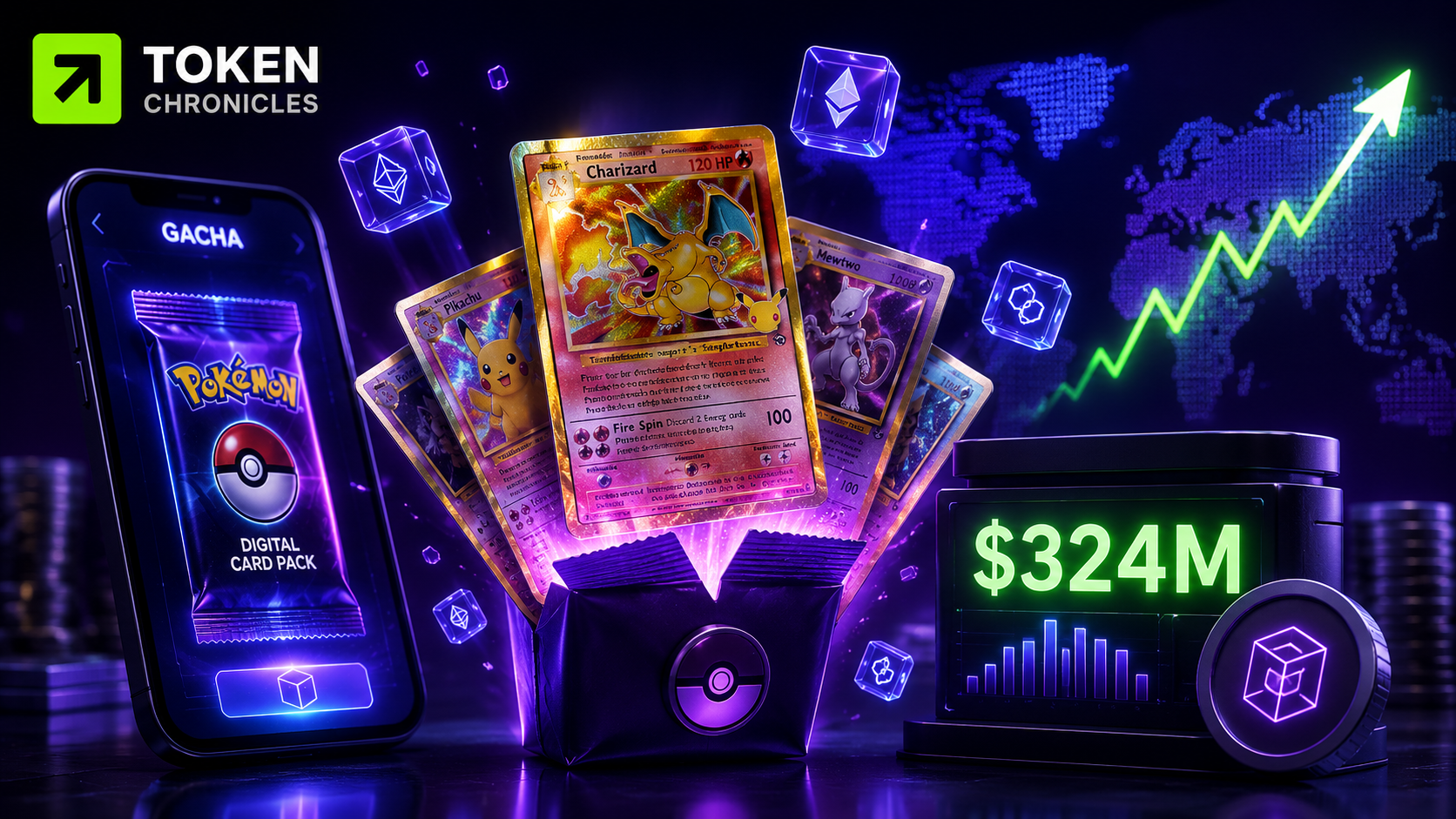
While the broader crypto market struggled through one of its weakest months in recent years, a surprising corner of the blockchain economy surged to new highs. Onchain gacha a blockchain-based system that lets users open randomized packs of tokenized collectibles generated a record $324 million in spending during June 2026, according to Blockworks Research.
The milestone came despite Bitcoin falling more than 20%, reaching a 21-month low, while spot Bitcoin ETFs recorded approximately $4.5 billion in net outflows. Instead of retreating from risk, many crypto users shifted their attention toward tokenized Pokémon cards and other digital collectibles.
Tokenized Pokémon Cards Gain Momentum
The sector revolves around gacha, a Japanese-style randomized purchase system where buyers pay a fixed amount to receive an unknown reward.
Applied to trading cards, users purchase digital booster packs backed by real, authenticated collectibles stored in secure vaults. Opening a pack reveals a random card, with rare cards carrying significantly higher market value than common ones.
The excitement of potentially uncovering a valuable collectible has turned blockchain-based trading card platforms into one of crypto’s fastest-growing niche markets.
Real cards, real ownership
Projects such as Collector Crypt and Courtyard bridge physical collectibles with blockchain technology by tokenizing professionally graded trading cards.
Each NFT represents ownership of a specific physical card stored in a secure vault. Owners can:
- Trade the NFT instantly onchain
- Sell it back to the platform
- Hold it as a collectible
- Redeem it for delivery of the physical card
Most tokenized cards have already been authenticated and graded by companies such as PSA, Beckett, or CGC, helping establish transparency and market value.
Solving a liquidity problem
Traditional trading card markets are often slow and inefficient.
Selling a valuable collectible typically requires finding a buyer, verifying authenticity, negotiating pricing, and arranging secure shipping.
Blockchain removes much of that friction.
Tokenized ownership allows cards to change hands instantly while the physical asset remains securely stored until redemption, creating continuous liquidity without moving the underlying collectible.
According to Collector Crypt, the platform has tokenized roughly $40 million worth of trading cards and comic books and acquires approximately $2 million in new inventory every week to meet growing demand.
Pokémon’s popularity drives growth
The surge also reflects booming demand for Pokémon collectibles globally.
Research from Circana shows Pokémon became the best-selling toy brand in the United States during 2025, generating approximately $2.5 billion in sales.
Meanwhile, grading companies have experienced overwhelming demand as collectors continue submitting millions of cards for authentication.
This strong real-world market has provided fertile ground for blockchain platforms offering tokenized ownership and instant trading.
Speculation meets collecting
The rapid rise of onchain gacha has also reignited debates around speculation.
Many platforms offer instant buyback programs, allowing users to quickly sell lower-value cards and purchase additional packs within seconds.
The system resembles the “loot box” mechanics commonly seen in video games, where users pay for randomized rewards with varying probabilities.
Critics argue the model encourages gambling-like behavior, while supporters maintain it simply digitizes an existing trading card experience that has existed for decades.
Collectors still want physical cards
Despite active speculation, many users remain genuine collectors.
Data from Dune Analytics shows thousands of tokenized cards are redeemed regularly, indicating that buyers continue requesting physical delivery rather than treating every NFT purely as a trading asset.
Collector Crypt says around 30% of its users eventually redeem their cards, while millions of dollars’ worth of insured collectibles are shipped every month.
A new chapter for Real-World Asset Tokenization
The success of tokenized trading cards highlights another emerging use case for real-world asset (RWA) tokenization.
Instead of focusing solely on tokenized stocks or real estate, blockchain companies are applying the same technology to collectibles, creating faster markets with greater liquidity and global accessibility.
Although questions remain about long-term sustainability and speculative behavior, June’s record spending demonstrates that tokenization is expanding beyond traditional financial assets into consumer collectibles, opening new opportunities for both crypto investors and hobbyists alike.