


As artificial intelligence agents become increasingly capable of negotiating contracts, making purchases, and executing financial transactions without human involvement, a coalition of technology companies and legal institutions has introduced a new framework designed to bring legal certainty to the emerging AI economy.
The initiative, known as the Legal Context Protocol (LCP), seeks to establish standardized legal rules for transactions conducted by autonomous AI agents, helping businesses determine responsibility when disputes arise.
Building the Legal Foundation for Autonomous AI
The American Arbitration Association (AAA), in partnership with technology firm Integra Ledger, officially launched the Legal Context Protocol to address one of the biggest challenges facing agentic AI: legal accountability.
While AI payment infrastructure and digital identity solutions continue to evolve rapidly, experts argue that the legal systems governing autonomous machine-to-machine interactions have not kept pace.
The new protocol is designed to fill that gap by embedding legal terms, contractual agreements, consent mechanisms, and dispute resolution processes directly into AI-driven transactions.
Why Current Legal Models Fall Short
Traditional online commerce relies heavily on user agreements, terms of service, and click-through contracts that require human interaction.
However, those models become far less practical when autonomous software agents negotiate and complete transactions without direct human input.
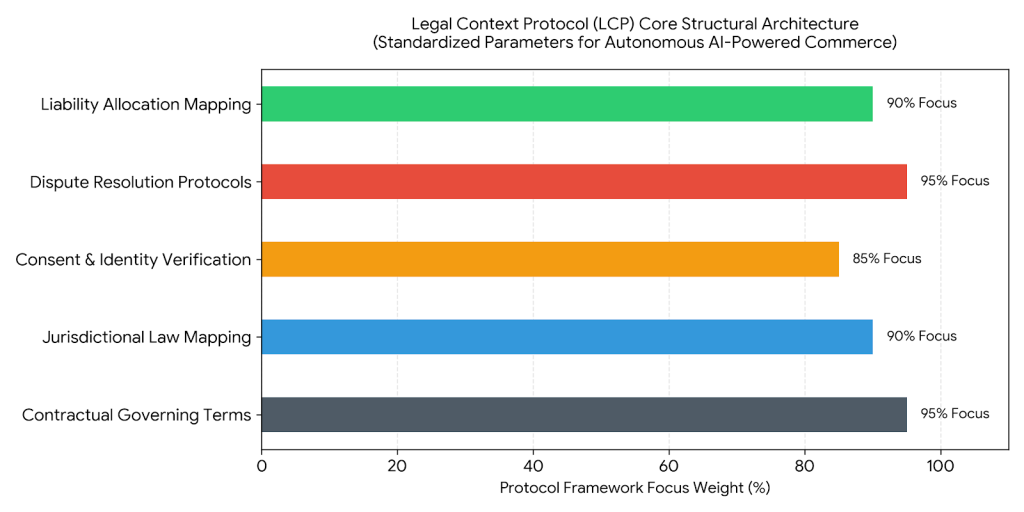
The Legal Context Protocol introduces a standardized framework that allows AI systems to understand:
- The legal terms governing a transaction
- Which jurisdiction’s laws apply
- How consent is established
- How disputes should be resolved
- Which parties hold responsibility if something goes wrong
The goal is to ensure that autonomous commerce remains legally enforceable while reducing uncertainty for businesses and consumers.
Industry Leaders Back the Initiative
The project has attracted support from a broad range of organizations spanning artificial intelligence, blockchain, financial technology, and enterprise software.
Among the founding contributors are major industry players including:
- IBM
- Circle
- Hedera
- Cardano
- Stellar Development Foundation
- Ava Labs
- Aptos Foundation
- Sei Labs
- Mysten Labs
- Crossmint
- Wayfair
The collaboration reflects growing industry recognition that legal infrastructure must evolve alongside advances in AI automation.
Agentic AI Is Becoming a Multi-Trillion-Dollar Market
Industry analysts expect autonomous AI agents to play an increasingly important role in global commerce over the coming years.
Businesses are already exploring AI systems capable of independently managing procurement, negotiating contracts, processing payments, coordinating supply chains, and interacting with other AI agents.
Several market forecasts suggest the sector could experience explosive growth throughout the decade.
Research firms estimate that spending driven by autonomous AI commerce may reach trillions of dollars within the next several years, while demand for AI-powered digital services is expected to accelerate rapidly across industries.
Creating Trust for the AI Economy
Supporters of the Legal Context Protocol argue that widespread adoption of agentic AI will require more than advanced technology it will also depend on establishing clear legal standards that businesses, regulators, and consumers can trust.
Rather than replacing existing payment or identity systems, the protocol is intended to complement them by providing a legal framework that verifies what was agreed, under which terms, and what remedies exist if contractual obligations are not fulfilled.
As autonomous AI moves beyond experimentation into real-world commercial applications, initiatives like the Legal Context Protocol could become a critical building block for the next generation of digital commerce.
By combining legal certainty with automated transactions, the project aims to help create a more secure, transparent, and trustworthy foundation for the rapidly expanding AI-driven economy.


