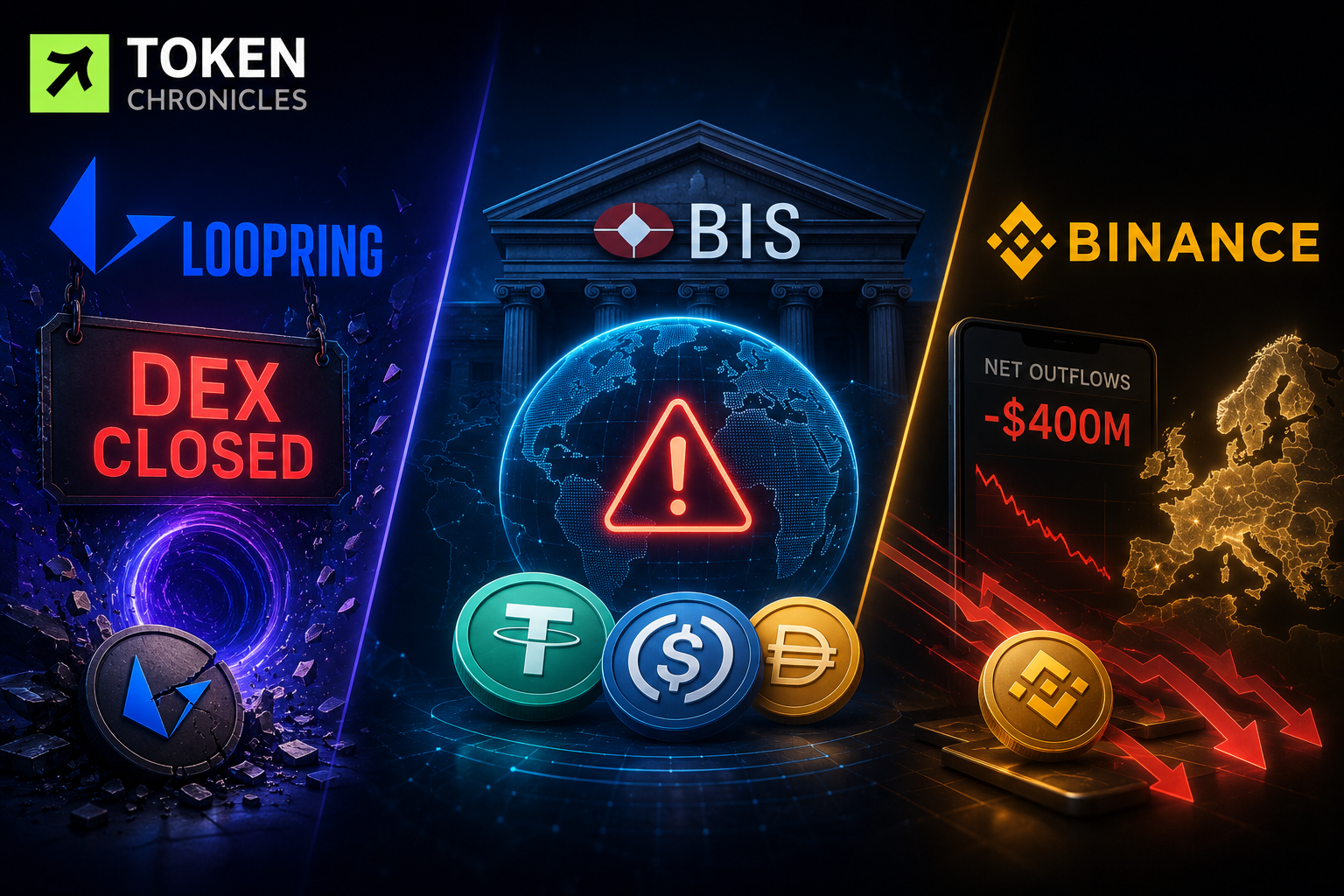


Loopring, one of Ethereum’s earliest Layer-2 scaling projects and the first protocol to demonstrate the potential of zero-knowledge (zk) rollups, has announced the closure of its decentralized exchange (DEX) and automated market maker (AMM), bringing an end to its trading operations after years of declining adoption.
The shutdown takes effect immediately, with all trading services halted as the project prepares to return user funds.
A Pioneer Overtaken by Innovation
Launched in 2017, Loopring was among the first blockchain projects to use zero-knowledge proofs to improve Ethereum’s scalability. The protocol raised $45 million through its initial coin offering (ICO) and played a significant role in proving that zk-rollups could deliver faster, cheaper transactions while maintaining Ethereum’s security.
However, blockchain technology has evolved rapidly over the past few years.
The Loopring team acknowledged that its original architecture lacked key features that newer Layer-2 networks now offer, including Ethereum Virtual Machine (EVM) compatibility, smart contract composability, and broader support for real-world applications.
“As the first zk-rollup, we lacked a virtual machine, composability, and practical payment use cases. Those limitations ultimately prevented our ecosystem from reaching wider adoption,” the team said.
Adoption Never Reached Critical Mass
Despite its technological achievements, Loopring struggled to attract sustained user activity.
The developers admitted that the protocol never gained the level of ecosystem growth needed to compete with newer Layer-2 platforms such as zkSync, Scroll, and Starknet, all of which offer full Ethereum compatibility and more flexible developer environments.
The team also acknowledged that while it excelled in engineering, it lacked the business development capabilities necessary to build a thriving ecosystem around the technology.
Exchange Delistings Added Pressure
The challenges intensified in 2026 as several major cryptocurrency exchanges removed LRC, Loopring’s native token, from their trading platforms.
Combined with increasing competition and declining market activity during the ongoing crypto downturn, these developments accelerated the project’s decision to discontinue its exchange services rather than continue operating with limited user engagement.
Users Will Receive Their Funds
Loopring stated that it will calculate final user balances before distributing assets directly to users’ Ethereum wallets.
The team also confirmed it will cover Ethereum gas fees associated with the withdrawals, ensuring users can recover their funds without additional costs.
The protocol had already discontinued its wallet services in 2025 as part of a broader effort to reduce operational complexity.
Once a Major DeFi Player
At its peak during the 2021 bull market, Loopring managed more than $760 million in total value locked (TVL).
Today, that figure has fallen to approximately $8 million, representing a decline of nearly 99%.
Its native LRC token has experienced a similar collapse, falling from an all-time high of $3.75 to around $0.01.
One of Loopring’s most notable achievements was its partnership with GameStop, which used the protocol to launch its NFT marketplace in 2022.
Crypto Winter Continues to Reshape the Industry
Loopring’s closure adds to a growing list of crypto projects that have shut down during the current market downturn.
According to industry data, more than 60 blockchain projects and protocols have ceased operations in 2026 as reduced funding, weaker user activity, and changing market dynamics force many earlier-generation platforms to exit the industry.
The trend highlights how rapidly blockchain infrastructure continues to evolve, with newer technologies replacing pioneering projects that helped lay the foundation for today’s decentralized ecosystem.
Why It Matters
Loopring’s shutdown marks the end of one of the earliest success stories in Ethereum scaling.
Although the project struggled to remain competitive, its innovations helped establish zero-knowledge rollups as one of the most promising scaling technologies in blockchain.
Its legacy lives on through the next generation of Layer-2 networks that continue building upon the technical breakthroughs Loopring introduced nearly a decade ago.