

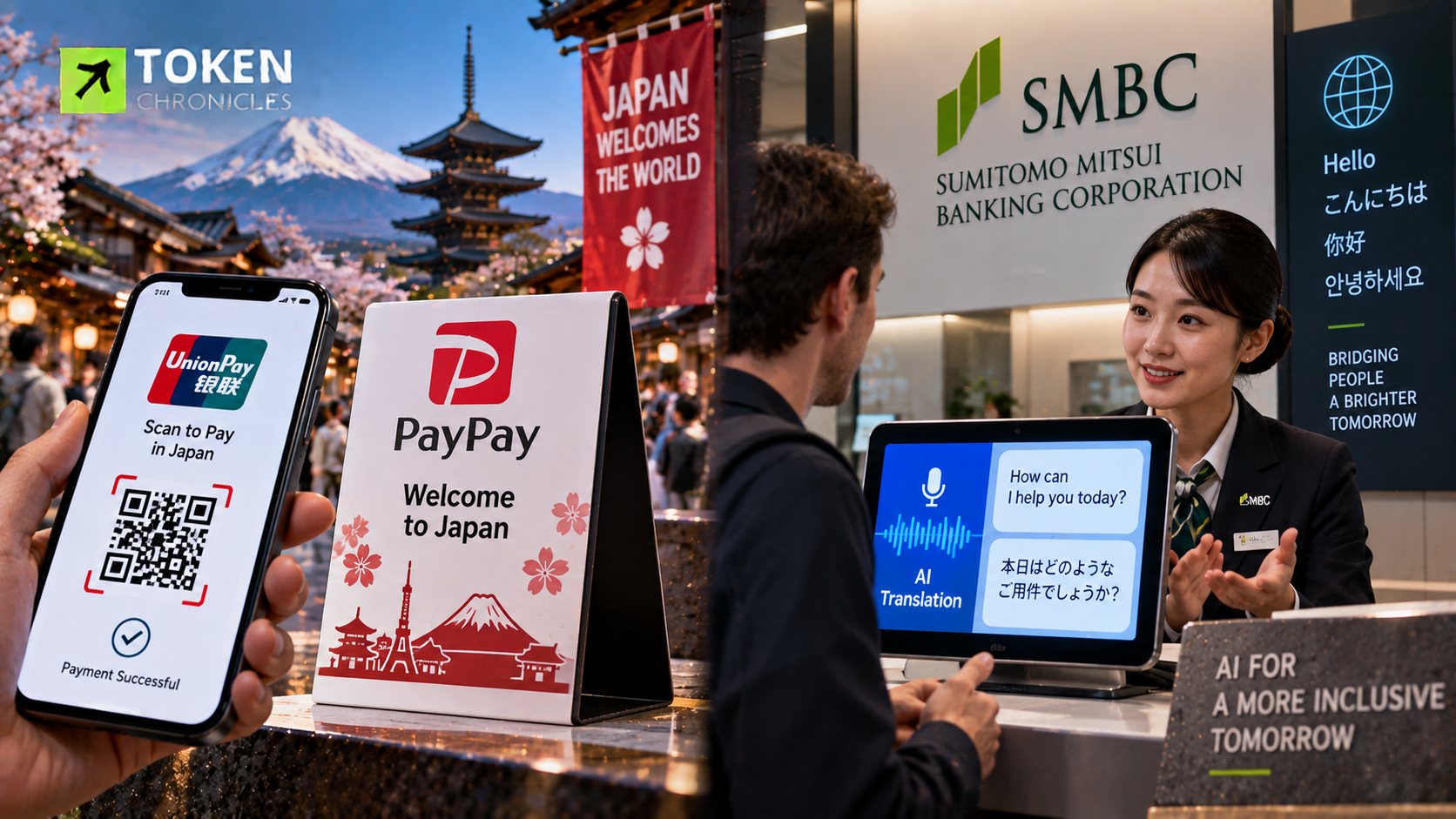
Japan’s financial-services industry is advancing two separate digital initiatives, with PayPay expanding UnionPay QR payment acceptance for international visitors and Sumitomo Mitsui Banking Corporation deploying an AI-powered interpretation tool for employees. The developments highlight how Japanese financial institutions are using technology to improve cross-border payments and customer communication.
Key Takeaways
- PayPay introduced UnionPay App QR payments at participating merchants across Japan through the HIVEX platform.
- UnionPay users with eligible cards issued in mainland China, Hong Kong and Macau can pay without downloading PayPay.
- PayPay says its merchant network now supports 36 overseas payment services across 17 markets.
- SMBC is rolling out SMBC-Interpreter, an internal translation application powered by OpenAI’s GPT-Live-1.
- SMBC says customer audio and translated responses are not stored or used to train AI models.
PayPay Expands QR Payment Options for International Visitors
PayPay has expanded its international payment infrastructure by adding UnionPay App payments to participating merchants across Japan.
The company announced the integration on September 3, explaining that eligible UnionPay users can make purchases through PayPay’s participating merchant network using the HIVEX payment platform.
The initiative is primarily aimed at overseas visitors who want to use familiar payment credentials while traveling in Japan.
Instead of opening a PayPay account, eligible travelers can register their UnionPay cards directly through the UnionPay App and use the application to complete purchases at supported locations.
The arrangement is particularly relevant for visitors from mainland China, Hong Kong and Macau, where UnionPay has a substantial presence.
HIVEX Connects Japanese Merchants With Overseas Wallets
The underlying infrastructure is provided through HIVEX, which is designed to connect domestic merchants with international mobile-payment services.
This allows participating merchants to accept certain overseas payment applications without having to establish an entirely separate technical integration for every foreign wallet.
Customers can use their UnionPay App payment code at participating PayPay locations. Purchases can include everyday expenses such as restaurants, accommodation and shopping.
Transactions are displayed in Japanese yen at the merchant, while the customer’s UnionPay application handles the conversion into the user’s home currency.
This structure effectively separates the merchant-facing payment experience from the visitor’s existing financial application.
TBCASoft, the company operating the HIVEX platform, said UnionPay App payments became available at participating PayPay locations during early September.
The company also referenced a network of more than 500 million linked UnionPay card users. That figure represents cards connected through UnionPay’s broader issuing network and should not be interpreted as the number of UnionPay users currently making purchases through PayPay merchants in Japan.
Merchant participation is also location-dependent. Although PayPay describes the service as available across Japan, that does not mean every merchant accepting PayPay can necessarily process UnionPay App transactions.
PayPay Now Supports 36 Overseas Payment Services
The UnionPay addition is part of a broader effort by PayPay to make its merchant ecosystem more accessible to international visitors.
Following the latest integration, PayPay said its network supports 36 overseas cashless payment services across 17 countries and regions.
The company estimates that those markets represent approximately 80% of international visitors to Japan.
That figure refers to the geographic markets represented by PayPay’s supported payment services. It does not mean that 80% of foreign tourists have used PayPay or completed transactions at PayPay-enabled merchants.
PayPay’s international coverage has expanded considerably over time. An earlier announcement in October 2025 listed 28 overseas payment services spanning 14 countries and regions.
The company also said transaction value generated through overseas cashless services in fiscal 2024 was approximately three times its fiscal 2019 level, although it did not provide the underlying transaction amount.
The addition of UnionPay therefore gives travelers another way to pay while allowing them to remain within an application they already use.
UnionPay Users Do Not Need to Download PayPay
One of the more practical aspects of the arrangement is that international visitors do not need to become PayPay users to access the new payment option.
Eligible UnionPay customers can keep their cards, account controls and transaction records within the UnionPay App.
For PayPay, this creates a pathway to international payment volume without requiring every visitor to register for its domestic wallet.
For merchants, meanwhile, the arrangement potentially increases the number of international payment methods that can be accepted through existing infrastructure.
PayPay has indicated that it intends to pursue additional relationships with overseas payment providers, although the company did not provide a specific timetable or forecast for future integrations or UnionPay transaction volumes.
SMBC Deploys AI-Powered Live Translation
While PayPay is focusing on payments, Sumitomo Mitsui Banking Corporation is applying artificial intelligence to a different challenge: communication between bank employees and customers who speak different languages.
SMBC announced on September 11 that it had begun introducing SMBC-Interpreter, an internal application designed to help employees communicate with customers in foreign languages.
The system uses OpenAI’s GPT-Live-1 to process spoken conversations and produce translated voice responses.
At the same time, translated text is displayed on screen.
That combination gives employees and customers two ways to follow the conversation: through spoken translation and synchronized written text.
How SMBC-Interpreter Works
The application is intended to assist employees during customer interactions where language differences could make communication difficult.
An employee can speak into the system, after which the AI processes the conversation and produces a translated response.
The translated wording appears visually on the screen at the same time.
This could allow employees to review the translated text while interacting with customers and provide another reference point when discussing banking services or operational information.
SMBC described the product as an internal support tool rather than a consumer-facing AI service.
The bank did not disclose the number of branches or employees participating in the initial rollout. It also did not provide a complete list of supported languages.
Importantly, the bank did not publish an accuracy rate, response-time benchmark or comparison between the AI system and professional human interpreters.
It also did not specify whether human interpretation remains mandatory for particular regulated procedures, contracts or customer disclosures.
SMBC Emphasizes Data Protection
Privacy is particularly important when artificial intelligence is used in banking because customer conversations can contain highly sensitive information.
SMBC said that neither the original audio nor the generated translations are stored within the application or its connected external services.
The bank also stated that the conversation content is not used to train AI models.
These safeguards are intended to address concerns about sensitive customer information being retained or repurposed by an AI system.
However, the announcement did not identify an independent audit of those controls, meaning the company’s statements remain the primary source for the described data-handling practices.
Two Separate Digital Finance Strategies
Although both announcements involve financial technology, the PayPay and SMBC initiatives are fundamentally different.
PayPay’s UnionPay integration focuses on cross-border payments and merchant acceptance.
SMBC-Interpreter focuses on communication between employees and customers.
Neither company presented the respective initiative as a cryptocurrency or stablecoin project.
PayPay’s UnionPay service uses conventional card-linked mobile payments, while SMBC’s application is an AI translation system.
That distinction is important because Japan is simultaneously exploring other forms of digital financial infrastructure, including proposals involving tokenized deposits and yen-denominated stablecoins.
Those initiatives should not be confused with the products announced by PayPay and SMBC.
Digital Infrastructure Becomes a Competitive Tool
The developments nevertheless demonstrate how financial institutions are approaching digital transformation from multiple directions.
For PayPay, the priority is making its merchant network more useful to international visitors and reducing friction between domestic businesses and overseas payment ecosystems.
For SMBC, artificial intelligence is being deployed to reduce communication barriers and potentially make multilingual banking interactions easier for employees.
Both approaches rely on technology to improve existing financial services rather than replacing traditional financial institutions altogether.
Japan’s Financial Technology Push Continues
Japan has been expanding its digital-finance infrastructure while financial institutions experiment with payments, artificial intelligence, blockchain and tokenization.
PayPay’s expansion illustrates the growing importance of interoperable payment networks as international travel and cross-border commerce generate demand for familiar payment methods.
SMBC’s AI interpreter demonstrates another side of that transformation, showing how generative AI can be integrated into internal banking workflows without necessarily becoming part of the financial transaction itself.
Neither initiative comes with a publicly disclosed revenue target, cost estimate or earnings forecast.
As a result, the immediate financial impact on PayPay, SMBC or their parent groups remains unclear.
For now, the significance lies primarily in the infrastructure being deployed.
PayPay is making it easier for international visitors to use familiar QR payments at Japanese merchants, while SMBC is testing AI as a real-time communication layer for banking staff. Together, the initiatives show how Japan’s financial sector is adopting new technology across both the transaction and customer-service sides of banking.