

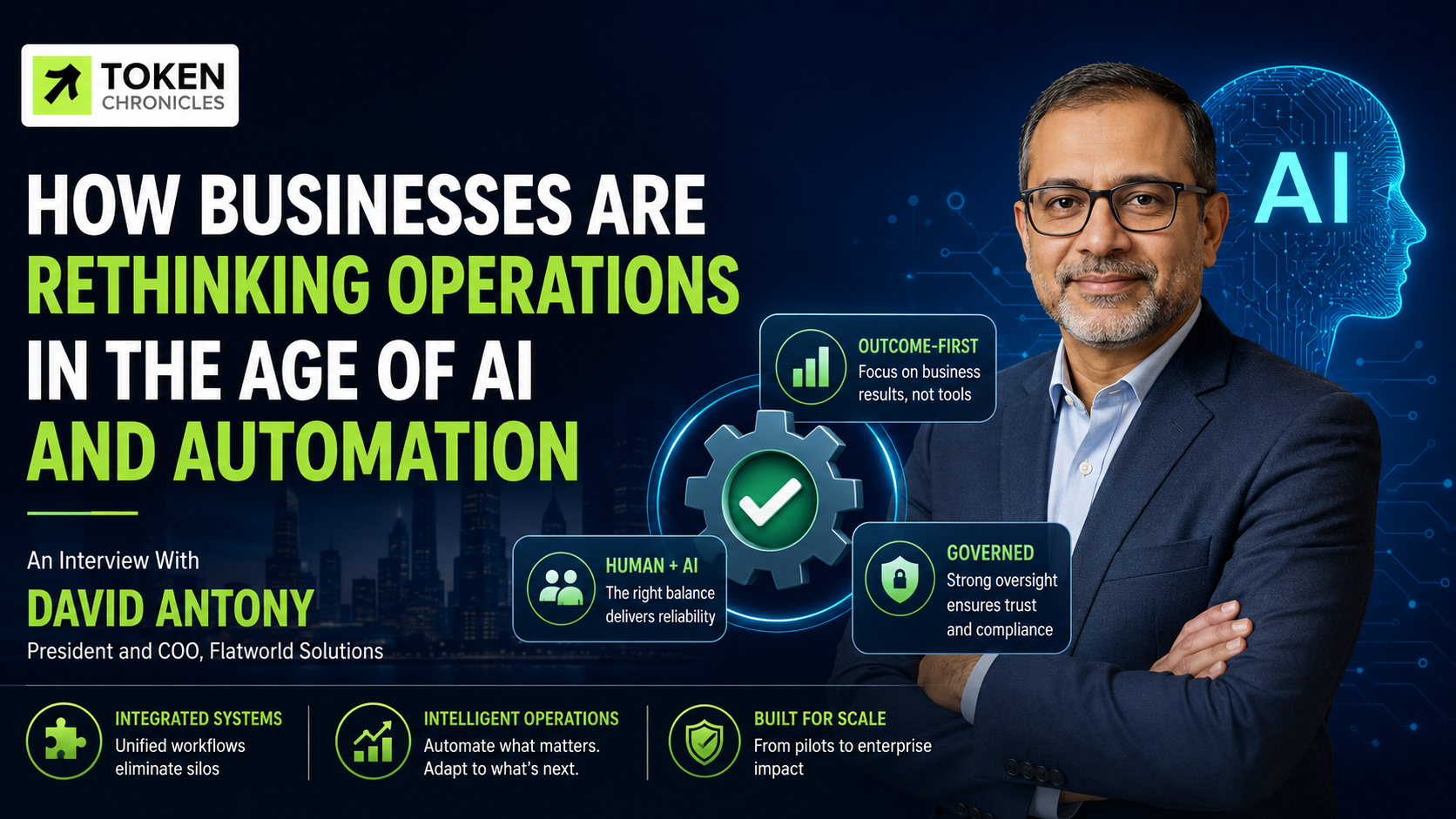
As artificial intelligence moves rapidly from experimentation into mainstream business operations, companies are discovering that simply adding automation does not automatically make an organization more efficient. In many cases, AI exposes weaknesses that were already embedded in workflows, data structures and management processes.
In an interview with TechBullion, David Antony, President and COO of Flatworld Solutions, discusses how businesses can approach AI and automation more effectively. Drawing on more than two decades of experience across customer-facing and back-office operations, Antony explains why companies need to focus on business outcomes, process design and governance rather than chasing individual AI tools.
His perspective covers enterprise automation, legacy infrastructure, AI governance, cybersecurity, organizational change, intelligent operations and the challenges of moving successful pilots into large-scale production.
A Career Built Around Technology and Business Operations
Antony says his professional focus has centered on helping companies improve both their customer-facing activities and internal operations.
Flatworld Solutions operates across areas including customer support, healthcare, finance, software and mortgage services, serving customers in more than 100 countries. The company’s activities have increasingly moved toward the intersection of business process outsourcing, technology, artificial intelligence and automation.
That experience has shaped Antony’s view that technology should support operational objectives rather than become an objective in itself.
AI Often Reveals Problems Instead of Solving Them
One of the biggest misconceptions surrounding automation is that deploying an AI system will immediately eliminate inefficiencies.
According to Antony, the opposite can happen when companies automate processes that were already poorly structured. AI does not necessarily create fragmentation; instead, it can make existing weaknesses much more visible.
For example, marketing might introduce an AI chatbot, sales could deploy an automated outreach platform, while finance adopts another system for extracting information from invoices. Each tool may provide value independently, but running them separately can create duplicated work, inconsistent information and multiple sources of truth.
As more disconnected systems are added, integration becomes increasingly difficult. Antony therefore argues that businesses should approach automation at the enterprise-workflow level, rather than allowing individual departments to build isolated solutions.
Automation Needs Human Oversight
Another source of complexity comes from unrealistic expectations.
AI systems operate in environments where data can change, models can drift, regulations can evolve and unusual cases can appear. Even systems that perform well during testing may behave differently when exposed to real-world conditions.
As a result, businesses frequently add monitoring teams, quality checks and manual intervention after an automation system has already been deployed.
Antony believes these safeguards should be designed into the workflow from the beginning. Human review, audit trails and clearly defined checkpoints can make automated systems more dependable rather than treating human involvement as evidence that automation has failed.
Start With the Process, Not the Technology
For businesses planning an automation strategy, Antony recommends beginning with the desired business result.
Organizations should first understand how a process currently operates, identify unnecessary steps and standardize workflows before deciding what should be automated. Otherwise, technology can simply reproduce an inefficient process at a much larger scale.
He also recommends designing around unified workflows instead of accumulating separate tools for every department.
An effective automation architecture should establish:
- Which decisions AI can make independently
- Where employees must remain involved
- How exceptions will be handled
- How data will move between systems
- Which platform will serve as the central source of information
With these foundations in place, automation becomes an operational capability rather than a collection of disconnected software products.
Governance Becomes More Important as AI Expands
As AI spreads across departments, governance can no longer be treated as the responsibility of one team.
Antony describes several layers of governance that organizations should consider. Model governance involves monitoring AI performance and identifying problems such as model drift. Process governance requires businesses to periodically review and improve automated workflows. Data governance addresses access controls, data quality and associated risks.
Security is another growing concern. AI can expand the attack surface while making social-engineering techniques more sophisticated.
For this reason, automated decisions should remain transparent and auditable. Human accountability is still essential, particularly when AI is involved in sensitive financial, regulatory or customer decisions.
Legacy Technology Requires a Gradual Approach
Many businesses continue to rely on older technology because those systems remain dependable. The challenge is connecting modern AI capabilities to that infrastructure without creating another layer of technical complexity.
Antony recommends beginning with a limited number of high-value workflows instead of attempting to transform the entire organization simultaneously.
Companies should test and refine individual use cases before expanding them across the business.
Legacy applications can create additional difficulties when they lack modern APIs. Embedding automation directly into these systems may provide a short-term solution but can eventually create tightly connected components that are expensive and difficult to maintain.
A middleware layer or dedicated data architecture can provide a more flexible connection between older applications and newer AI systems.
Flatworld’s Approach: Business Results Before AI
Antony says Flatworld Solutions approaches automation from its experience managing real operational processes across different industries.
Rather than beginning with a goal such as “implement AI,” the company first examines the client’s desired outcome and analyzes the workflow from beginning to end.
Not every activity should necessarily be automated.
Some tasks may be too sensitive, too unusual or too limited in scale to justify automation. In those circumstances, introducing AI can create additional monitoring requirements that outweigh the potential efficiency gains.
The objective is therefore to identify where automation creates measurable value and where human involvement remains the better option.
Automating a Bad Process Only Makes the Problem Bigger
One of the most common mistakes Antony sees is automating a process without first understanding it.
Companies may take an existing workflow and simply reproduce it digitally, even when the original process is fragmented or inefficient.
Poor documentation can make the problem even worse because important dependencies and exceptions may not be captured.
Another frequent mistake is adopting numerous automation products without establishing a common framework. Instead of simplifying operations, the organization ends up managing a growing collection of disconnected systems.
Change Management Can Determine Whether Automation Succeeds
Technology alone does not guarantee adoption.
Employees who have spent years following established procedures may continue using familiar methods even after a new digital system is introduced. Businesses therefore need to prepare employees for changes in responsibilities, workflows and decision-making.
Antony points out that this behavior existed even before the AI era. During earlier digitization efforts, employees sometimes continued completing tasks manually and then entered the same information into digital systems, reducing much of the intended efficiency.
Automation programs can also fail when companies optimize them for controlled pilot environments rather than the complexity of enterprise operations. A solution that works under ideal conditions may encounter very different challenges when deployed throughout an organization.
Innovation and Oversight Must Develop Together
Antony argues that governance should not be viewed as an obstacle to innovation.
Businesses can maintain separate environments for experimentation and production, allowing teams to test emerging technologies without immediately exposing critical operations to unproven systems.
Before moving an AI solution into production, companies should conduct extensive testing, validation and refinement.
This becomes especially important when AI operates as a “black box.” In regulated sectors such as mortgages and insurance, organizations may need to explain why a particular decision was reached rather than simply provide the outcome.
That makes explainability, auditability, traceability and human oversight important components of responsible AI deployment.
The Next Stage: Intelligent Operations
Looking ahead, Antony expects businesses to move beyond basic task automation toward what he describes as intelligent operations.
Instead of asking how many tasks can be automated, organizations will increasingly decide which activities are best performed by people, AI systems or conventional software.
That requires businesses to remain adaptable.
Technological leaders can lose their position when they fail to adjust their operating models as markets change. Antony points to the contrasting trajectories of companies such as Amazon and Barnes & Noble, as well as BlackBerry’s decline, as examples of how adaptability can determine long-term competitiveness.
The Bigger Lesson for Businesses
The central message from Antony’s perspective is that AI is not a substitute for sound operational design.
Companies that deploy AI on top of inefficient processes may simply automate their existing problems. Those that first simplify workflows, establish governance, integrate their data and prepare their workforce can use automation to build more scalable operations.
The strongest organizations may therefore not be the ones deploying the greatest number of AI tools. They will be the companies capable of combining technology, human judgment, governance and adaptable processes into an operating model that can evolve as AI continues to change the business landscape.