
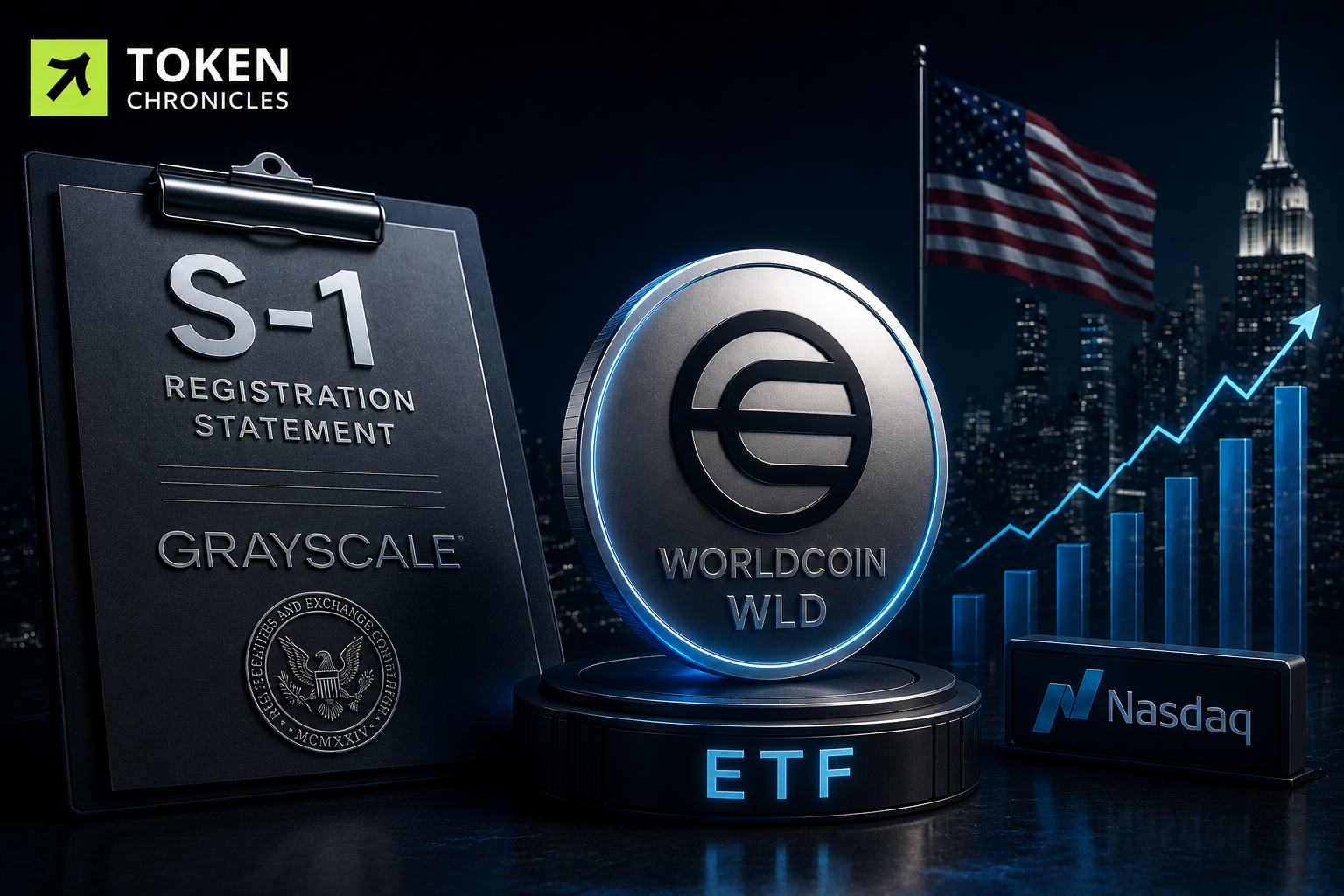
Crypto asset manager Grayscale has filed an S-1 registration statement for a proposed Worldcoin exchange-traded fund, potentially giving US investors a regulated way to gain direct exposure to the WLD token through traditional brokerage accounts.
If approved, the Grayscale Worldcoin ETF would become the first US exchange-traded fund focused specifically on Worldcoin and is intended to trade on the Nasdaq under the ticker GWLD.
The filing represents another sign that the US crypto ETF market is expanding beyond Bitcoin and Ether into a much broader range of digital assets.
Grayscale seeks to bring WLD into the ETF market
According to the preliminary filing, the proposed fund would provide investors with exposure to the price of Worldcoin (WLD) without requiring them to directly purchase, custody, or manage the cryptocurrency themselves.
Under the proposed structure, BitGo Bank & Trust would custody the fund’s WLD holdings, while BNY Mellon would act as administrator and transfer agent. CSC Delaware Trust Company is expected to serve as trustee.
Several important details have yet to be disclosed, including the fund’s management fee, seed investment, authorized participants, and liquidity providers.
The S-1 filing is an early step in the regulatory process and does not guarantee that the ETF will ultimately launch.
Worldcoin brings a different narrative to crypto ETFs
Worldcoin stands apart from many of the digital assets already represented in crypto investment products because of its connection to digital identity and proof of human verification.
WLD is an ERC-20 token associated with World, a project co-founded by Sam Altman that is building a network designed to distinguish humans from automated systems using its proof-of-human verification infrastructure.
The project has attracted significant attention as artificial intelligence makes it increasingly difficult to differentiate between human and machine-generated activity online.
That gives a potential WLD ETF exposure to a different investment narrative than Bitcoin’s store-of-value thesis or Ethereum’s smart-contract ecosystem: the emerging intersection of AI, digital identity, biometrics, and blockchain infrastructure.
Crypto ETFs are moving beyond Bitcoin and Ether
Grayscale’s Worldcoin filing also reflects the rapid diversification of the US crypto investment market.
The asset manager already offers a broad lineup of crypto-related exchange-traded products providing exposure to assets including Bitcoin, Ether, XRP, Solana, Dogecoin and Chainlink.
For years, institutional crypto investment products were overwhelmingly concentrated around Bitcoin and, later, Ether. That landscape is now broadening as asset managers explore regulated products tied to alternative blockchain networks and tokens.
If regulators continue allowing a wider range of crypto ETFs, traditional investors could eventually gain access to diversified segments of the digital asset economy without interacting directly with wallets, exchanges, or on-chain infrastructure.
Worldcoin ETF could test investor demand for more specialized tokens
The proposed GWLD fund could also provide an important test of how much demand exists for single-asset crypto ETFs outside the largest cryptocurrencies.
Bitcoin and Ether already have substantial institutional recognition and liquidity. More specialized assets such as WLD represent a different proposition, with their investment cases often tied to specific protocols, technologies, and ecosystems.
For Worldcoin, an ETF could potentially increase accessibility and visibility among traditional investors. However, approval would not eliminate risks associated with the underlying token, including volatility, regulatory uncertainty, project-specific risks, and questions surrounding biometric identity technologies.
Grayscale’s filing ultimately highlights a broader evolution underway in crypto investing.
The ETF market is no longer focused exclusively on bringing Bitcoin into traditional finance. Asset managers are increasingly attempting to package individual crypto sectors and emerging blockchain narratives into regulated investment products.
If approved, the first US Worldcoin ETF would push that expansion further, bringing one of crypto’s most prominent AI-and-digital-identity-linked assets directly into the traditional ETF market.