
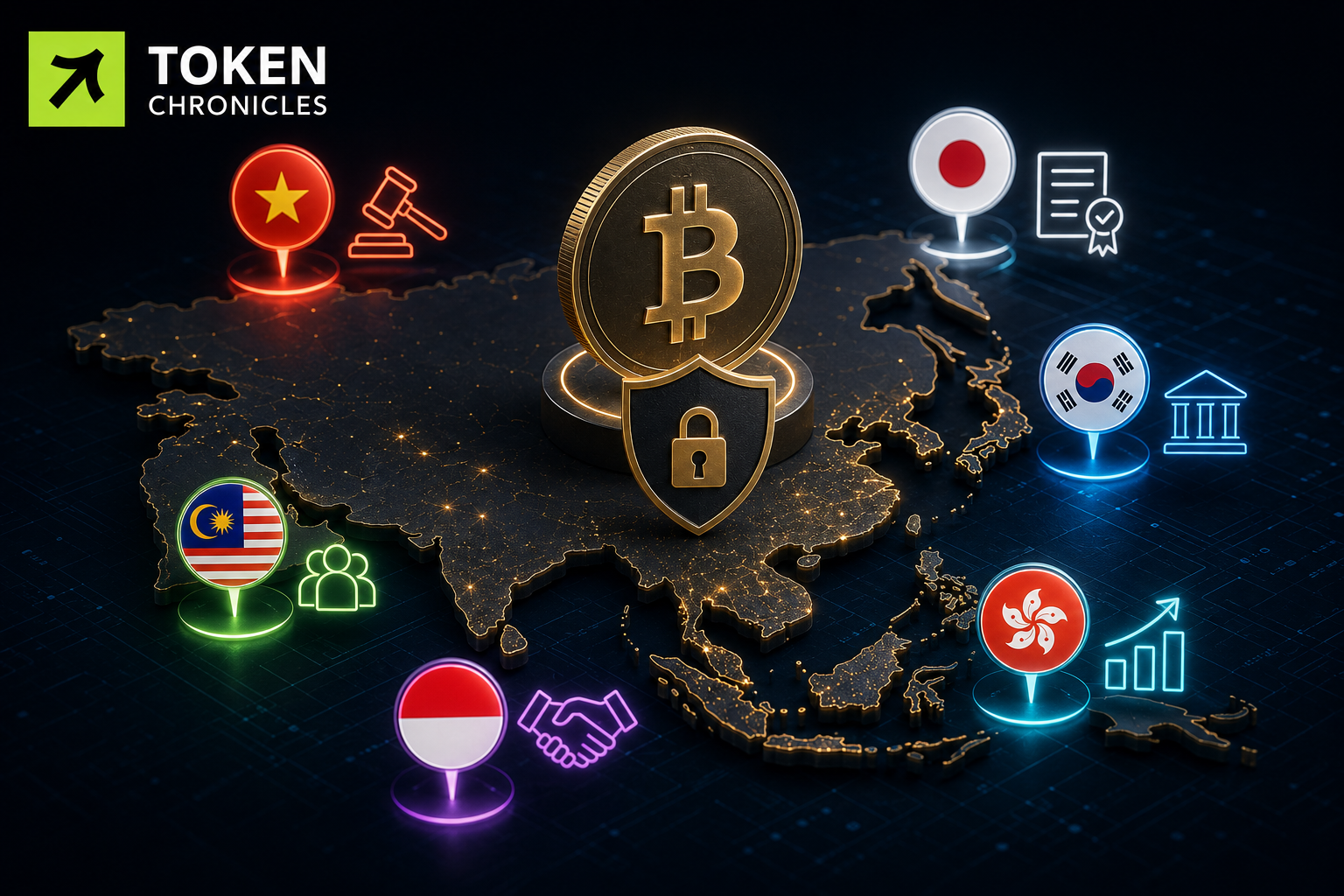
Asia’s crypto regulatory landscape is undergoing significant changes, with governments across the region taking sharply different approaches to digital assets.
Vietnam is preparing fines for users trading on unlicensed offshore exchanges, Japan has moved to classify cryptocurrencies as financial assets, South Korea is considering crypto within its national asset framework, and reports suggest Coinbase may be allowing some mainland Chinese users to complete identity verification.
Meanwhile, Malaysia is dealing with controversy surrounding Balaji Srinivasan’s Network School, Hong Kong continues expanding tokenization, and Bybit is strengthening its regulated presence in Indonesia.
Vietnam could fine users of unlicensed offshore crypto exchanges
Vietnam is introducing tougher penalties as it prepares to launch its regulated digital asset market.
Under the reported rules, retail investors who trade through unlicensed overseas crypto platforms could face fines of up to approximately $1,900. This could potentially affect users of major international exchanges such as Binance, OKX and Bybit if those platforms are not licensed under Vietnam’s new framework.
The situation creates an unusual transition period because Vietnam’s Finance Ministry has reportedly not yet issued final exchange licenses, although several platforms have received approval in principle.
Additional penalties could apply to investors who trade digital assets specifically restricted to foreign participants, while crypto businesses may face larger fines for operating or advertising without authorization, failing to conduct required customer identification, or improperly handling customer account information.
The measures signal a shift away from Vietnam’s historically large offshore-driven crypto market toward a more tightly controlled domestic ecosystem.
Malaysia investigates controversy around Balaji Srinivasan’s network school
In Malaysia, Balaji Srinivasan’s Network School in Forest City has become the subject of controversy over allegations involving Israeli citizens reportedly attending through second nationalities.
The issue is particularly sensitive because Malaysia does not maintain diplomatic relations with Israel and generally restricts Israeli passport holders from entering the country.
Malaysian immigration authorities reportedly found that hundreds of foreign nationals associated with the community held valid documentation. However, Johor authorities have continued examining regulatory matters surrounding business licensing, building usage and commercial activities.
The dispute escalated after Srinivasan suggested the project and its investment could leave Malaysia if the situation deteriorated.
The controversy highlights an interesting tension surrounding the broader “network state” concept: digital-first communities may seek to operate globally, but they remain subject to the immigration, licensing and political frameworks of the physical jurisdictions where they establish themselves.
Japan reclassifies crypto as financial assets
Japan is moving toward deeper integration of cryptocurrencies into its traditional financial regulatory system.
Revisions to the country’s Financial Instruments and Exchange Act reportedly classify crypto assets within a financial-asset framework, shifting key elements of oversight away from the previous Payment Services Act structure.
The changes introduce stricter enforcement, including stronger penalties for unauthorized crypto businesses and new restrictions targeting insider trading.
At the same time, the reform could eventually deliver a major tax benefit for Japanese crypto investors.
Crypto gains in Japan have historically faced tax rates that could reach approximately 55% for some individuals. Under the new framework, eligible crypto taxation is expected to move closer to a roughly 20% flat-rate structure, bringing it more in line with taxation of traditional investment assets.
However, the revised tax treatment is reportedly not expected to take effect until 2028.
The shift represents a broader change in Japan’s approach: crypto is increasingly being regulated less as a separate payment technology and more as an established investment asset class.
South Korea moves toward recognizing crypto as a national asset
South Korea is also broadening how digital assets fit within government financial frameworks.
The country has proposed modernizing its decades-old national asset management legislation by expanding the definition of state assets to potentially include cryptocurrencies and intellectual property.
The proposed National Asset Basic Act would replace a framework originally designed primarily around physical assets such as real estate.
More importantly, the philosophy behind state asset management could shift from simply holding and administering assets toward actively maximizing their economic value.
South Korea is simultaneously advancing several other crypto initiatives.
Authorities are strengthening compensation mechanisms for victims of crypto scams, considering clearer procedures for seizing self-custodied digital assets during investigations and restarting discussions around broader digital asset legislation.
The Bank of Korea is also expanding its Project Hangang CBDC pilot, with additional banks expected to participate and new capabilities including biometric payments and person-to-person transfers.
Together, these developments show South Korea moving toward deeper institutional integration of digital assets while simultaneously tightening consumer protection and enforcement.
Upbit faces scrutiny following $30M hack
South Korean regulators are also examining Upbit operator Dunamu following a reported $30 million security breach.
The Financial Supervisory Service has been investigating whether the incident exposed weaknesses under the country’s existing Virtual Asset User Protection Act.
One regulatory challenge is that current legislation reportedly does not provide sufficiently clear sanctions specifically addressing certain exchange hacks or IT failures.
That gap could be addressed through South Korea’s forthcoming broader digital asset legislation.
The case demonstrates how crypto regulation is evolving beyond market manipulation and investor disclosures toward operational resilience, cybersecurity and platform accountability.
Reports suggest Coinbase may be verifying some mainland Chinese users
Reports have also raised questions about whether Coinbase may be allowing some users based in mainland China to complete identity verification.
According to reports cited by Wu Blockchain, users may now be able to verify using a Chinese identity document and mainland address, whereas some previously needed documentation connected to Hong Kong.
However, China does not appear among Coinbase’s officially supported markets, making the practical significance of the reported verification change unclear.
The development should therefore not be interpreted as confirmation that Coinbase has formally launched regulated services in mainland China.
China continues to maintain strict restrictions around domestic cryptocurrency trading, making any potential expansion by an international exchange particularly sensitive.
Hong Kong pushes further into tokenized finance
Hong Kong, meanwhile, continues moving in the opposite direction by actively developing regulated digital asset infrastructure.
The jurisdiction has reportedly approved a crypto-native tokenized fund associated with investment manager Baillie Gifford, allowing eligible professional investors to gain blockchain-based ownership exposure.
Tokenized funds are becoming an increasingly important part of Hong Kong’s digital asset strategy.
Rather than focusing exclusively on cryptocurrency trading, the city is positioning blockchain infrastructure as a potential new layer for fund administration, ownership records, settlement and distribution of traditional financial products.
This could strengthen Hong Kong’s position as one of Asia’s leading regulated hubs for institutional tokenization.
Bybit expands regulated presence in Indonesia
Bybit is also expanding its presence in Southeast Asia through Indonesia.
The exchange is launching a regulated local operation following its acquisition of Indonesian crypto platform NOBI.
The strategy reflects a broader trend among global crypto exchanges: instead of serving markets entirely through offshore platforms, companies are increasingly acquiring or partnering with locally licensed businesses to meet jurisdiction-specific regulatory requirements.
This localization model could become increasingly important as Asian governments tighten restrictions on unlicensed cross-border crypto services.
Asia’s crypto market is fragmenting into distinct regulatory models
The latest developments show that there is no single Asian approach to cryptocurrency.
Vietnam is pushing users toward licensed domestic platforms. Japan is integrating crypto more deeply into securities-style regulation. South Korea is expanding both institutional recognition and enforcement. Hong Kong is positioning itself around regulated tokenization, while Indonesia is opening pathways for international exchanges through local licensing.
China remains the major exception, maintaining strict restrictions on domestic crypto activity even as questions emerge around how global platforms interact with Chinese users.
The broader trend, however, is increasingly clear.
Asia is moving beyond the question of whether crypto should be regulated. Governments are now deciding where digital assets belong inside existing financial systems, which institutions can provide access, and how cross-border platforms should operate within national boundaries.
For crypto companies, the next phase of Asian expansion will therefore depend less on simply acquiring users and more on navigating an increasingly fragmented network of local licenses, tax regimes, investor protections and financial regulations.