

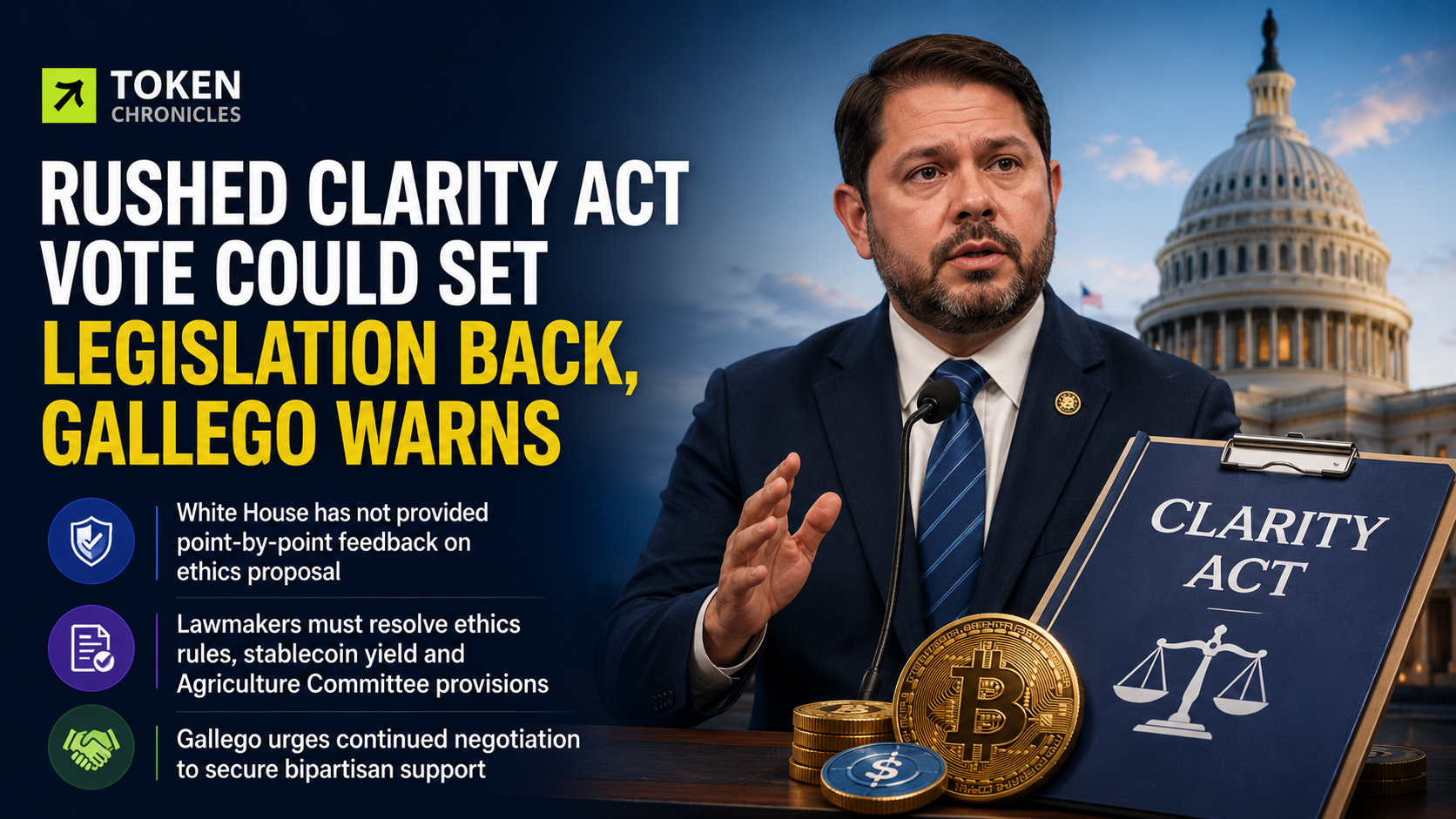
Democratic Senator Ruben Gallego has warned that pushing the CLARITY Act to a Senate vote before lawmakers resolve major disagreements could ultimately set U.S. crypto market-structure legislation back.
Speaking at the SALT Wyoming Blockchain Symposium, Gallego urged Democrats and Republicans to continue negotiating rather than force an immediate vote. He said lawmakers still need to resolve the bill’s Agriculture Committee provisions, assemble the broader legislative package and determine how the final legislation would move through the House.
“Don’t go for a fast vote,” Gallego said, arguing that a quick vote could produce an outcome that lawmakers ultimately do not want.
Senate Vote Expected in September
The CLARITY Act is intended to establish a comprehensive federal framework for digital assets while dividing regulatory responsibilities between the Securities and Exchange Commission (SEC) and the Commodity Futures Trading Commission (CFTC).
The legislation has already advanced through Congress but remains stalled over several unresolved provisions.
Senate Majority Leader John Thune previously indicated that lawmakers would postpone consideration until September, with the bill expected to be among the Senate’s first priorities when lawmakers return from their August recess.
That timeline leaves negotiators with a limited window to reach an agreement before the Senate’s legislative calendar becomes increasingly constrained.
Ethics Rules Remain a Major Obstacle
One of the most contentious issues involves ethics restrictions for government officials and their families with cryptocurrency interests.
Gallego said he and Republican Senator Thom Tillis had submitted compromise language to the White House before the congressional recess but had not received detailed, point-by-point feedback.
According to Gallego, Democrats need sufficiently strong ethics provisions to support the broader legislation.
He said negotiators had repeatedly submitted proposals to the White House but had received limited substantive feedback.
The White House had not publicly responded to Gallego’s comments at the time of reporting.
The issue has become particularly sensitive because of the Trump family’s involvement in cryptocurrency ventures. Any restrictions affecting senior officials or their families could therefore have broader political implications.
Stablecoin Rewards Also Remain Unresolved
Ethics provisions are not the only obstacle.
Senate negotiations also involve disagreements over how the legislation should address stablecoin rewards and other aspects of the digital-asset market.
Stablecoin rewards have significant commercial implications for crypto exchanges and financial intermediaries that distribute or generate revenue from dollar-pegged assets.
Resolving these provisions will be important if lawmakers want to produce a bipartisan bill capable of clearing the Senate’s 60-vote threshold.
Trump Pushes for a “Fair” CLARITY Act
Gallego’s warning comes as the Trump administration continues pressing Congress to pass the legislation.
President Donald Trump recently called on lawmakers to approve what he described as a “fair version” of the CLARITY Act during a White House meeting with cryptocurrency executives.
The administration has argued that comprehensive legislation is necessary to provide long-term certainty for the U.S. digital-asset industry and help maintain the country’s competitiveness in financial technology.
White House crypto adviser Patrick Witt has previously indicated that the administration is willing to negotiate with Democrats ahead of the September vote, while emphasizing that the process cannot continue indefinitely.
A Delicate Path to 60 Votes
The Senate’s 60-vote threshold remains the biggest procedural challenge.
Republicans hold a majority but do not have enough seats to pass the bill without Democratic support. That makes bipartisan negotiations essential.
Gallego’s comments suggest that Democrats are not necessarily opposed to the legislation itself but want unresolved issues addressed before allowing it to advance.
A rushed vote without sufficient bipartisan backing could therefore fail to clear the Senate and potentially make subsequent negotiations more difficult.
The coming weeks will determine whether lawmakers can bridge the remaining differences.
For the crypto industry, the stakes are substantial. The CLARITY Act could establish clearer asset classifications, define the SEC-CFTC regulatory boundary and create a federal framework for crypto exchanges, brokers and other market participants.
But Gallego’s warning highlights the political reality: getting the bill to a vote quickly is not the same as getting it passed. The immediate priority for negotiators may be building enough bipartisan support to ensure that the September vote moves the legislation forward rather than pushing it further away from the finish line.