
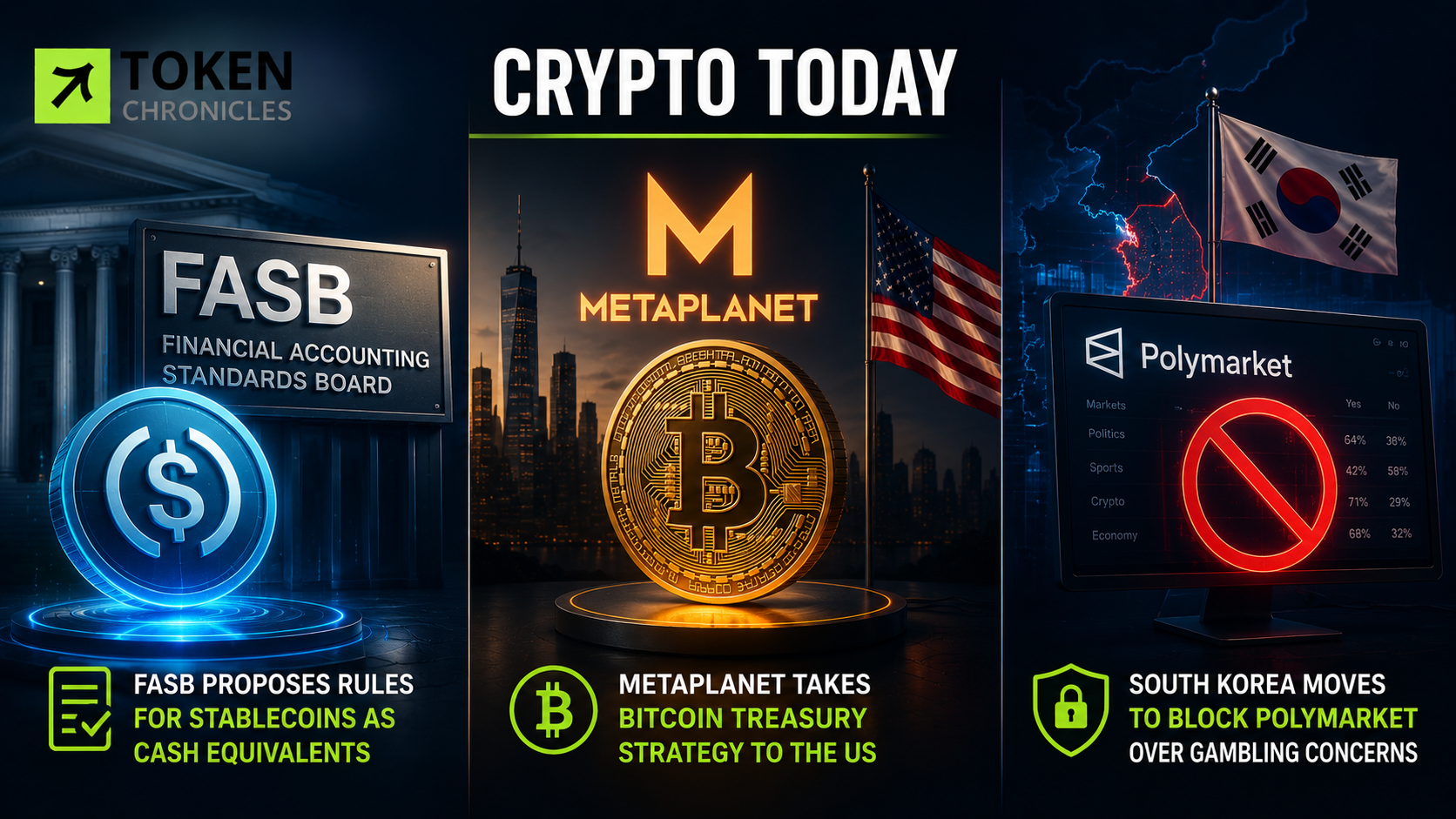
Crypto markets are seeing major developments across accounting standards, corporate Bitcoin strategies and regulation. The U.S. Financial Accounting Standards Board is considering new guidance that could allow certain stablecoins to qualify as cash equivalents, Metaplanet is expanding its Bitcoin treasury strategy into the U.S., and South Korea has moved to block Polymarket over gambling concerns.
FASB Proposes Rules for Stablecoins as Cash Equivalents
The Financial Accounting Standards Board (FASB) has proposed new guidance clarifying when certain stablecoins and other digital assets could be classified as cash equivalents under U.S. generally accepted accounting principles.
The proposal would add examples to the existing definition of cash equivalents rather than changing the definition itself. The goal is to provide companies with greater clarity as digital assets become increasingly integrated into corporate financial operations.
Under the proposed framework, a qualifying stablecoin would need to meet several conditions, including an on-demand contractual redemption right, a direct ability to redeem the asset with its issuer for a known amount of cash and reserves maintained on at least a one-to-one basis in short-term, highly liquid assets.
Simply having an active secondary market would not be sufficient if holders cannot directly redeem the token with its issuer.
The proposal would also exclude stablecoins backed by assets such as cryptocurrencies or gold because fluctuations in the value of those reserves could create additional valuation risks.
Companies would retain discretion over whether to classify qualifying digital assets as cash equivalents while also considering applicable laws and regulations.
FASB is accepting public comments on the proposal until Nov. 19, after which it will review feedback before determining the final rules and their effective date.
Metaplanet Takes Bitcoin Treasury Strategy to the US
Japanese Bitcoin-focused company Metaplanet is preparing to extend its corporate Bitcoin treasury strategy into the United States through a deal involving 2,100 BTC.
The company plans to contribute the Bitcoin to Nasdaq-listed Super League Enterprise as part of a transaction that would give Metaplanet a controlling interest in the company.
Super League is expected to be renamed Superplanet and become Metaplanet’s U.S. Bitcoin treasury platform.
The 2,100 BTC is currently worth roughly $135 million and will come from Metaplanet’s existing Bitcoin holdings rather than from a new purchase.
Metaplanet CEO Simon Gerovich said the structure could give the company access to both U.S. and Japanese capital markets while allowing the new U.S. entity to pursue acquisitions.
The transaction is expected to close during the fourth quarter of 2026, subject to shareholder approval and other closing conditions.
Super League’s stock jumped more than 50% following the announcement, accompanied by a sharp increase in trading volume.
The move highlights the growing trend of publicly traded companies using Bitcoin treasury strategies as part of broader capital-market and corporate expansion plans.
South Korea Moves to Block Polymarket
South Korean authorities have ordered access to Polymarket to be blocked after determining that the prediction market violates the country’s gambling restrictions.
The country’s media and communications review commission concluded that Polymarket falls within categories of information that facilitate gambling or the operation of gambling venues under South Korean law.
The regulator focused on Polymarket’s winner-takes-all structure, where users can profit or lose money based on the outcomes of events involving politics, sports, weather and other subjects.
Authorities also pointed to Polymarket’s role in operating prediction markets, establishing trading rules, facilitating crypto deposits and withdrawals, providing settlement infrastructure and collecting transaction fees.
Polymarket argued that it had removed Korean-language services, did not accept South Korean won and used noncustodial transactions and smart contracts rather than directly holding customer funds.
South Korean regulators rejected those arguments, saying decentralization, technical architecture and the use of trading interfaces or order books do not exempt a platform from complying with domestic law.
The decision underscores the growing regulatory divide over prediction markets, particularly where regulators view event-based trading as a form of gambling rather than financial-market activity.