

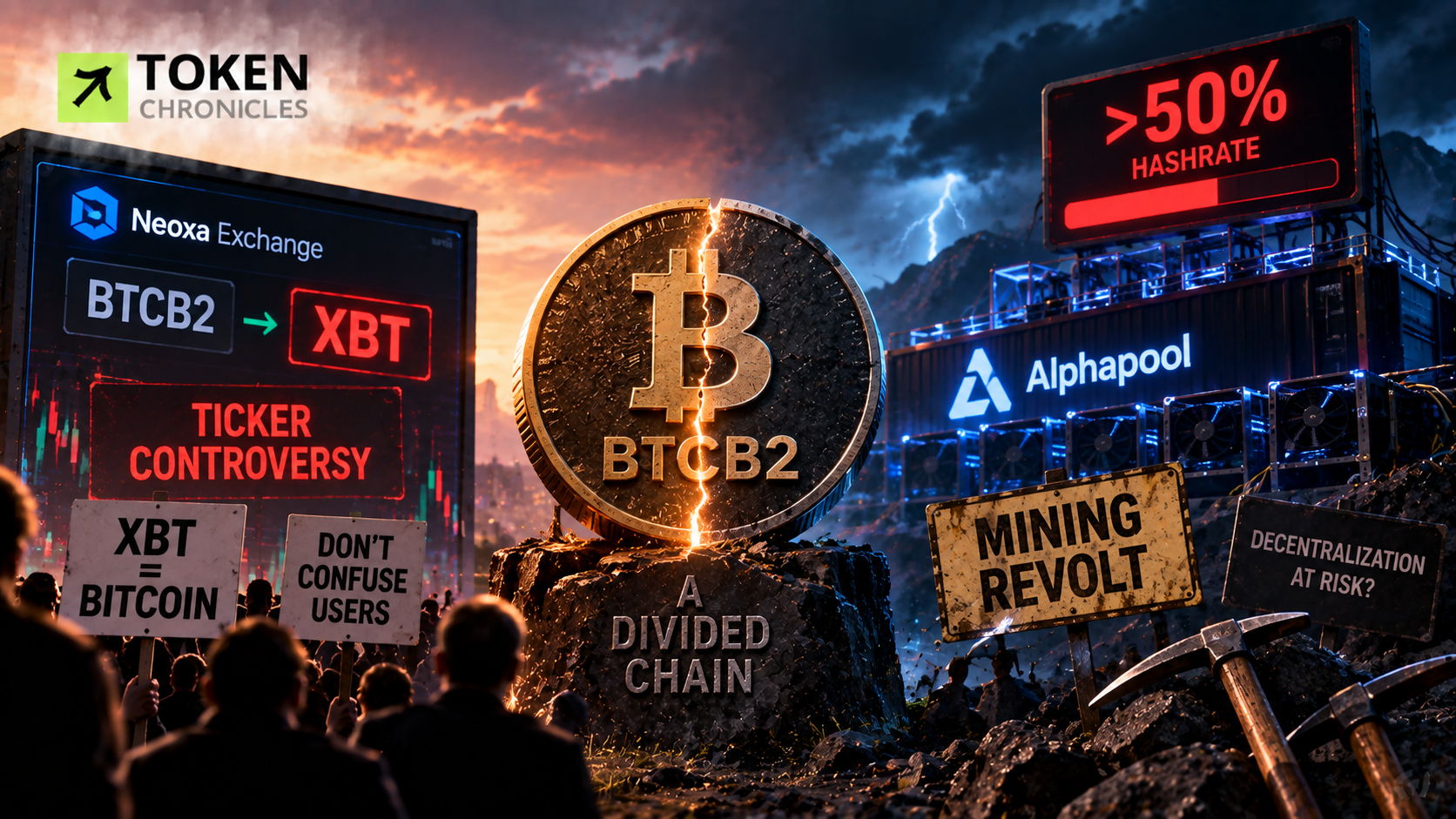
The Bitcoin fork BTCB2 is facing renewed criticism after a pair of smaller trading platforms began using the ticker XBT for the asset, a designation widely associated with Bitcoin itself.
The decision has sparked debate over whether the ticker could confuse traders, particularly because XBT has long been used as an identifier for Bitcoin across parts of the cryptocurrency industry and institutional trading infrastructure.
At the same time, BTCB2 is dealing with a separate controversy surrounding its mining distribution. Alphapool briefly controlled more than half of the network’s reported hashpower, raising questions among supporters and critics about the fork’s decentralization and the appropriate response to concentrated mining power.
Key Takeaways
- Neoxa Exchange changed BTCB2’s ticker to XBT on September 8 after discussions with the project team.
- Critics argue that XBT is strongly associated with Bitcoin and could create confusion between BTC and the forked asset.
- BTCB2 was trading substantially below its reported September 6 levels, with the USDC market around $250–$350 at the time described in the source.
- Alphapool at one point controlled more than 50% of BTCB2’s reported hashrate.
- The mining pool subsequently indicated it would voluntarily limit its share to 30%, while its reported share later fell below 18%.
- The dispute has revived broader questions about the fork’s claims of decentralization.
BTCB2’s XBT Ticker Creates a New Branding Dispute
BTCB2, also known as Bitcoin Blake2b, originated from a Bitcoin fork on August 8, 2026, at block height 961632.
Following the split, the project made several significant technical changes, including moving its proof-of-work algorithm to BLAKE2b and reducing the block size.
The fork subsequently appeared on a small number of trading platforms. One of them, Neoxa Exchange, changed the asset’s ticker from BTCB2 to XBT after discussions with representatives of the project.
That decision quickly drew criticism.
The central issue is not simply the choice of three letters. XBT is an established identifier commonly used for Bitcoin, alongside BTC, in portions of the financial and cryptocurrency ecosystem.
Critics therefore argue that assigning XBT to a Bitcoin fork could make it more difficult for traders to distinguish the alternative chain from Bitcoin’s primary network.
Neoxa defended its decision, saying that the exchange already had a BTC ticker assigned to Bitcoin and that deposits and withdrawals were clearly labeled. The exchange also argued that individual projects generally select their preferred tickers and said it had found no legal prohibition against using XBT.
The controversy illustrates a broader problem facing cryptocurrency forks: branding can become almost as important as technical differences when multiple networks share similar names, logos and terminology.
BTCB2 Price Falls as Trading Remains Relatively Thin
The ticker controversy comes as BTCB2’s market price has fallen sharply from levels reported earlier in September.
According to the supplied market data, BTCB2 was trading around $250 to $350 per coin in the USDC market at approximately 6:45 p.m. EDT, compared with previously reported levels of roughly $750–$1,000 on September 6.
The USDC market had recorded approximately 915,672 USDC in 24-hour volume, while the BTC-denominated market recorded around 5.35 BTC during the same period.
Because the asset trades on relatively small venues and liquidity is limited compared with Bitcoin itself, individual market prices can potentially move considerably with comparatively modest trading activity.
Meanwhile, the BTCB2 blockchain was reported to be approximately 3,866 blocks ahead of the Bitcoin blockchain, with an estimated 16.9–17.6 PH/s of mining power supporting the network.
Around 27 mining pools were participating in the network at the time, according to the supplied information.
Alphapool’s Hashrate Raises Decentralization Questions
The more serious technical controversy emerged around BTCB2’s mining ecosystem.
On September 8, Alphapool reportedly controlled more than 50% of the network’s hashrate at one point.
For a proof-of-work blockchain, a single mining entity controlling a majority of the network’s computational power can raise legitimate security and decentralization questions. However, the significance depends on factors including how long the concentration lasts, whether the pool or its miners are acting independently, and what capabilities the controlling entity actually exercises.
BTCB2 supporters began debating the situation in community channels, with some questioning whether the concentration represented a potential threat while others argued that miners were simply directing their hardware toward whichever network offered the best economics.
The disagreement became more contentious when a proposal surfaced suggesting that Alphapool’s payout address could be blacklisted at the consensus level.
Knots creator Luke Dashjr reportedly warned users not to run the proposed code, adding another layer to an already heated debate.
Alphapool Signals a 30% Voluntary Limit
Amid the dispute, an account associated with Alphapool reportedly indicated that the mining operation would voluntarily limit its participation to approximately 30% of the Knots/BTCB2 network’s hashrate.
The pool also indicated that it would reject additional mining connections once the threshold was reached.
Later figures cited in the source showed Alphapool’s share had fallen to less than 18%, significantly below the level that initially triggered the controversy.
The episode demonstrates the complicated relationship between mining pools and decentralized networks.
A mining pool can accumulate substantial hashpower without necessarily controlling all of the underlying mining hardware. Individual miners may connect or disconnect their equipment based on profitability, meaning a pool’s apparent share can change rapidly.
Nevertheless, a sustained concentration of hashpower can become an important consideration for users evaluating the security and decentralization of a proof-of-work blockchain.
The Debate Over What Counts as an “Attack”
The Alphapool controversy has also exposed a fundamental disagreement between different BTCB2 communities.
Critics of the fork have questioned why contributing a large amount of mining power would be treated as hostile behavior if the mining activity follows the network’s consensus rules.
Alphapool itself reportedly argued that supplying hashpower and helping secure a blockchain should not automatically be characterized as an attack simply because the resulting distribution of mining power is politically or ideologically uncomfortable for some participants.
BTCB2 supporters, meanwhile, remain concerned about excessive concentration and the potential implications for network independence.
The disagreement ultimately comes down to a broader question: Is decentralization measured by the number of participants securing a network, the distribution of hashpower, the independence of individual miners, or all of these factors together?
Branding and Decentralization Put BTCB2 Under Pressure
The simultaneous ticker and mining controversies have placed BTCB2 under increased scrutiny.
The XBT dispute focuses on identity and market clarity, while the Alphapool episode centers on network security and mining concentration.
Both issues touch on a common challenge for cryptocurrency forks: establishing a distinct identity and proving that the new network can operate independently of the blockchain from which it originated.
BTCB2 supporters continue to promote the project as an alternative Bitcoin chain, while critics dispute that characterization and question the project’s branding and decentralization claims.
The competing narratives are likely to remain contentious as long as BTCB2 maintains a separate blockchain, trades under similar Bitcoin branding and relies on a comparatively small mining ecosystem.
What Happens Next?
For BTCB2, several developments will be worth watching.
First, exchanges will need to decide whether they continue using XBT or adopt a more clearly differentiated ticker. Greater clarity could help reduce the possibility of users confusing BTCB2 with Bitcoin itself.
Second, the distribution of mining power will remain important. Alphapool’s reported decline from more than 50% to below 18% significantly changes the immediate picture, but hashrate concentration can fluctuate quickly as miners move between pools and networks.
Finally, BTCB2’s ability to attract sustained liquidity, independent miners and ecosystem development will ultimately determine whether it can establish itself as a meaningful alternative chain.
For now, the fork is facing a difficult combination of falling prices, ticker controversy and questions over mining concentration three challenges that could prove more consequential than the project’s technical differences alone.