

Bitcoin continues to trade below the $75,000 level, with investors struggling to find clear market direction amid ongoing volatility. While price action alone suggests weakness, recent on-chain activity involving two of the largest institutional Bitcoin holders has added a new layer of attention to the market.
According to blockchain analyst Axel Adler, wallets linked to BlackRock and Strategy (formerly MicroStrategy) recently transferred a combined 7,459 BTC into Coinbase Prime infrastructure.
Importantly, these transactions do not confirm that either company is selling Bitcoin. However, they place a substantial amount of BTC closer to exchange liquidity, creating uncertainty about whether the coins could eventually reach the open market.
Institutional Bitcoin Moves Draw Attention
On May 28, approximately 7,048 BTC associated with BlackRock’s spot Bitcoin ETF operations were transferred through a Coinbase Prime deposit address and into Coinbase Prime’s custody network.
Separately, wallets linked to Strategy moved roughly 411 BTC through an intermediary address before those funds also arrived at Coinbase Prime.
While institutional investors regularly move assets for reasons such as:
- Portfolio rebalancing
- Custody restructuring
- Collateral management
- Operational transfers
the movement of large amounts of Bitcoin into exchange-related infrastructure naturally attracts market attention.
The key question is whether these transfers represent preparation for future selling activity or simply routine institutional operations.
Not a Sale, But a Potential Supply Overhang
Adler emphasizes that no evidence currently confirms an immediate sale.
However, Bitcoin held in cold storage is generally viewed as inactive supply, while Bitcoin transferred into exchange-adjacent infrastructure becomes significantly easier to sell if market conditions warrant.
As a result, traders are now watching whether existing demand around current price levels is strong enough to absorb any potential selling pressure should these coins eventually enter the market.
The situation is less about confirmed distribution and more about the possibility of additional supply becoming available.
Bitcoin Tests a Critical Support Zone
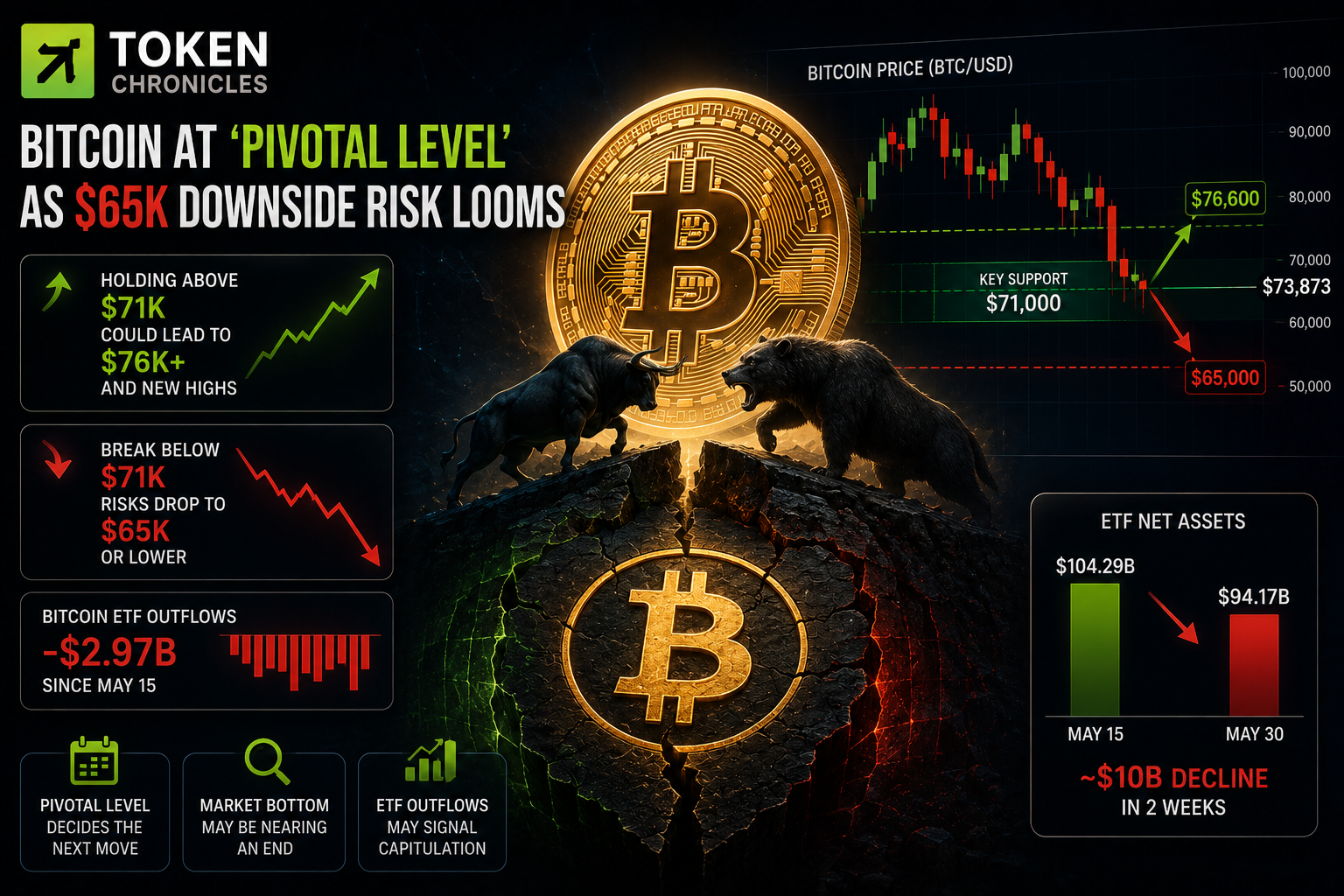
At the same time, Bitcoin is trading near one of the most important support levels of the current market cycle.
Following its peak above $120,000 in late 2025, Bitcoin entered a prolonged correction that eventually found strong buying interest in the $63,000–$66,000 range earlier this year.
That support zone helped fuel a recovery through March and April.
Now, Bitcoin is retesting the $72,000–$74,000 region, an area that previously acted as resistance before turning into support.
For bullish investors, holding this level is critical because it maintains the pattern of higher lows established since February.
Technical Picture Remains Mixed
From a technical standpoint, Bitcoin remains under pressure.
The cryptocurrency continues to trade below its:
- 50-week moving average
- 100-week moving average
which suggests the medium-term trend remains challenged.
However, Bitcoin is still comfortably above its:
- 200-week moving average near $61,000
This indicates that the broader long-term bull market structure remains intact despite recent weakness.
Another positive sign is that trading volume during the latest pullback has remained relatively moderate, suggesting widespread panic selling has not yet emerged.
What Comes Next?
Market participants are closely monitoring whether buyers can defend the current support zone.
If demand strengthens around current levels, Bitcoin could attempt another move toward the $80,000 region.
However, if support near $72,000 fails, attention would likely shift back toward the major demand zone between $63,000 and $66,000, where strong buying activity previously emerged earlier in 2026.
For now, the transfer of 7,459 BTC from BlackRock- and Strategy-linked wallets has created an additional question for the market: can current demand absorb any future supply that may emerge, or will institutional movements add further pressure to an already cautious market?