

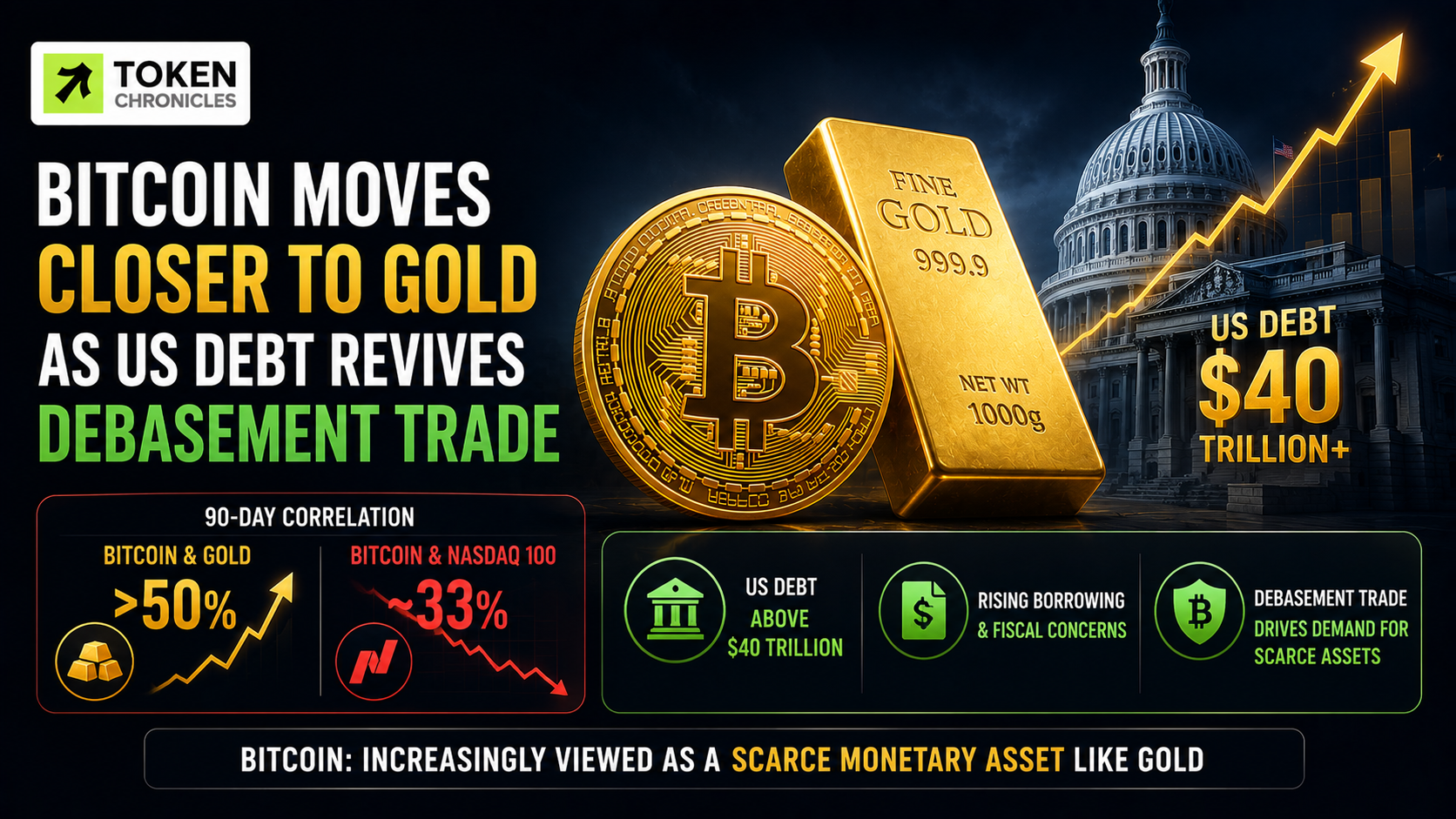
Bitcoin is increasingly showing characteristics associated with gold rather than technology stocks, according to Grayscale. At the same time, elevated US government debt and continued borrowing are strengthening the investment case for scarce assets as concerns about currency debasement return.
- Bitcoin’s 90-day correlation with gold has risen above 50%.
- Its correlation with the Nasdaq 100 has dropped to about 33%, from more than 60%.
- US government debt has surpassed $40 trillion, adding to concerns about fiscal sustainability.
Bitcoin’s Relationship With Gold Is Strengthening
Bitcoin’s correlation with traditional financial assets appears to be undergoing a significant change.
Grayscale said the cryptocurrency is increasingly behaving like a scarce monetary asset rather than a high-growth technology investment. The shift could reinforce Bitcoin’s potential role as a portfolio diversifier.
According to Bloomberg data cited by Grayscale, Bitcoin’s 90-day correlation with the Nasdaq 100 declined from above 60% to approximately 33% through Aug. 24.
At the same time, Bitcoin’s relationship with gold strengthened considerably. Its correlation with the precious metal rose from close to zero at the beginning of 2026 to more than 50%.
The changing relationship is notable because Bitcoin has frequently traded alongside growth-oriented equities in recent years. Its increasingly independent price behavior may indicate that investors are paying greater attention to its limited supply and monetary characteristics.
Gold has also been performing strongly. Futures briefly moved above $4,700 in late August as markets reassessed the outlook for the US dollar, government borrowing and long-term interest rates.
$40 Trillion Debt Adds Fuel to the Debasement Narrative
Bitcoin’s changing market profile comes as US government debt has moved above $40 trillion.
The rising debt burden has renewed debate over persistent fiscal deficits, increasing interest costs and the government’s need to continually issue new debt.
The US Treasury expects to borrow hundreds of billions of dollars through privately held marketable securities during the second half of the year. Its borrowing requirements for the July-to-September quarter alone were projected at approximately $739 billion, followed by another $628 billion during the final quarter.
Treasury is also managing substantial issuance across different maturities. Its August refunding operation included $125 billion in three-, 10- and 30-year securities, alongside plans for billions of dollars in liquidity-supporting buybacks.
These developments have strengthened the argument that investors could increasingly look toward assets that are less directly tied to government-issued currencies and sovereign debt.
Bridgewater founder Ray Dalio has similarly warned that US debt could potentially reach $55 trillion to $60 trillion over the next decade, while identifying gold and Bitcoin as assets that could benefit if monetary and fiscal pressures intensify.
Bitcoin’s Limited Supply Becomes More Relevant
Bitcoin’s investment appeal is partly based on its predetermined issuance structure.
Unlike fiat currencies, Bitcoin does not have a central authority capable of freely expanding its supply. Its network rules limit total issuance to approximately 21 million BTC.
That characteristic places Bitcoin within the broader debasement trade, where investors seek scarce assets when they become concerned about declining currency purchasing power or excessive government borrowing.
Gold has traditionally dominated this strategy, but Bitcoin’s fixed supply has increasingly brought the digital asset into the same conversation.
The narrative has received additional attention as investors assess Treasury’s debt-management operations and the broader direction of US fiscal policy.
However, Treasury bond buybacks should not be confused with Federal Reserve quantitative easing. Treasury finances its operations through government debt issuance, while quantitative easing involves central-bank purchases of securities.
Bitcoin Is Becoming Less Closely Tied to Tech Stocks
The latest correlation data suggest that Bitcoin’s relationship with equities may be changing.
For years, Bitcoin was frequently treated as a risk-on asset whose performance was closely linked to technology stocks. A declining Nasdaq correlation combined with a stronger relationship with gold could indicate that investors are beginning to assign greater importance to Bitcoin’s scarcity and monetary properties.
That could strengthen the argument for Bitcoin as a diversification asset within broader portfolios.
Still, correlation is not permanent. Market relationships can shift quickly depending on liquidity, interest rates, investor positioning and macroeconomic conditions.
A stronger connection with gold therefore does not guarantee that Bitcoin will consistently behave like a safe-haven asset.
The Debasement Trade Gains Momentum
The broader investment debate is increasingly centered on how investors can protect purchasing power amid expanding government debt and persistent fiscal deficits.
Gold remains the established asset in this category, while Bitcoin offers a digital alternative with a predetermined supply and a globally accessible network.
If Bitcoin continues to move independently from technology stocks while maintaining a stronger relationship with gold, its role within the debasement narrative could become increasingly significant.
For now, the data point to an important shift: Bitcoin may be gradually evolving from a predominantly technology-linked risk asset toward an asset increasingly viewed through the same scarcity and monetary lens as gold.