

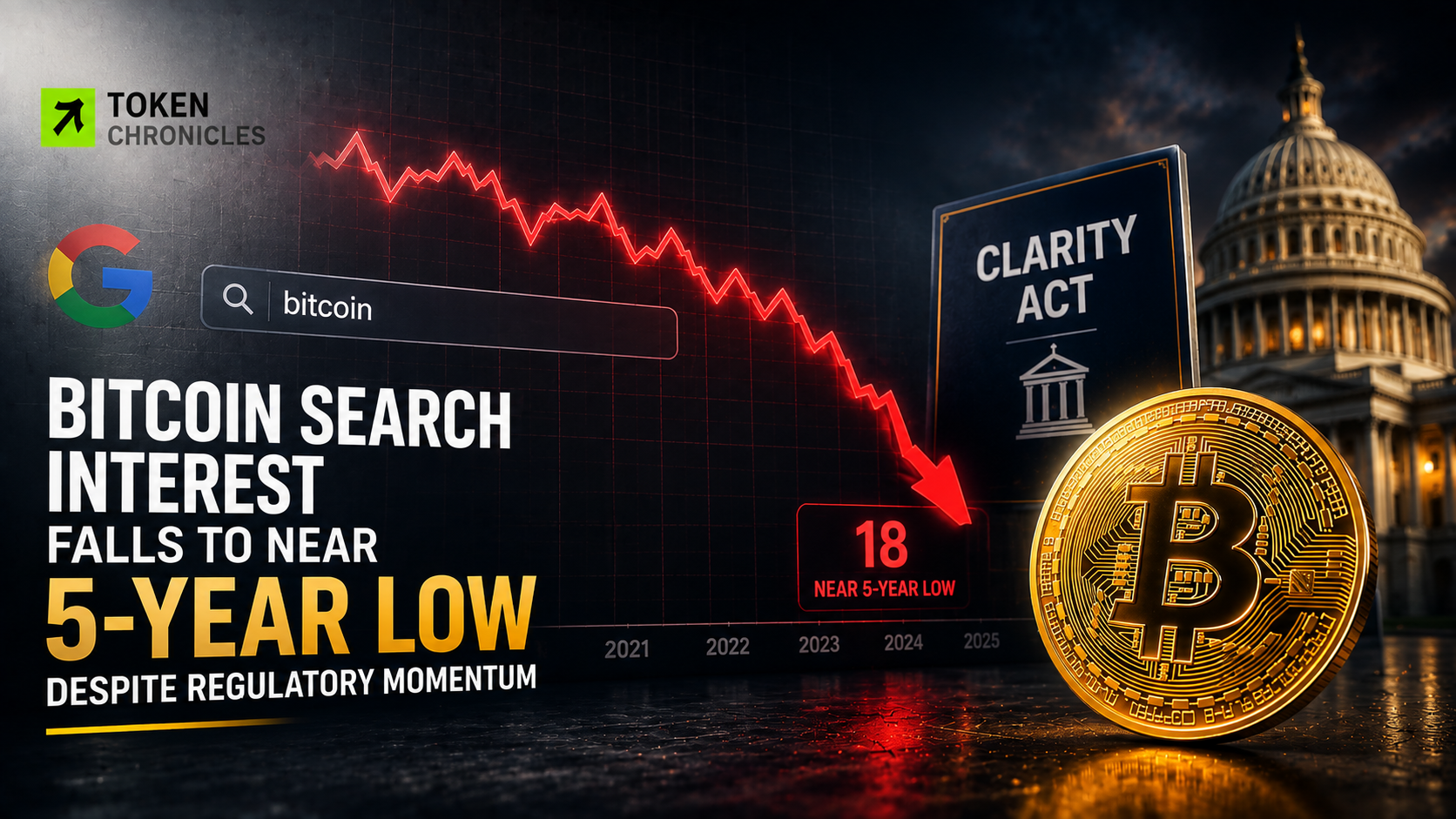
Public interest in Bitcoin across the United States has dropped to one of its lowest levels in nearly five years, according to new Google Trends data, even as the cryptocurrency industry approaches a potentially pivotal week for U.S. regulation.
The decline in online search activity comes despite increasing institutional adoption, a pro-crypto political environment, and the anticipated Senate vote on the CLARITY Act, legislation that could reshape the regulatory framework for digital assets in the United States.
Google Searches Continue to Decline
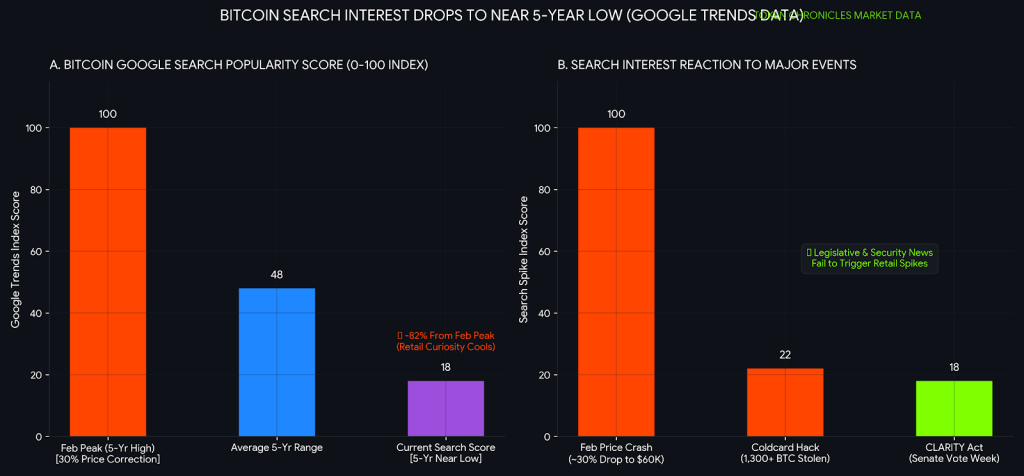
Google Trends data shows that searches for the term “Bitcoin” have fallen to a popularity score of 18, one of the lowest readings recorded over the past five years.
The figure is less than one-fifth of the search interest seen during the first week of February, when Bitcoin experienced one of its sharpest corrections in recent history.
At that time, Bitcoin’s price fell roughly 30%, briefly dropping toward $60,000 amid a broader technology-sector selloff, driving search interest to its highest level during the five-year period.
The latest data suggests that retail curiosity has cooled significantly, despite crypto remaining an increasingly important part of financial and political discussions.
Regulatory Progress Fails to Spark Retail Attention
The decline in search activity is particularly notable because it coincides with several major industry developments.
This week, the U.S. Senate is expected to consider the CLARITY Act, a landmark piece of legislation that could establish the country’s first comprehensive regulatory framework for digital assets.
The bill is viewed as one of the most significant regulatory proposals ever introduced for the cryptocurrency industry, yet it has done little to increase online interest among the broader public.
Similarly, the recent Coldcard hardware wallet exploit, which resulted in the theft of more than 1,300 BTC, also failed to generate a meaningful spike in Bitcoin-related searches.
These trends suggest that retail attention may be becoming less reactive to industry news than in previous market cycles.
Institutional Adoption Continues to Accelerate
While internet search activity has weakened, ownership trends tell a very different story.
According to a recent report from River, Bitcoin adoption among Americans continues to grow steadily.
The report estimates that approximately 49.6 million Americans now own Bitcoin, representing nearly one in five U.S. adults.
By comparison, only 28.8 million Americans reportedly own gold, indicating that Bitcoin has surpassed the traditional precious metal as a preferred investment asset among U.S. investors.
The findings suggest that long-term ownership continues expanding even as public search interest declines.
Maturing Market May Explain Lower Search Volume
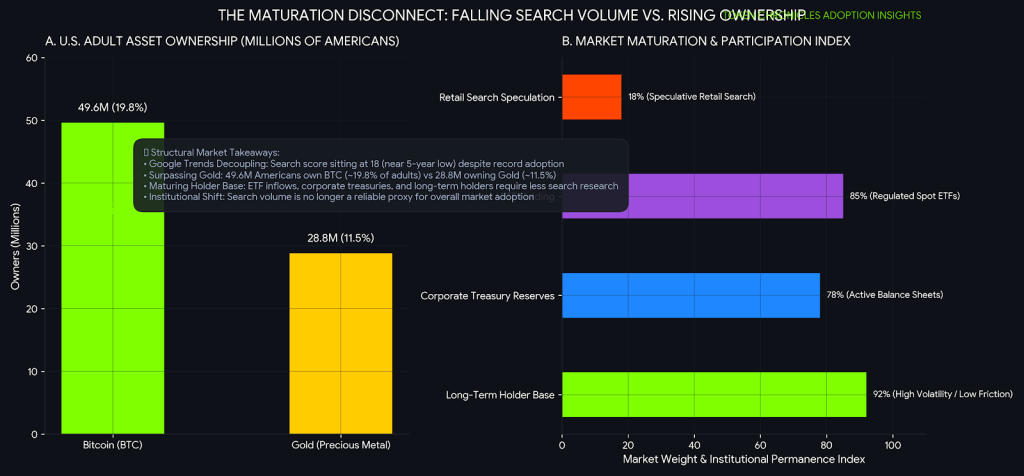
The disconnect between declining search activity and rising ownership may reflect the continued maturation of the cryptocurrency market.
In Bitcoin’s earlier growth phases, significant price movements, regulatory headlines, and major news events often generated dramatic increases in Google searches as new investors sought information.
Today, a larger proportion of Bitcoin ownership comes from institutional investors, long-term holders, corporations, exchange-traded funds, and experienced market participants who require less frequent online research.
As a result, search volume may no longer serve as a reliable indicator of overall adoption or market participation.
Retail Curiosity Slows While Adoption Expands
Although Google Trends indicates that public curiosity surrounding Bitcoin has cooled considerably, broader industry metrics continue pointing toward increasing mainstream adoption.
Institutional investment continues to expand, corporate treasury allocations remain active, and lawmakers are moving closer to establishing clearer regulatory frameworks for digital assets.
The contrast highlights an evolving cryptocurrency market where declining online attention does not necessarily signal weakening fundamentals.
Instead, Bitcoin appears to be transitioning from a highly speculative asset driven by retail excitement into a more established financial instrument supported by growing institutional participation and long-term ownership.