Bitcoin may be entering the final stage of its latest market correction, according to on-chain analysts who believe investor capitulation is beginning to emerge—a phase that has historically marked the formation of long-term market bottoms.
Recent blockchain data shows that more investors are selling Bitcoin at a loss, a trend that has often preceded recovery periods in previous market cycles.
UTXO Data Signals Growing Capitulation
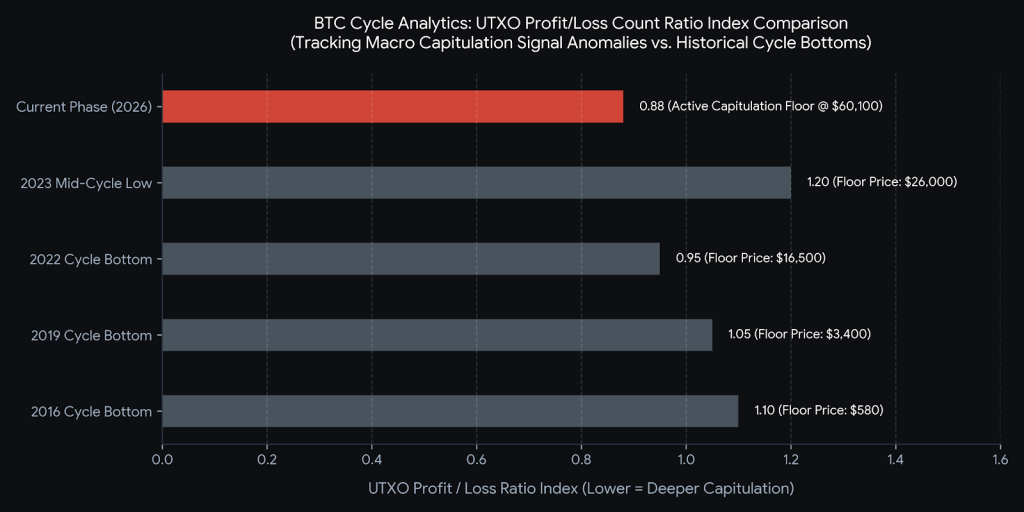
CryptoQuant analyst Darkfost pointed to Bitcoin’s Unspent Transaction Output (UTXO) Profit/Loss Ratio, a widely followed on-chain indicator that measures whether coins are being spent in profit or at a loss.
According to the analyst, the ratio has dropped to its lowest level during the current correction, indicating that a growing number of Bitcoin holders are realizing losses rather than taking profits.
This is the first time the indicator has reached such levels since the current market downturn began, suggesting that investor capitulation is becoming more widespread.
Historically, similar conditions have appeared near the end of major bear markets when selling pressure begins to exhaust itself.
Long-Term Investors May Be Watching Closely
While capitulation often creates fear across financial markets, analysts argue that it has historically provided attractive entry opportunities for long-term investors.
Darkfost noted that previous instances of this signal have coincided with periods when market participants largely lost confidence and exited their positions.
The last comparable reading occurred during the previous Bitcoin correction in mid-2023, when BTC briefly traded near $26,000 before beginning its next recovery phase.
Although the signal has appeared, analysts caution that market bottoms typically develop over weeks or even months rather than immediately following a single indicator.
Additional Analysts See Similar Patterns
Market analyst DurdenBTC also highlighted the latest UTXO readings, describing the signal as one that has historically identified major Bitcoin cycle lows since 2016.
According to the analyst, buying during periods of widespread pessimism has rarely felt comfortable, but those moments have often produced the strongest long-term investment opportunities.
The comments reinforce a growing view among on-chain researchers that the market may be approaching a stabilization phase rather than entering the early stages of a new downtrend.
Long-Term Holders Begin Feeling the Pressure
Darkfost also examined Bitcoin’s Spent Output Profit Ratio (SOPR), another on-chain metric used to determine whether coins are being sold above or below their acquisition price.
The indicator shows that even long-term holders are increasingly realizing losses, suggesting that selling pressure is no longer limited to short-term traders.
However, the analyst believes much of the recent correction has been driven primarily by short-term investors transferring Bitcoin to exchanges, increasing immediate selling pressure across the market.
Market May Be Entering a Base Formation Phase
Blockchain analytics platform Swissblock offered a similarly cautious assessment.
According to the firm, Bitcoin may have already moved beyond the initial breakdown stage of the correction, but the market is still in what it describes as a “base formation” phase.
While prices have started to stabilize, momentum indicators remain relatively weak, suggesting that a sustained recovery could still require additional time before stronger bullish signals emerge.
Geopolitical Tensions Add Fresh Uncertainty
Beyond on-chain metrics, broader macroeconomic and geopolitical developments continue to influence market sentiment.
Renewed military action involving the United States and Iran has introduced additional uncertainty across global financial markets, contributing to increased volatility in both traditional and digital assets.
Following reports of U.S. military strikes on Iranian targets, Bitcoin briefly fell below the $60,000 level before recovering part of its losses.
The episode highlights how macro events continue to influence short-term crypto price movements, even as long-term on-chain indicators begin signaling potential stabilization.
Why It Matters
Capitulation has historically represented one of the final stages of Bitcoin bear markets, occurring when widespread selling pressure forces investors to exit positions at a loss.
Although no single indicator can accurately predict a market bottom, the latest UTXO and SOPR data suggest that selling pressure may be approaching exhaustion.
If history repeats, the current phase could eventually provide a foundation for the next long-term recovery. However, analysts emphasize that market bottoms typically require patience, with periods of sideways price action often preceding any sustained upward trend.