

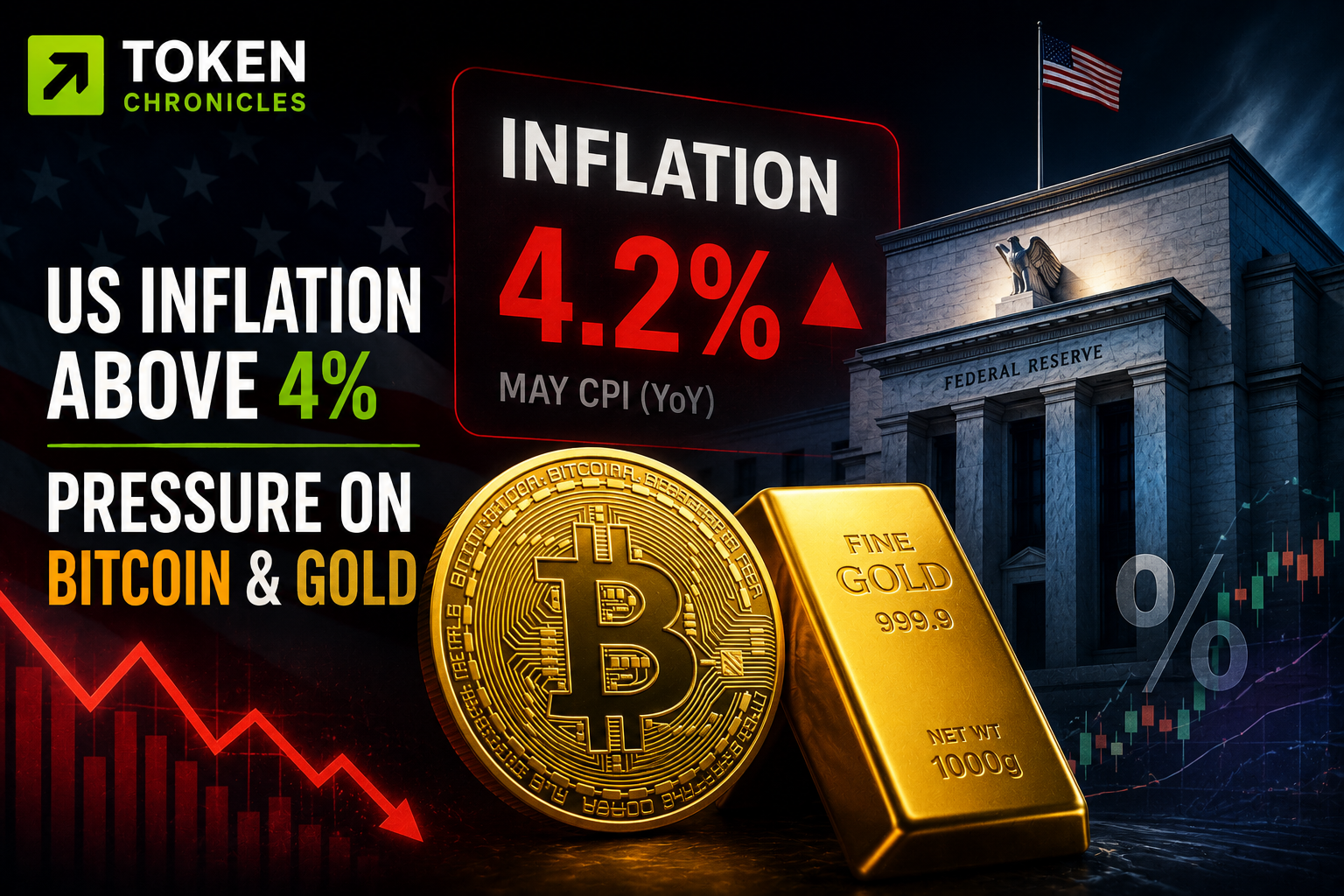
Fresh inflation data from the United States has renewed concerns across global financial markets, with analysts warning that both Bitcoin and gold could face continued pressure as investors reassess expectations for Federal Reserve policy.
According to data released Wednesday, the U.S. Consumer Price Index (CPI) rose 4.2% year-over-year in May, signaling that inflation remains stubbornly above the Federal Reserve’s target range. The reading has reduced hopes for near-term interest rate cuts and, in some cases, reignited discussions about the possibility of further monetary tightening later this year.
For risk-sensitive assets such as cryptocurrencies and precious metals, the implications could be significant.
Inflation Surprise Challenges Market Expectations
The Consumer Price Index remains one of the Federal Reserve’s most closely watched economic indicators, measuring changes in the prices consumers pay for a broad basket of goods and services.
While markets had hoped for clearer evidence that inflation was steadily cooling, the latest reading suggests price pressures remain persistent throughout the economy.
The data has prompted investors to reassess expectations for monetary policy, with many now anticipating that the Federal Reserve will maintain a cautious stance rather than move quickly toward easing financial conditions.
According to market analysts, this environment is creating a difficult backdrop for both digital assets and traditional inflation hedges.
Higher Rates Continue to Weigh on Bitcoin
Bitcoin has already endured a challenging first half of the year.
The world’s largest cryptocurrency has fallen approximately 36% since January, reflecting a combination of weaker risk appetite, institutional caution, and broader macroeconomic uncertainty.
Analysts argue that elevated inflation complicates Bitcoin’s recovery prospects because it reduces the likelihood of interest-rate cuts that would otherwise inject liquidity into financial markets.
Iggy Ioppe, Chief Investment Officer at institutional trading firm Theo, believes the latest CPI report reinforces the Federal Reserve’s cautious approach.
“Today’s inflation reading keeps the Fed data-dependent and in no rush to cut rates.”
According to Ioppe, the inflation report is unlikely to act as a clear bullish catalyst for Bitcoin.
Instead, investors may continue focusing on market positioning and macroeconomic developments rather than expecting a rapid return of liquidity-driven rallies.
Without meaningful improvements in monetary conditions, risk assets may struggle to regain sustained momentum.
Gold Also Faces Headwinds Despite Inflation Narrative
Although gold is traditionally viewed as a hedge against inflation, analysts note that the precious metal is currently facing its own set of challenges.
Gold prices have declined roughly 23% from their January highs, despite persistent inflation concerns.
The primary issue remains rising real yields.
When interest rates remain elevated, investors can earn stronger returns from government bonds and other fixed-income instruments, increasing the opportunity cost of holding non-yielding assets such as gold.
Ioppe explained that without imminent Federal Reserve rate cuts, gold may continue facing pressure from higher real yields.
“The opportunity cost of holding a non-yielding asset remains elevated.”
As a result, both Bitcoin and gold find themselves navigating an environment where inflation remains high, but monetary policy remains restrictive.
Institutional Investors Remain Cautious
Markus Thielen, Head of Research at 10x Research, believes the current macroeconomic landscape continues to present significant challenges for Bitcoin.
According to Thielen, the latest inflation data does not provide sufficient evidence to encourage large institutional investors to significantly increase their cryptocurrency exposure.
“We continue to view the current macro environment as a headwind for Bitcoin.”
Institutional investors, he argues, are likely waiting for clearer signs that inflation is moving decisively lower before committing substantial new capital to digital assets.
Without that confirmation, many funds may remain on the sidelines or maintain conservative allocations.
Geopolitical Risks Add Another Layer of Uncertainty
Beyond inflation, global geopolitical developments are also influencing market sentiment.
Analysts point to ongoing tensions involving Iran and the broader Middle East as an additional source of uncertainty for investors.
The primary concern centers on energy markets.
Any disruption to global oil supplies could drive crude prices higher, potentially reigniting inflationary pressures and making it even more difficult for central banks to loosen monetary policy.
Crude oil has already surged more than 50% this year, significantly outperforming both Bitcoin and gold.
Thielen warned that continued disruptions could place further upward pressure on inflation expectations during the coming months.
If energy prices continue rising throughout the summer, markets may face renewed concerns about persistent inflation and prolonged higher interest rates.
Bitcoin Could Test Key Support Levels
Given the combination of elevated inflation, geopolitical uncertainty, and weak institutional demand, some analysts believe Bitcoin remains vulnerable to additional downside volatility.
Thielen suggested that a move below the psychologically important $60,000 level is becoming an increasingly realistic possibility if market conditions fail to improve.
While Bitcoin has shown resilience during previous periods of macroeconomic stress, sustained ETF outflows and weaker investor confidence have made recovery attempts more fragile.
Investors are closely monitoring support zones as traders assess whether the current correction is nearing exhaustion or has further room to run.
Federal Reserve Rate Cuts Remain the Key Catalyst
Despite growing concerns, not all analysts believe interest rate hikes are imminent.
Tim Sun, Senior Researcher at HashKey Group, noted that while discussions surrounding further tightening have intensified, the probability of additional Federal Reserve rate increases remains relatively low.
Instead, he believes markets will remain focused on the timing of eventual rate cuts.
According to Sun, a meaningful recovery in risk appetite will likely require three conditions:
- Inflation trending lower on a sustained basis.
- Rate cuts becoming a realistic possibility.
- Improved market liquidity and lower borrowing costs.
Only when those factors align, he argues, will investors regain confidence in higher-risk assets such as cryptocurrencies.
Markets Expect Fed to Hold Steady
Current futures market data suggests investors still expect the Federal Reserve to leave interest rates unchanged at its upcoming meeting.
According to CME FedWatch data, markets are pricing in approximately a 98% probability that policymakers will maintain current rates during the next Federal Open Market Committee meeting.
While this reduces the likelihood of immediate tightening, it also highlights how far expectations for aggressive rate cuts have shifted over recent months.
For Bitcoin, gold, and other risk assets, the message remains clear: inflation must show a convincing path lower before monetary conditions become supportive again.
The Road Ahead for Bitcoin and Gold
The latest inflation report underscores the delicate balancing act facing investors in 2026.
Bitcoin continues to search for renewed institutional demand, while gold struggles against the reality of elevated real yields. At the same time, geopolitical tensions and rising energy prices threaten to keep inflation pressures alive.
Until inflation begins to ease more convincingly and the Federal Reserve gains confidence to loosen policy, analysts expect both Bitcoin and gold to remain vulnerable to volatility.
For now, markets appear caught between persistent inflation concerns and hopes for future monetary easing leaving investors waiting for the next major catalyst that could determine the direction of both traditional and digital stores of value.